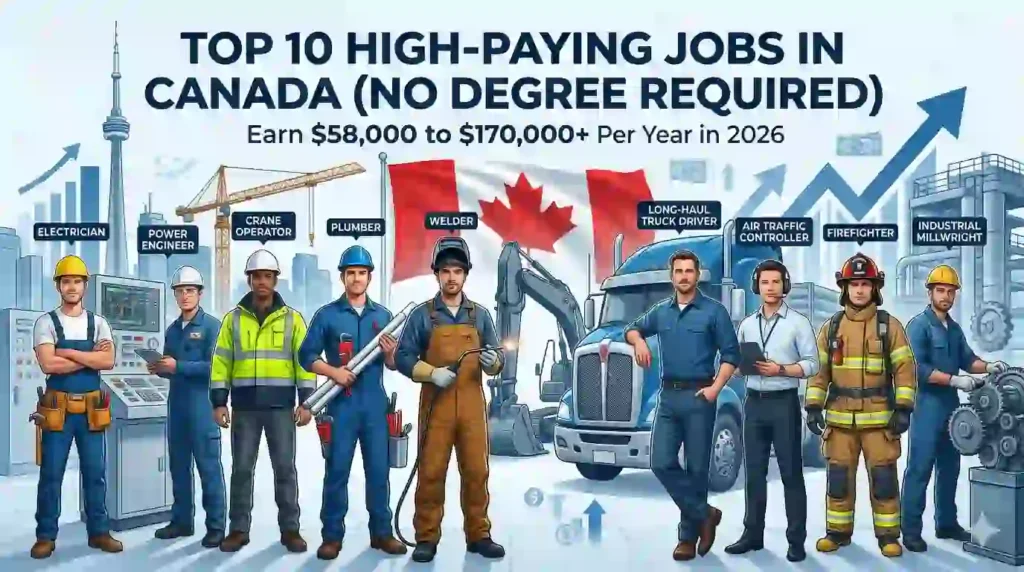
A university degree is no longer the only path to a strong income in Canada. Across construction sites, power plants, hospitals, and transportation hubs, thousands of workers are earning six-figure salaries with nothing more than a high school diploma, a trade certificate, or an apprenticeship behind them. If you’re searching for the highest paying jobs in Canada without a degree, this guide breaks down real wage data, the training each role actually requires, and how foreign workers can qualify for these positions in 2026.

Canada’s skilled trades shortage has made this an unusually good time to enter the workforce without a four-year degree. Hundreds of thousands of trades positions are expected to need filling by 2030 as experienced workers retire, and employers are responding with higher wages, signing incentives, and faster pathways to permanent employment. For immigrants and international workers, this shortage also means more provinces are adding trades occupations to their Provincial Nominee Program draws.
Table of Contents
Why Skilled Trades Pay So Well in Canada
The simplest explanation is supply and demand. Fewer young Canadians are entering apprenticeship programs compared to previous generations, while infrastructure projects, housing construction, and energy production keep expanding. That gap pushes wages upward, especially in provinces like Alberta, Saskatchewan, and the Northwest Territories where labor is scarce and isolated worksites pay a premium.
Another factor is risk and physical demand. Jobs involving electrical systems, heavy machinery, working at heights, or remote locations carry built-in hazard pay. Combine that with strong union representation in many trades, and you get hourly wages that often outpace entry-level office jobs requiring a bachelor’s degree. This is exactly why the highest paying jobs in Canada without a degree tend to cluster around the skilled trades and technical sectors rather than office work.
1. Electrician
Electricians remain one of the most consistently well-paid trades in the country. According to the Government of Canada Job Bank, electricians across Canada earn between $20.00 and $48.00 per hour, with a national median of $35.00 per hour — roughly $72,800 a year for full-time work. Wages climb even higher in Alberta, where the median sits at $38.00 per hour, and in Quebec, where it reaches $41.30 per hour.
Becoming an electrician requires a high school diploma followed by a multi-year apprenticeship combining paid on-the-job training with technical college coursework. Most provinces require passing the Red Seal exam to work across Canada without re-certifying in each province. Demand is strong in residential construction, commercial buildings, and the renewable energy sector, where electricians are needed to wire solar and EV charging infrastructure.
2. Power Engineer
Power engineers operate and maintain the boilers, turbines, and generators that keep hospitals, factories, and commercial buildings running. This occupation does not require a university degree; instead, candidates complete a technical certificate and progress through provincial licensing classes, from a 4th Class certificate up to a 1st Class, with pay increasing at each level. Power engineers at oil refineries, pulp mills, and large institutional buildings in Alberta and British Columbia frequently report salaries in the $80,000 to $110,000 range once they reach 2nd or 1st Class certification, with senior chief engineers at large facilities earning more.
This is a particularly good option for workers who prefer steady indoor shift work over outdoor construction labor, and the certification pathway is well documented through provincial technical safety authorities.
3. Crane Operator
Crane operators are essential to large-scale construction and port logistics, and the role pays well because so few workers are certified to handle heavy mobile and tower cranes safely. Entry-level crane operators in Canada typically start around $47,000 to $50,000 a year, while experienced operators in high-demand provinces such as Alberta and British Columbia can earn $75,000 to $80,000 annually, with some specialized tower crane operators on major infrastructure projects exceeding that.
Training involves a certification program through a recognized trade school or union local, followed by supervised hours operating equipment before working independently. No degree is required, but a clean safety record and strong spatial awareness are non-negotiable in this line of work.
4. Plumber
Plumbing remains one of the most stable and recession-resistant trades because the work is never optional — residential, commercial, and industrial properties all need functioning water and gas systems year-round. Plumbers typically enter through a high school diploma and a four to five year apprenticeship, after which Red Seal certified plumbers can expect annual earnings in the $65,000 to $90,000 range, with self-employed plumbers running their own service business often earning more.
The trade also offers a clear path to business ownership. Many licensed plumbers eventually start their own contracting companies, which significantly increases earning potential beyond a typical hourly wage.
5. Welder
Welding is one of the more accessible high-paying trades because certificate programs can often be completed in under two years, sometimes in a matter of months for entry-level certifications. Skilled welders working in structural steel, pipeline, or shipbuilding sectors in provinces like Alberta and Saskatchewan commonly earn between $36 and $55 an hour, and welders willing to travel to remote industrial or oilfield sites often command premium day rates on top of base pay.
Specializing in pipeline welding or underwater welding can push earnings considerably higher, though these niches require additional certification and carry more physical risk.
6. Heavy Equipment Operator
Heavy equipment operators run bulldozers, excavators, graders, and other machinery on construction sites, mining operations, and forestry projects. Most operators train through a combination of short certificate courses and supervised on-site hours rather than a lengthy apprenticeship, making this one of the faster routes into a well-paying trade. Wages vary by machine type and project, but operators working on major infrastructure or resource extraction projects in Alberta and the northern territories frequently earn $70,000 to $90,000 annually.
7. Long-Haul Truck Driver
Truck driving continues to be one of the most underrated high-income paths for workers without a degree. A standard Class 1 (AZ) commercial license can be obtained in a matter of weeks, and drivers willing to take long-haul or specialized routes — particularly ice road and northern resource routes — can earn anywhere from $60,000 at the entry level up to $150,000 or more for experienced owner-operators handling specialized freight. Companies are actively recruiting internationally for this role due to a persistent driver shortage, making it one of the more realistic entry points for newcomers to Canada.
8. Air Traffic Controller
Air traffic controllers are among the highest paid workers in Canada who do not hold a university degree, though the selection process is rigorous. According to Job Bank data, air traffic controllers earn a national average base salary of approximately $100,000 a year, with controllers in busier regional airports such as Edmonton reporting salaries closer to $136,000. Candidates train directly through NAV CANADA’s selection and certification program, which includes aptitude testing, simulator assessments, and on-the-job training rather than a traditional degree program. Competition for spots is high, but the pay reflects the precision and responsibility the job demands.
9. Firefighter
Firefighting offers strong pay, excellent benefits, and long-term job security, all without requiring a university degree. Candidates typically need a high school diploma, basic and advanced first aid certification, and completion of a fire academy program. Firefighters in major Canadian cities can earn well over $90,000 annually once past probationary status, with senior firefighters and captains in cities like Edmonton and Calgary reporting salaries above $170,000 including overtime. Competition for firefighter positions is intense, and most successful candidates supplement their applications with additional certifications such as paramedic training.
10. Industrial Millwright
Millwrights install, maintain, and repair the mechanical equipment that keeps factories, mills, and processing plants running — everything from conveyor systems to industrial pumps and gearboxes. This trade is taught through a Red Seal apprenticeship combining technical college terms with paid work experience. Experienced millwrights in manufacturing-heavy provinces like Ontario commonly earn $70,000 to $95,000 a year, and those working in steel mills or heavy industrial plants often see overtime push annual earnings higher still.

How to Qualify for These Jobs as a Foreign Worker
Most of the occupations on this list fall under Canada’s skilled trades immigration streams, which is good news for international applicants. Several provinces run dedicated trades categories under their Provincial Nominee Program, and the federal Express Entry system includes a specific Federal Skilled Trades Class for occupations like electricians, plumbers, and welders.
The realistic path usually looks like this: secure a valid job offer or apprenticeship placement, apply for the appropriate work permit, complete any provincial licensing or Red Seal certification requirements once in Canada, and then use that Canadian work experience to apply for permanent residence. Employers in trades-heavy provinces are often more willing to support a Labour Market Impact Assessment (LMIA) for these roles precisely because local labor shortages are well documented.
It’s worth checking each occupation’s specific requirements directly through Job Bank, since licensing rules differ by province and some trades require passing a provincial exam even after foreign certification.
Salary Comparison Table
| Job Title | Typical Entry Requirement | Approx. Annual Salary (CAD) |
|---|---|---|
| Electrician | High school diploma + apprenticeship | $58,000 – $85,000+ |
| Power Engineer | Technical certificate + provincial licensing | $65,000 – $110,000+ |
| Crane Operator | Trade certification + supervised hours | $47,000 – $80,000+ |
| Plumber | High school diploma + apprenticeship | $65,000 – $90,000+ |
| Welder | Certificate program (under 2 years) | $60,000 – $100,000+ |
| Heavy Equipment Operator | Short certificate + on-site training | $70,000 – $90,000+ |
| Long-Haul Truck Driver | Class 1 (AZ) license | $60,000 – $150,000+ |
| Air Traffic Controller | NAV CANADA selection program | $100,000 – $136,000+ |
| Firefighter | Fire academy + first aid certification | $90,000 – $170,000+ |
| Industrial Millwright | Red Seal apprenticeship | $70,000 – $95,000+ |
Provincial Wage Snapshot (Electrician Example)
| Province | Median Hourly Wage |
|---|---|
| Alberta | $38.00 |
| Quebec | $41.30 |
| Saskatchewan | $37.50 |
| Ontario | $34.00 |
| British Columbia | $34.00 |
| National Average | $35.00 |
Final Thoughts
Skipping a university degree doesn’t mean settling for a lower income in Canada. The trades and technical roles covered here consistently rank among the country’s better-paying occupations, and many come with faster entry timelines, lower training costs, and stronger job security than degree-dependent careers. For workers planning to immigrate, focusing on an in-demand trade can also open up immigration pathways that are simply unavailable in saturated white-collar fields.
If you’re serious about pursuing one of these careers, your next steps should be checking current job postings and wage data on Job Bank, researching the specific licensing requirements for your target province, and looking into apprenticeship or LMIA-supported job offers that can fast-track your move to Canada. Once you have a target role in mind, it’s also worth reviewing the Canada work visa process so you know exactly which permit applies to your situation before you start applying.
If you’re still deciding between destinations, our comparison of Canada vs Europe for immigrants in 2026 breaks down how the two stack up on wages, visa difficulty, and long-term settlement options. And before you send out applications, make sure your resume is actually built for the Canadian market — our guide to the best resume format for Canada jobs covers exactly what hiring managers and ATS systems expect to see.
What is the highest paying job in Canada without a degree?
Air traffic control and senior firefighting positions are among the highest paying, with experienced workers earning $100,000 to over $170,000 annually, though electricians and power engineers also reach six-figure incomes with enough experience and certification.
Can I immigrate to Canada with a trade skill instead of a degree?
Yes. Canada’s Federal Skilled Trades Class and several Provincial Nominee Program streams are specifically designed for tradespeople, and many provinces actively prioritize occupations like electricians, welders, and plumbers due to ongoing labor shortages.
How long does it take to become a certified electrician or welder in Canada?
Welding certificates can take under two years, while electrician apprenticeships typically run four to five years combining paid on-the-job training with technical college terms, after which candidates can write the Red Seal exam.
Do these high-paying trade jobs require a work permit for foreign workers?
Most foreign workers need a valid job offer, often supported by an LMIA, before applying for a work permit; some provinces also offer trades-specific immigration streams that can speed up the process.
Which province in Canada pays the highest wages for skilled trades?
Alberta and Quebec consistently report some of the highest median wages for trades like electricians, while the Northwest Territories often pay a premium due to remote location and labor scarcity.