
Canada is one of the most in-demand destinations for foreign workers right now. The country is dealing with genuine labour shortages across construction, healthcare, food service, and technology — and employers are actively looking outside Canada to fill roles that local workers simply are not taking up.
But working in Canada legally as a foreign national almost always comes down to one document: the LMIA.
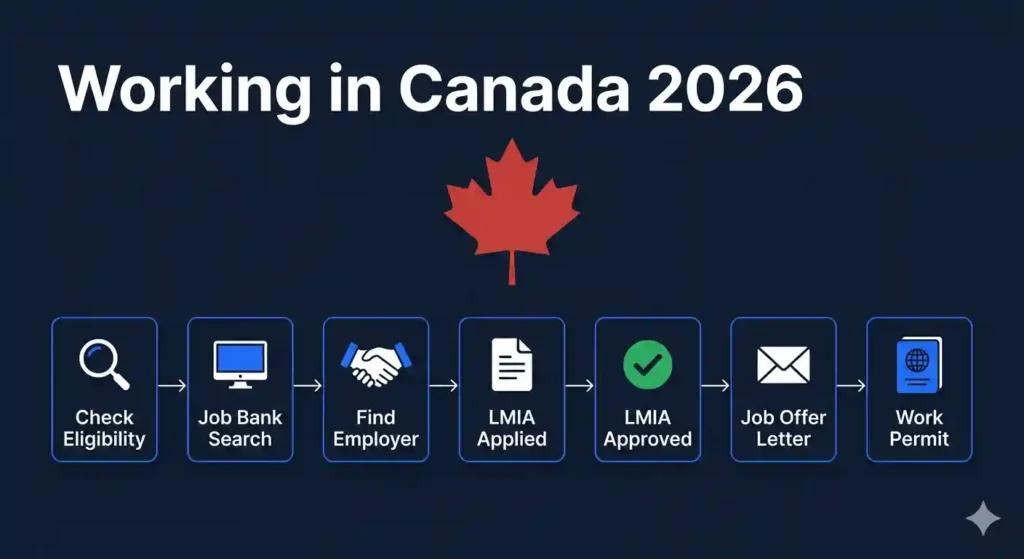
If you have been researching how to move to Canada for work, you have probably seen this term everywhere. LMIA jobs, LMIA-approved employers, LMIA support — it sounds complicated, and the process genuinely has more steps than most people expect. But it is not impossible to navigate, and thousands of foreign workers successfully secure LMIA-backed job offers every single year.
This guide explains exactly how to get an LMIA job offer in Canada in 2026 — what the process looks like from both sides, where to find legitimate employers, which industries have the most openings, and what the 2026 rule changes mean for your application. How to Get LMIA Job Offer in Canada in 2026
Table of Contents
What Is an LMIA and Why Does It Matter
Before you can understand how to get a job offer, you need to understand what an LMIA actually is and why employers go through the effort of obtaining one.
LMIA stands for Labour Market Impact Assessment. It is a document that a Canadian employer must obtain from Employment and Social Development Canada (ESDC), also known as Service Canada, before they are allowed to hire a foreign worker for most positions. The document essentially proves two things: that the employer has genuinely tried to fill the role with a Canadian citizen or permanent resident, and that hiring a foreign worker will not negatively affect the Canadian labour market.
From the employer’s side, getting an LMIA is a significant commitment. It costs time, money, and paperwork. Employers pay a non-refundable application fee of $1,000 CAD per position in most cases, and the process can take several months. This is important to understand, because it means that employers who go through the LMIA process are serious about hiring — they are not posting fake jobs or stringing candidates along.
From your side as a foreign worker, a positive LMIA from an employer is what allows you to apply for a Canadian work permit. Without it, you cannot legally work in Canada under the Temporary Foreign Worker Program. The LMIA is not your visa — it is the employer’s proof of need that supports your work permit application.
You can read the official ESDC overview of the LMIA process directly at the Government of Canada website: https://www.canada.ca/en/employment-social-development/services/foreign-workers.html
Step-by-Step — How to Get an LMIA Job Offer in Canada
Getting an LMIA job offer is not a single action. It is a process that happens in stages, and understanding each stage helps you know exactly what you are working toward at any given point.
Step 1 — Check Whether You Actually Need an LMIA
This is the step most people skip, and skipping it wastes months.
Not every foreign worker in Canada needs an LMIA-backed job offer. A significant number of work permits are issued under the International Mobility Program (IMP), which is entirely separate from the Temporary Foreign Worker Program. LMIA-exempt categories include intra-company transfers, workers covered under CUSMA (formerly NAFTA) trade agreements, post-graduation work permit holders, spousal open work permit holders, and participants in International Experience Canada.
If you qualify for any of these categories, you do not need an employer to go through the LMIA process. This can save both you and the employer months of waiting.
The Government of Canada has a free tool that helps you determine whether a specific work situation requires an LMIA or qualifies for an exemption. Check it before you do anything else: https://www.canada.ca/en/immigration-refugees-citizenship/services/work-canada/permit/temporary/need-permit.html
Step 2 — Understand the Difference Between LMIA Approved and LMIA Requested
When you search for jobs on the Canada Job Bank, you will see two different LMIA statuses on postings. Understanding the difference matters because it affects your timeline.
LMIA Requested means the employer has applied for an LMIA or plans to apply, but has not yet received a positive decision from ESDC. The position is real, but there is uncertainty. The LMIA could take weeks or months to come through, and in some cases it is refused.
LMIA Approved means the employer already holds a positive LMIA decision from ESDC. This is the status you want. It means the employer has already done the hard work, the government has already approved the hire, and the process of getting your work permit can begin as soon as you receive the formal job offer letter.
When you are starting out, prioritise LMIA Approved postings. Your timeline to getting a work permit is significantly shorter, and there is no risk of the LMIA being refused after you have already gone through interviews.
Step 3 — Search in the Right Places
The most important platform for finding genuine LMIA jobs in Canada is the Government of Canada Job Bank. This is where employers participating in the Temporary Foreign Worker Program are required to post their positions, and it is the only platform where you can filter specifically for LMIA status.
Go to the Job Bank’s Temporary Foreign Workers section and use the LMIA status filter to show only approved positions. As of January 2026, the platform showed over 4,000 active postings in the Temporary Foreign Workers section, though the number of fully approved LMIA positions within that total is always a smaller subset.
The official Job Bank is at: https://www.jobbank.gc.ca/findajob/resources/info-foreign-workers
Beyond Job Bank, LinkedIn Canada, Indeed Canada, and WorkBC are useful supplementary platforms. Some provinces also run their own job portals. When searching, use specific job titles rather than just “LMIA jobs” — search for the actual role you are qualified for, combined with your target province or city. Specific searches return better results and put you in front of employers looking for your exact skills.
Step 4 — Target the Right Industries
Not every sector in Canada has the same volume of LMIA activity. If you want to maximise your chances of finding a legitimate job offer, focus your search on the industries where genuine shortages exist and where LMIA applications are consistently approved.

Construction and skilled trades are among the highest-volume sectors for LMIA hiring right now. Electricians, plumbers, welders, carpenters, and heavy equipment operators are in demand across multiple provinces. Alberta, British Columbia, and Ontario all have active construction pipelines that domestic labour cannot fully support.
Food service and hospitality continue to see consistent LMIA activity. Cooks, line cooks, food service supervisors, and kitchen managers are among the most chronically in-demand roles. The shortage in this sector is well-documented — around 80 percent of Canadian food service operators report difficulty hiring kitchen staff through domestic recruitment alone.
Healthcare support roles including personal support workers, healthcare aides, and dental assistants are seeing increased LMIA activity as provinces work to address workforce gaps in the sector.
Trucking and logistics is another reliable area. HGV drivers and long-haul truck drivers are consistently listed across multiple provinces, and the CDL qualification combined with relevant experience makes candidates competitive.
Technology roles in software development, data analysis, and cybersecurity also generate LMIA activity, though many tech roles qualify for LMIA-exempt pathways first — worth checking before pursuing the standard LMIA route.
Step 5 — Apply Strategically, Not at Volume
One of the most common mistakes foreign workers make is sending out hundreds of generic applications to every LMIA posting they can find. This approach almost never works, and it can actually damage your chances by making you look unfocused to employers who are already cautious about taking on the extra paperwork of an LMIA hire.
A better approach is to pick one or two sectors where your experience is genuinely strong, identify employers in those sectors who have a history of successful LMIA applications, and apply with a targeted CV that directly addresses what those employers are looking for.
Before applying, research the employer. Check their website, their Google reviews, and their history on Job Bank. Legitimate employers who regularly hire through the LMIA process usually have an established online presence and a track record you can verify. Be specific in your cover message — explain your work status, your availability for interview, and why your experience matches the role requirements exactly.
Speed matters more than you might expect. Employers going through the LMIA process have spent months and significant money getting to the point of posting. When they find a qualified candidate, they move quickly. Responding to postings within 24 to 48 hours and being immediately available for a video interview puts you ahead of most applicants.
Step 6 — Get the Formal Job Offer Letter
Once an employer selects you and holds a positive LMIA, they will issue you a formal job offer letter. This document is essential — it is what you use to apply for your work permit with IRCC.
The job offer letter should include the unique LMIA number issued by ESDC, the employer’s legal name and business number, your job title and duties, the wage offered, the employment duration, and the work location. Before you do anything else, verify every detail in this letter carefully. The wage stated in the LMIA is legally binding — your employer cannot pay you less than this amount, and if any detail is wrong it can cause problems at the work permit stage.
Do not pay anyone for this letter. It is illegal for an employer or recruiter to charge you for an LMIA, a job offer, or any part of the recruitment process. If anyone asks you for money at this stage, it is a scam. Walk away immediately.
Step 7 — Apply for Your Work Permit
With the job offer letter and LMIA number in hand, you can now apply for your Canadian work permit through the IRCC secure portal. This is an employer-specific work permit, meaning it ties you to the employer named in the LMIA for the duration stated in the offer letter.
The work permit application requires your passport, the job offer letter with the LMIA number, proof of your qualifications and experience, biometrics if required for your nationality, and evidence of your ties to your home country. Processing times vary by country of application and by stream, but for most applicants from South Asia, the Middle East, and Africa, standard processing currently runs between eight and sixteen weeks.
IRCC’s work permit application portal is at: https://www.ircc.canada.ca/english/work/index.asp
What Changed in 2026 — Rules You Need to Know
The LMIA landscape in 2026 has shifted significantly compared to previous years, and some of these changes directly affect your chances of finding a job offer depending on where you are looking.
From April 1, 2026, employers applying for low-wage LMIAs must advertise the position for a minimum of eight consecutive weeks in the three months before submitting their application. This is double the previous requirement and means the timeline from an employer deciding to hire internationally to actually receiving an approved LMIA has lengthened considerably for low-wage positions.
Low-wage LMIA applications are currently suspended in regions where the unemployment rate exceeds six percent. This means cities including Toronto and Edmonton are currently restricted for low-wage LMIA processing. If you are targeting low-wage roles, focus on provinces and cities with lower unemployment rates — Alberta outside Edmonton, much of British Columbia, Saskatchewan, and Manitoba currently have more active low-wage LMIA processing.
Quebec has its own separate rules. Montreal and Laval have an extended moratorium on low-wage LMIA processing until December 31, 2026. Quebec also operates a simplified LMIA list that was reduced from 76 to 60 occupations in February 2026 — roles on this list can skip the provincial recruitment requirement, which speeds up the process considerably for qualifying positions.
High-wage LMIAs and the Global Talent Stream for tech roles are not subject to the same regional restrictions and continue to process across the country.
Moving2Canada keeps an updated breakdown of current LMIA rules and processing timelines by stream: https://moving2canada.com/work/work-permits/lmia/
How to Spot an LMIA Scam and Protect Yourself
The LMIA job market has a serious fraud problem, and it has gotten worse in recent years as demand from foreign workers has increased. Knowing what legitimate looks like is as important as knowing where to search.

The single most important rule is this: paying for an LMIA or an LMIA job offer is illegal. Canadian law prohibits employers from recovering LMIA fees from workers directly or indirectly. Recruiters cannot charge placement fees. If anyone — whether they present themselves as an employer, a recruiter, or an immigration consultant — asks you for money in exchange for a job offer or LMIA support, that is a crime under Canadian law, and the job is almost certainly not real.
Other warning signs include job offers that arrive without any interview process, offers that seem too well-paid for the role described, employers who cannot provide a verifiable business address or registration number, and urgency pressure telling you to act immediately before the offer expires.
Verify any employer you are considering through the Canada Revenue Agency business registry and by searching their business name alongside the province they claim to operate in. Legitimate employers who participate in the LMIA process are registered, established businesses with a verifiable footprint. If you cannot find them online, that is a significant warning sign.
If you believe you have encountered an LMIA scam, you can report it to ESDC through the tip line listed on the Government of Canada website.
LMIA and Permanent Residency — The Bigger Picture
Many foreign workers pursue an LMIA job not just to work in Canada temporarily, but because it creates a pathway toward permanent residency.
A Canadian work permit supported by an LMIA allows you to gain Canadian work experience, which is one of the primary factors in Express Entry’s Comprehensive Ranking System. One year of skilled work experience in Canada under the Canadian Experience Class can significantly increase your CRS score and make you eligible for an invitation to apply for permanent residency.
Some employers who go through the LMIA process are also willing to provide a permanent job offer, which adds substantial points to your Express Entry profile directly. A valid job offer supported by a positive LMIA is worth either 50 or 200 additional CRS points depending on the NOC skill level of the position.
This means that for many people, getting an LMIA job offer is not just about getting a work permit — it is the first concrete step toward building a permanent life in Canada. Approaching your job search with that longer-term view tends to lead to better decisions about which roles to pursue, which employers to target, and how to present yourself as a candidate worth the investment of an LMIA application.
How to Get LMIA Job Offer in Canada in 2026
The IRCC Express Entry information page has full details on how a job offer affects your CRS score: https://www.canada.ca/en/immigration-refugees-citizenship/services/immigrate-canada/express-entry/eligibility/job-offer.html
Frequently Asked Questions
How long does it take to get an LMIA job offer in Canada?
It depends on two things — how long it takes you to find a willing employer, and how long the LMIA processing takes after that. Finding the right employer can take anywhere from a few weeks to several months depending on your industry and how targeted your search is. Once an employer has a positive LMIA in hand, the job offer itself comes quickly. As of March 2026, processing times vary by stream, and the fastest route is through the Global Talent Stream for qualifying tech roles, which can process in as little as two weeks. Standard high-wage and low-wage streams take considerably longer. The practical answer for most applicants is three to six months from starting your search to holding a signed job offer letter. Elec Training
Can an employer or recruiter charge me for an LMIA in Canada?
No — and this is one of the most important things to know before you start searching. Canadian program requirements clearly state that LMIA processing fees cannot be paid by or recovered from temporary foreign workers, and employers must also ensure that nobody recruiting on their behalf charges or recovers recruitment fees from workers. Violations can result in a negative LMIA decision and the employer being banned from the program. If anyone asks you for money in exchange for a job offer or LMIA support — whether they call it a processing fee, a guarantee fee, or anything else — it is illegal and almost certainly a scam. Openlearningacademy
Which provinces in Canada have the most LMIA job opportunities in 2026?
Alberta (outside Edmonton), British Columbia, Saskatchewan, and Manitoba currently have the most active LMIA processing for both high-wage and low-wage positions. Low-wage LMIAs are not being processed in regions where unemployment exceeds six percent — Toronto and Edmonton are currently among the restricted areas. If you are targeting low-wage or entry-level roles, focus your search on smaller cities and rural areas in provinces with lower unemployment rates. High-wage positions and Global Talent Stream applications are not subject to these regional restrictions and can be processed across the country. Elec Training
Does an LMIA job offer help with permanent residency in Canada?
Yes, significantly. A valid job offer supported by a positive LMIA adds either 50 or 200 points to your Express Entry Comprehensive Ranking System (CRS) score depending on the NOC skill level of the position. Beyond the direct CRS points, working in Canada on an LMIA-backed work permit allows you to build Canadian work experience — which is one of the strongest factors in the Canadian Experience Class pathway to permanent residency. Many foreign workers use an LMIA job as the first step in a longer plan that ends with a PR application.
What is the difference between a high-wage and low-wage LMIA in Canada?
The classification depends on whether the wage offered is above or below the median hourly wage in the province where the job is located. High-wage LMIAs have fewer restrictions, process across all regions, and require the employer to submit a transition plan explaining how they will reduce reliance on foreign workers over time. Low-wage LMIAs from April 1, 2026 require employers to advertise the position for a minimum of eight consecutive weeks before submitting their application, are subject to regional unemployment restrictions, and have caps on the proportion of temporary foreign workers an employer can hire. For most foreign workers, high-wage LMIA positions offer a faster and more reliable path to a job offer. Morgan McKinley