
Here is something most people get wrong about the UK job market.
They assume a university degree is the only route to a good salary. That assumption is costing people years of their life and tens of thousands of pounds in debt they did not need to take on.
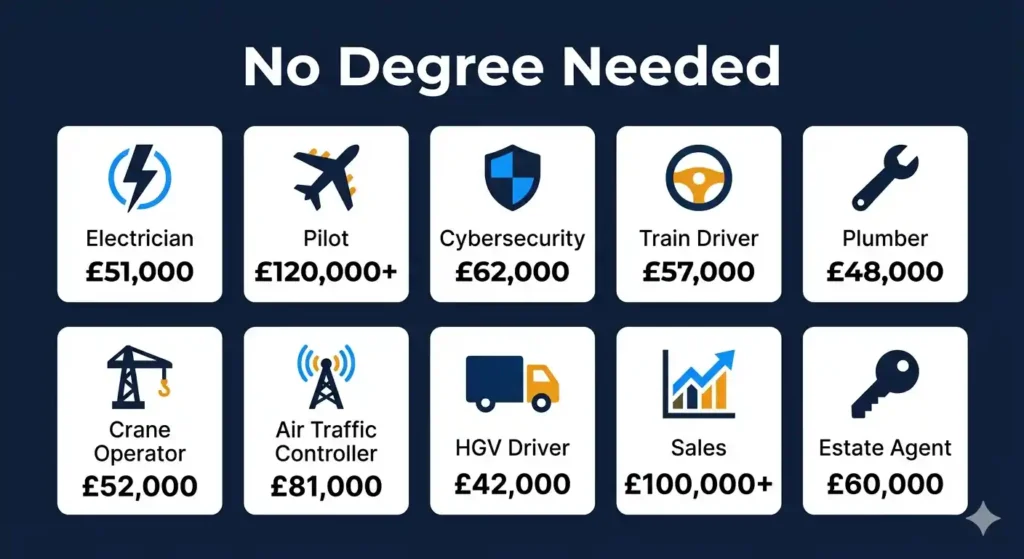
The reality in 2026 is very different. Skills-based hiring has grown by 63 percent in the UK since 2022, according to research by Remote. Major employers including Google UK, Deloitte, and the NHS have removed degree requirements from entire categories of roles. What they want now is proof that you can actually do the job.
Meanwhile, tuition fees in England are set to rise to £9,790 per year from the 2026/27 academic year. Three years of study means nearly £30,000 in fees alone, before rent, living costs, or interest on the loan.
This article covers ten of the highest paying jobs you can get in the UK in 2026 without a university degree — honest salary figures, how to get started, and what the realistic earning ceiling looks like. Highest Paying Jobs in UK Without a Degree 2026
Table of Contents
Why Degrees Are No Longer the Only Route to High Pay in the UK
The shift away from degree requirements is not a temporary trend. It is a structural change in how UK employers think about hiring.
The UK government’s own data shows that more than 30 percent of graduates are working in non-graduate roles five years after finishing university. At the same time, industries like construction, transport, cybersecurity, and skilled trades are reporting serious shortages of qualified workers. There are simply not enough people going into these fields to meet demand.
That imbalance has two effects. First, wages in shortage occupations go up because employers have to compete for the limited pool of qualified people. Second, employers become more flexible about entry requirements because they cannot afford to be picky.
If you are looking at a career change or deciding what to do after school, this is one of the most favourable moments in decades to build a high-paying career without going to university.
10 Highest Paying Jobs in the UK Without a Degree in 2026
1. Air Traffic Controller — £46,000 to £100,000+
Average salary: £81,000 | Starting salary: £46,000 | Time to qualify: 2–3 years, fully funded
Air traffic control is probably the most underrated non-graduate career in the UK. Controllers direct aircraft safely through UK airspace, manage takeoffs and landings, and communicate with pilots during every phase of flight. The responsibility is significant, and the pay reflects that.
You do not need any aviation background to apply. The National Air Traffic Services (NATS) runs its own training academy and selects candidates based on aptitude rather than qualifications. The selection process is challenging — psychometric tests, spatial reasoning assessments, and medical checks — but there is no degree requirement at any stage.
Once qualified, you start at around £46,000, which grows quickly with experience. Senior controllers at busy airports regularly earn above £80,000, and some experienced professionals clear £100,000. This is one of the few non-graduate careers where your earning potential genuinely rivals that of a doctor or solicitor.
Why it pays so well: The skill is rare, the responsibility is enormous, and qualified controllers cannot be replaced by automation. Demand for air travel continues to grow.
Learn more and apply at NATS careers: https://www.nats.aero/careers/
2. Electrician — £40,000 to £70,000+
Average salary: £51,000 | Starting salary: £28,000 | Time to qualify: 4 years via apprenticeship
The UK is facing a serious shortage of qualified electricians, and the timing could not be better for anyone considering this trade. The government’s push toward net-zero by 2050 means an enormous amount of new electrical infrastructure needs to be built and maintained. EV charging networks, solar installations, heat pump systems, and commercial rewiring projects are all driving demand upward.
An apprenticeship pays you from day one. You earn while you train, with wages increasing as you progress through your qualifications. Once you achieve your Gold Card certification and move into commercial or industrial settings, earnings move well beyond the average figure.

Self-employed electricians who specialise in renewable energy or work on large commercial contracts in London and the South East often earn £200 or more per day. That works out to well over £50,000 per year if you are consistently busy — and most experienced electricians right now are.
Why it pays so well: The UK does not have enough qualified electricians to meet current demand, especially in the renewable energy sector. Supply cannot keep up, and wages reflect that directly.
How to get started as an electrician in the UK: https://nationalcareers.service.gov.uk/job-profiles/electrician
3. Train Driver — £50,000 to £65,000
Average salary: £57,000 | Starting salary: £24,000 as trainee | Time to qualify: 12–18 months, fully paid
Train driving consistently ranks among the most satisfying jobs in the UK. The hours are structured, the pay is strong, and union agreements mean job security is about as solid as it gets.
There is no degree requirement. Train operators recruit based on aptitude and personal qualities. You need to be over 18, demonstrate good concentration, and pass a rigorous selection process that includes psychometric testing, colour vision checks, and a medical assessment. No A-levels. No specific subjects. Just the right personal qualities.
Once you get a place on a training programme — which is fully paid — you qualify within 12 to 18 months. Operators including Great Western Railway, Avanti West Coast, and Transport for London all run their own schemes. London Underground drivers are among the highest paid in the industry.
Why it pays so well: Train drivers belong to strong unions, and the role requires ongoing certification. The barriers to entry are selection and time, not qualifications — and that keeps salaries high.
4. Cybersecurity Specialist — £45,000 to £90,000
Average salary: £62,000 | Starting salary: £35,000 | Time to qualify: 6 months to 2 years
Cybersecurity is the fastest-growing high-salary field in the UK for non-graduates. The country has a shortfall of over 11,000 cybersecurity professionals. Every business from small firms to FTSE 100 companies needs people who can protect their systems. Demand is outpacing supply, and employers are hiring based on skills rather than degrees.

The entry route is unusually flexible. Platforms like TryHackMe and Hack The Box let you build real skills for free or at low cost. The CompTIA Security+ certification is the most widely recognised entry point and takes most people three to six months to prepare for. With that qualification, roles like SOC Analyst, security engineer, and junior penetration tester become accessible.
Career progression is rapid for people who keep learning. An analyst starting at £35,000 can realistically earn £60,000 to £70,000 within three to four years. Senior penetration
testers and cloud security architects regularly earn above £80,000, and some specialist contractors earn more than that as day rates.
Why it pays so well: Cyber attacks are increasing every year and every organisation needs protection. The talent gap between supply and demand keeps salaries moving upward.
UK Cyber Security Council — entry routes and certifications: https://www.ukcybersecuritycouncil.org.uk/careers-and-learning/
5. Plumber and Gas Engineer — £40,000 to £65,000+
Average salary: £48,000 | Starting salary: £25,000 | Time to qualify: 2–4 years
Plumbing and gas engineering have the same supply problem as electricians. The current generation of experienced tradespeople is retiring, and not enough young people are entering apprenticeships to replace them. Wages are rising as a direct result.
Starting with a plumbing apprenticeship gives you the core qualification. Adding ACS certification and Gas Safe registration opens up boiler servicing, central heating installation, and commercial gas work — all of which pay significantly more than general plumbing alone.
The renewable heating sector is particularly worth watching. The UK is phasing out gas boilers in new homes and has ambitious heat pump installation targets. Engineers who qualify in heat pump and air source heating systems are positioning themselves for a decade of strong demand. Self-employed heating engineers in this area are already earning well above £60,000 per year.
Why it pays so well: Retirement rates among experienced tradespeople are outpacing new apprentice starts. The gap between supply and demand is expected to widen, not close, over the next decade.
Gas Safe Register — qualification and registration information: https://www.gassaferegister.co.uk/
6. Commercial Pilot — £60,000 to £120,000+
Average salary: £70,000 qualified | Captain level: £120,000+ | Training cost: £70,000–£100,000
This is the most expensive career on the list to enter. Pilot training typically costs between £70,000 and £100,000 depending on the route you take. Financing is available, and some airlines run sponsored cadet programmes that reduce the upfront cost. What it does not require, at any stage, is a university degree.
You need a Commercial Pilot Licence (CPL) and an Airline Transport Pilot Licence (ATPL) to fly commercially. Many people take the modular route — completing training
in stages while working in other jobs to manage costs.
UK airlines including British Airways, easyJet, and Ryanair operate structured cadet pathways. The job involves irregular hours and time away from home, which is not for everyone. But for people who want it, the salary ceiling at captain level is among the highest on this list. Long-haul captains with major carriers regularly earn above £120,000 per year.
Why it pays so well: The aviation industry globally is facing a pilot shortage. Every flight requires two qualified pilots, and the length of the qualification pathway means supply consistently lags behind demand.
Civil Aviation Authority — UK pilot licensing requirements: https://www.caa.co.uk/
7. HGV Driver (Specialist) — £35,000 to £52,000+
Average salary: £42,000 | Starting salary: £32,000 | Time to qualify: 6–12 weeks for licence
The HGV driver shortage that made national headlines a few years ago has not been fully resolved. The average UK HGV driver is in their late 40s, and retirement rates are consistently outpacing new entrants. That demographic gap is keeping wages elevated and entry opportunities open.
Getting your HGV licence is one of the quickest routes to a decent salary on this list. The Category C licence for rigid vehicles and C+E for articulated trucks can be obtained in a matter of weeks. Many logistics companies will fund your training in exchange for a short-term commitment to work for them.
Specialist work pays better than standard HGV driving. Tanker drivers transporting fuel or chemicals, drivers carrying abnormal loads, and those with ADR certification for hazardous materials earn significantly above the standard rate. Temperature-controlled pharmaceutical logistics is another area where experienced drivers are consistently in demand.
Why it pays so well: Essential goods need to move around the country every day. Specialist HGV work requires additional certification that most drivers do not bother with, which limits competition and keeps pay high.
8. Senior Sales Executive — £40,000 to £100,000+
Average OTE: £70,000–£100,000 for consistent performers | Entry: SDR or BDR role | No qualifications required
Sales is one of the very few careers where your income is genuinely uncapped and where no qualification gives you any meaningful advantage over someone who can simply sell well.
The highest paying sales roles in the UK are in B2B technology, SaaS (Software as a
Service), financial services, and enterprise software. A senior account executive at a UK tech firm can earn £100,000 or more in total compensation through base salary and commission. Top performers in enterprise sales earn considerably more.
Entry is accessible. Many technology companies hire sales development representatives (SDRs) without degree requirements. The role focuses on outbound prospecting, lead qualification, and booking meetings. Promotion to account executive and beyond is based almost entirely on results rather than credentials.
Why it pays so well: Sales directly generates revenue. Companies pay disproportionately for people who can consistently bring in new business, regardless of their educational background.
9. Crane Operator — £45,000 to £70,000
Average salary: £52,000 | Starting salary: £35,000 | Time to qualify: 1–2 years
Crane operation sits in an unusual position in the UK job market. It pays very well, it is consistently in demand, and almost nobody outside the construction industry realises how strong the earnings are.
Experienced tower crane operators working on major infrastructure and housing projects in London regularly earn day rates that translate to annual incomes of £50,000 to £70,000. Offshore crane operators working on wind farms, oil platforms, and marine construction earn more still, often with additional allowances for remote site work.
Entry is through the Construction Plant Competence Scheme (CPCS) certification, which can be reached via a Lifting Technician apprenticeship or directly through a training programme. The UK government’s housing targets and investment in renewable energy infrastructure mean demand for qualified crane operators is not going to ease soon.
Why it pays so well: Operating a crane requires precision, spatial judgement, and safety awareness. Mistakes are potentially catastrophic. The combination of responsibility, certification requirements, and limited supply keeps rates high.
10. Real Estate Agent — £40,000 to £100,000+
Average salary: £45,000–£60,000 with commission | Starting salary: £20,000 base | Entry: 3–6 months for Propertymark qualification
UK estate agents are not legally required to hold a degree. The highest earners in the industry built their careers through experience, local knowledge, and the ability to build genuine relationships with buyers and sellers.
Commission structures mean that top-performing agents in London and the South East earn exceptionally well. A single sale on a £700,000 property generates significant commission. Agents who close consistently — four or five deals a month in a busy
market — earn incomes that put many graduate professionals to shame.
The NAEA Propertymark qualification is the most respected credential in the sector. Most agencies will fund it for you once you join. It covers property law, agency practice, and client management, and can be completed alongside work.
Why it pays so well: Property prices in the UK mean that even a modest percentage commission adds up quickly. High performers who build a strong local reputation compound that advantage year after year.
Propertymark — qualification routes and career information: https://www.propertymark.co.uk/
How to Actually Get Started
Reading a list of well-paid jobs is easy. The harder part is choosing one and taking the first step.
A few things worth knowing before you do. Most of the careers on this list have a genuine skills shortage at their core. That is good news for you, because it means employers are motivated to take on good candidates and train them. You are not competing with hundreds of identical applicants for every position.
The people who progress fastest in these careers are the ones who do not stop at the minimum qualification. An electrician who adds a solar installation certificate earns more than one who does not. A cybersecurity analyst who moves from CompTIA Security+ to CISSP gets a substantial salary increase. A plumber who qualifies in heat pump installation is better positioned than one who only does general maintenance. In every field on this list, the willingness to keep learning is the actual driver of earnings.
The UK Apprenticeship Service is a good starting point if you are looking at any of the trade or technical paths. It lists current vacancies by location and sector, and shows which employers are actively taking on apprentices right now.
UK Apprenticeship Service — find vacancies near you: https://www.apprenticeships.gov.uk/
The National Careers Service is also worth visiting if you want guidance on which path fits your situation, or if you want to talk through your options with an adviser.
National Careers Service — free careers advice and guidance: https://nationalcareers.service.gov.uk/
None of the ten careers above require you to take on three years of debt before you start earning. Most let you earn from day one or very close to it. Several have realistic salary ceilings that match or exceed what most graduates ever manage.
The degree that employers used to treat as the primary signal of capability is now just one signal among many. In 2026, the question the UK job market is actually asking is simpler than that: can you do the work?
Highest Paying Jobs in UK Without a Degree 2026
Frequently Asked Questions
Can you earn £50,000 a year in the UK without a degree?
Yes, and it is more common than most people realise. Roles like train driver, electrician, plumber, and cybersecurity analyst all have average salaries at or above £50,000 in 2026. Air traffic controllers regularly earn above £80,000 with experience. The key is choosing a field with a genuine skills shortage, where employers are competing for qualified workers rather than the other way around.
Is it worth doing an apprenticeship instead of going to university in the UK?
For many people in 2026, yes. An apprenticeship lets you earn while you train, with no tuition debt at the end. Electricians, plumbers, crane operators, and cybersecurity professionals all enter through apprenticeship or certification routes, and many reach salaries that match or exceed what the average graduate earns — often three to five years sooner. The UK Apprenticeship Service lists current vacancies at apprenticeships.gov.uk.
What is the easiest high-paying job to get in the UK without a degree?
HGV driving is one of the most accessible. The licence can be obtained in six to twelve weeks, many employers fund the training, and experienced specialist drivers earn £40,000 to £52,000 or more. Sales development roles at technology companies are another fast entry point — no qualifications needed, and top performers in B2B sales regularly earn £70,000 to £100,000 in total compensation.
Which jobs in the UK are in shortage and pay well without a degree?
The biggest shortages in 2026 are in cybersecurity (over 11,000 unfilled roles), electricians, plumbers and gas engineers, HGV drivers, and air traffic controllers. These shortages directly push wages up, because employers have to offer better pay to attract the limited pool of qualified candidates. If you want both job security and strong earnings, shortage occupations are where to focus.
How long does it take to get a high-paying job in the UK without a degree?
It depends on the field. HGV driving can get you earning well within three months. Cybersecurity roles are accessible within six to twelve months with the right certifications. Train driver training takes twelve to eighteen months. Electrician and plumber apprenticeships run for two to four years, but you are earning throughout. Commercial piloting takes the longest at two to three years, plus significant training costs. Most paths are faster than a three-year university degree and come without the debt.