Open any side hustle article in 2026 and you will find the same advice repeated over and over — build a personal brand, grow your Instagram following, post on LinkedIn, put yourself out there. The people giving this advice are not lying. It works for them. But here is what they never tell you: they built their income by teaching people how to build income. Their business model requires self-promotion. Yours does not have to.
The internet economy actually runs on two completely separate tracks. The first is the creator economy, where you are the product. Your face, your name, your story, your personality — all of it is constantly on display and everything depends on people knowing who you are. The second is the platform economy, where your work is the product and you are essentially invisible. A marketplace connects what you made with people who want it, automatically, through search and algorithms. You collect a payment. Nobody needed to know your name for any of that to happen.
Every single hustle in this guide operates on the second track. You do not need followers. You do not need a personal brand. You do not need to tell anyone who you are. You just need to produce good work and put it in the right place.
Table of Contents
1. Selling Digital Templates on Etsy and Gumroad
This is the closest thing to a perfect no-promotion income model that exists online today. You create a digital file — a Notion productivity dashboard, a resume template, a Canva Instagram kit, a monthly budget spreadsheet, a wedding planning checklist — and you list it on Etsy. That is genuinely it.
Etsy has over 96 million active buyers already on the platform searching for exactly what you might create. When someone in Manchester searches for “minimal resume template” or a freelancer in Toronto looks for “client onboarding document,” your listing appears in their results. The platform does every single bit of the marketing. Your job is to create something useful and write an accurate title and description.
The numbers from 2026 are clear on what this looks like in practice. Shops with 50 to 100 well-optimized listings in the right niches can realistically generate $500 to $2,000 per month in passive income. Shops with 300 to 500 listings in demand categories regularly hit $3,000 to $8,000 per month. Most new sellers make their first sale within 30 to 60 days. Consistent sales of 10 or more orders per month often take 6 to 12 months of active listing and optimization. MyDesignsSidequesthustle
The compounding effect is what makes this genuinely different from service work. Every new template you add sits on top of your existing catalog. A template you created and listed 14 months ago can still sell today without any additional effort from you. Sellers who research their niche and optimize listings consistently earn 80 to 95 percent profit margins on every sale. InsightAgent
One honest warning: the days of throwing up a generic “Social Media Template” and making thousands are over. In 2026, success is not about selling general templates but about selling solutions to specific problems. A template for somatic healing practitioners or an Airbnb host welcome book for beach properties will outperform a generic Instagram post template every time. Specific niches have less competition and more targeted buyers. Dylan Jahraus Blog
Where to start: Etsy.com for the largest built-in audience, Gumroad.com for better control and lower fees, and Creative Market if your work is aimed at professional designers.
2. Transcription Work on Rev and TranscribeMe
Transcription is one of the cleanest platform-based income models online because the dynamic is so simple. A business records a podcast, a legal firm records a deposition, a university records a lecture. They need it typed out accurately. You log into a platform, pick a job from the queue, transcribe it, submit it, get paid. The platform has already acquired the client. You are filling existing demand, not generating new demand.
Rev pays freelancers weekly via PayPal for all approved work. Transcriptionist pay ranges from $0.30 to $1.10 per audio minute, captioner pay from $0.54 to $1.10 per audio minute, and subtitle translators earn $1.70 to $4.00 or more per audio minute depending on language. Rev
A realistic look at the numbers: a good transcriptionist types at roughly a 3:1 ratio, meaning three minutes of work per one minute of audio. At $0.75 per audio minute average, a 10-minute audio file pays $7.50 and takes roughly 30 minutes to complete — around $15 per hour. It is not life-changing money but it is completely frictionless. No portfolio, no reviews, no building anything up. You apply, pass a short accuracy test, and work immediately.
One important thing to understand about transcription in 2026: AI has changed this market significantly. AI now handles the bulk of basic transcription jobs, which means human transcriptionists mostly work on audio that AI cannot handle well — heavy accents, multiple overlapping speakers, poor audio quality, technical terminology. This makes the work slightly harder but also filters out a lot of competition. If you speak a second language fluently, subtitle translation pays considerably more and has less competition than English transcription.
Where to start: Rev.com/freelancers for the largest volume of available work. TranscribeMe.com for shorter clips that suit people who want to work in short sessions.
3. AI Training Data Work on DataAnnotation and Outlier
This is the highest-paying no-promotion hustle available to most people in 2026 and it is genuinely underused. AI companies building large language models need enormous amounts of human-generated data to improve their systems — written prompts, comparisons between AI responses, code evaluations, creative writing samples, and feedback on AI outputs across dozens of categories. Real humans doing this work is what makes AI models better.
You apply to a platform, complete a written assessment, get placed into task pools that match your skills, and work from a queue. There is no profile photo, no public rating system, no bidding on projects, and no client relationships to manage. The platform handles everything except the actual work.
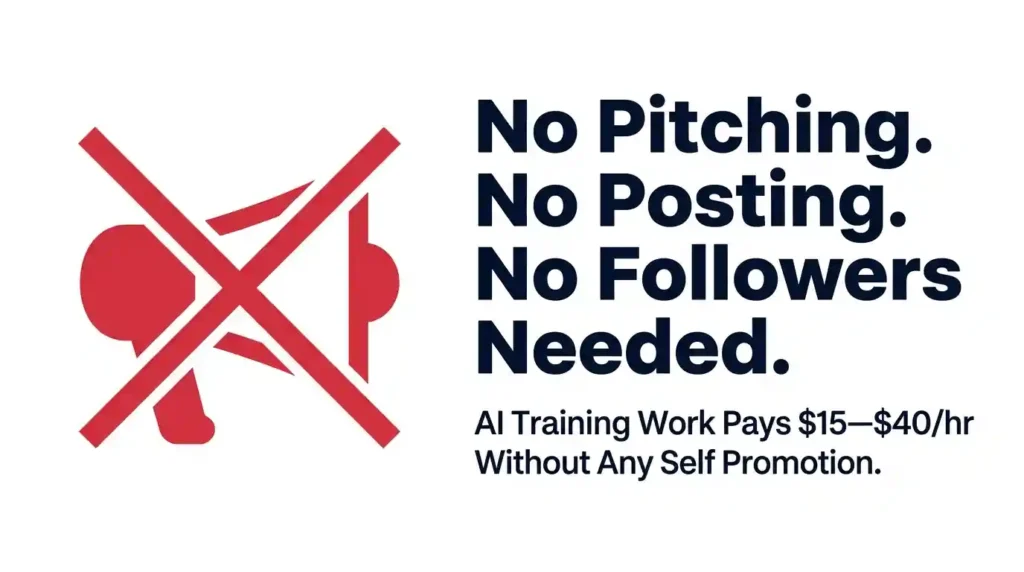
Pay is typically $20 to $40 per hour for skilled tasks, often lower for basic labelling. Effective hourly rates drop once you factor in unpaid screening, task hunting, and occasional submission bugs. More specifically, entry-level US-based annotators earn $15 to $20 per hour, more complex domains including medical, legal, finance, and coding pay $20 to $30 per hour, and lead annotators and QA roles reach $28 to $40 per hour. CareerSeeker AIJobright
Outlier AI pays between $15 and $100 or more per hour depending on expertise, project complexity, and location. General contributors in the US average around $31 per hour, while specialized roles like legal review can pay up to $100 per hour. Payments are processed weekly on Tuesdays via PayPal, ACH bank transfer, or Airtm. RemoWork
The honest reality is that task availability varies significantly week to week. Some weeks there is plenty of work, other weeks the queue is empty and you have no warning. This makes it excellent supplemental income but unreliable as a primary income source. The best approach is to be active on two or three platforms simultaneously so when one goes quiet you have others to fall back on.
Combining two or three platforms such as Outlier plus DataAnnotation plus one other smooths earnings during slow demand cycles. RemoWork
Where to apply: DataAnnotation.tech, Outlier.ai, and Alignerr.com as a third option if the first two have slow periods.
4. Writing for Content Agencies — Textbroker and Verblio
Content agencies sit between businesses that need articles written and writers who produce them. You interact with the agency platform, not the end client. There is no discovery call, no proposal, no negotiation, no building a client relationship. You log in, browse writing orders sorted by topic, pick one that matches your knowledge, write to the brief provided, submit, and receive payment.
Textbroker assigns writers a quality level from 2 to 5 based on a sample you submit. Higher levels get higher rates and access to better-paying direct client orders. The work is available immediately after passing the assessment and there is no waiting period to start earning. Writers who commit a few hours per day can generate $400 to $900 per month consistently without ever having a client conversation.
Verblio works differently. Clients on a subscription post content requests and writers submit drafts speculatively — you only get paid when a client accepts your piece. The risk is higher but the reward is also higher, with accepted articles paying $40 to $180 depending on length and complexity. Writers who understand what subscription clients are looking for and hit the brief well report very good acceptance rates.
The underlying dynamic of both platforms is important: you are anonymous. The business buying the content often does not even know a human wrote it versus a team of writers. Your name is never on anything. You show up, produce quality work, and money appears in your account.
Where to start: Textbroker.com gives you immediate access to a queue of work with no waiting. Verblio.com for better per-article rates once you have a feel for what clients want.
5. Stock Photography and Video — Shutterstock and Adobe Stock
If you own a decent camera or even a modern smartphone with good optics, you can build an income stream that earns every month from photographs you took once. The stock media marketplace is entirely search-driven. A marketing team in Berlin needs an image of a home office setup. A magazine editor in New York needs a photo of diverse people collaborating around a table. They search on Shutterstock or Adobe Stock, find an image that fits, buy a license, and the money hits your contributor account. You were not involved. You did not even know the sale happened.
The relationship between portfolio size and income is direct and well documented. A library of 50 images earns almost nothing. At 300 to 500 images you start seeing meaningful monthly income. Contributors maintaining libraries of 1,000 or more images across multiple platforms commonly earn $400 to $1,500 per month in completely passive royalties.
What sells well in 2026 specifically: authentic workplace and remote work setups are in constant demand as businesses update their marketing materials. Diverse people in everyday situations — not staged or overly polished — perform well because brands have moved away from obviously stock-looking photography. Food preparation, small business settings, sustainable living, and home interiors all have consistent commercial demand.
A practical approach that multiplies earnings with no extra work: upload the same images to both Shutterstock and Adobe Stock simultaneously. Both platforms pay royalties independently and there is no exclusivity requirement for most contributors. You do the upload work once and earn from two income streams.
Where to start: Shutterstock Contributor Portal and Adobe Stock Contributor — create both accounts and upload the same library to each.
6. Print-on-Demand Design — Redbubble and Merch by Amazon
You design something. A platform prints it on a product, ships it to a customer, handles returns, manages customer service, and sends you a royalty. You never touch a physical product. You never speak to a customer. The buyer finds your design through the platform’s own search engine, buys it, and the entire transaction happens without your awareness or involvement.
Redbubble is the fastest entry point in this space because there is no application or approval process. You create a free account, upload a design today, and it is live and searchable immediately. The platform has millions of monthly visitors searching for designs across thousands of categories.
Merch by Amazon is more competitive and requires an application, but the traffic advantage is extraordinary. Amazon’s search engine and recommendation algorithm surface your designs to buyers who are already on the platform with their credit card linked and ready to purchase. A well-targeted design in a specific niche — a particular profession, a specific hobby, a regional identity — can sell hundreds of units per month from Amazon’s organic traffic alone.
What works in 2026 is niche specificity. A t-shirt that says “funny teacher” competes against thousands of listings. A t-shirt with a specific joke that only fifth-grade teachers who drink too much coffee would understand has a fraction of the competition and a very loyal target buyer. The more precisely targeted the design, the better it performs on platform search.
Where to start: Redbubble.com to go live immediately with no approval. Merch by Amazon for higher long-term earnings once accepted.
7. Kindle Direct Publishing — Amazon KDP
Amazon KDP gives you access to the most powerful book discovery engine ever built. When you publish on KDP, Amazon’s search algorithm, its recommendation system, the “Customers also bought” feature, and the Kindle Unlimited subscription pool all work together to surface your books to relevant readers. You never need to tell a single person that your book exists.
There are two distinct approaches that work well. The first is niche non-fiction ebooks — practical guides on specific topics, how-to books for specific audiences, or reference materials for particular professions. These sell through Amazon search and earn through direct purchases and Kindle Unlimited page reads. The second is low-content books — journals, notebooks, puzzle books, activity books, and planners — which require minimal writing, are faster to produce, and sell primarily through Amazon’s category browsing and search.
The income model is built on catalog size, not individual bestsellers. One book earning $50 per month is a curiosity. Thirty books each earning $50 per month is $1,500 in passive income. Authors who consistently publish across 20 to 50 titles and optimize their listings properly commonly reach $1,000 to $5,000 per month from royalties alone. The key word is consistently — this requires sustained output over 12 to 24 months before the catalog reaches critical mass.
KDP pays 35 to 70 percent royalties depending on pricing and territory. There are zero upfront costs. If your book earns nothing, you have lost time but no money.
Where to start: kdp.amazon.com — free account, publish your first book, and begin learning what Amazon search actually rewards.
8. User Testing — UserTesting and Respondent
Companies spend enormous budgets building products and then discover that real users cannot figure out how to use them. Rather than guess why, they hire ordinary people to use their website or app while thinking aloud on a screen recording. This is called user testing and it pays remarkably well for something that requires zero qualifications and zero experience.
UserTesting works like this: you sign up, complete a sample test to confirm your audio and screen recording setup works, and then get matched to paid tests based on your demographic profile — your age, location, occupation, income level, and device usage patterns. Each test runs 15 to 20 minutes and pays $10. You receive a notification when a matching test is available, complete it within the given window, and get paid within 14 days via PayPal. There is no bidding, no pitching, no building a reputation. Either you match a test’s demographic requirements or you do not.
Respondent.io targets more senior professionals for qualitative research studies — 45 to 60 minute paid sessions that earn $75 to $200 each. Researchers want specific professional backgrounds and life experiences. If your background matches, you can access studies that pay significantly more per hour than most white-collar jobs, for occasional work that requires no preparation beyond showing up and being honest.
The income ceiling on user testing is limited by test availability — most active testers realistically earn $150 to $400 per month. Think of it as supplemental income that requires minimal setup and zero ongoing promotion rather than a primary income source.
Where to start: UserTesting.com for the highest test volume. Respondent.io for higher-paying research studies if you have a professional or specialist background.
9. Selling AI Prompt Packs — PromptBase and Etsy
The generative AI explosion has created an entirely new category of digital product that did not exist three years ago. Most people who use tools like ChatGPT, Claude, Midjourney, or DALL-E know what they want to achieve but do not know how to prompt effectively to get there. Professionals who have figured out precise, high-performing prompts for specific use cases can package them and sell them repeatedly to people who want the shortcut.
Well-organized prompt packs for specific professional niches — 50 prompts for email marketing campaigns, 40 prompts for real estate agents, 100 Midjourney prompts for product photography, a complete ChatGPT system for freelance writers — sell consistently on PromptBase and Etsy for $8 to $40 per pack. PromptBase was built specifically for this market and has its own search engine connecting prompt creators with buyers. Etsy surfaces prompt packs through its existing search to buyers already comfortable with digital purchases.
The no-promotion dynamic is identical to other digital product sales. You create the pack, optimize your listing title with the exact terms buyers search for, and the platform brings buyers to you. Sellers with 20 to 30 well-organized prompt packs across multiple niches earn $600 to $2,500 per month from platform traffic alone. The marginal cost of each additional sale after the initial creation effort is zero.
Where to start: PromptBase.com as a purpose-built marketplace for this product type. Etsy.com for access to a larger general audience already familiar with buying digital downloads.
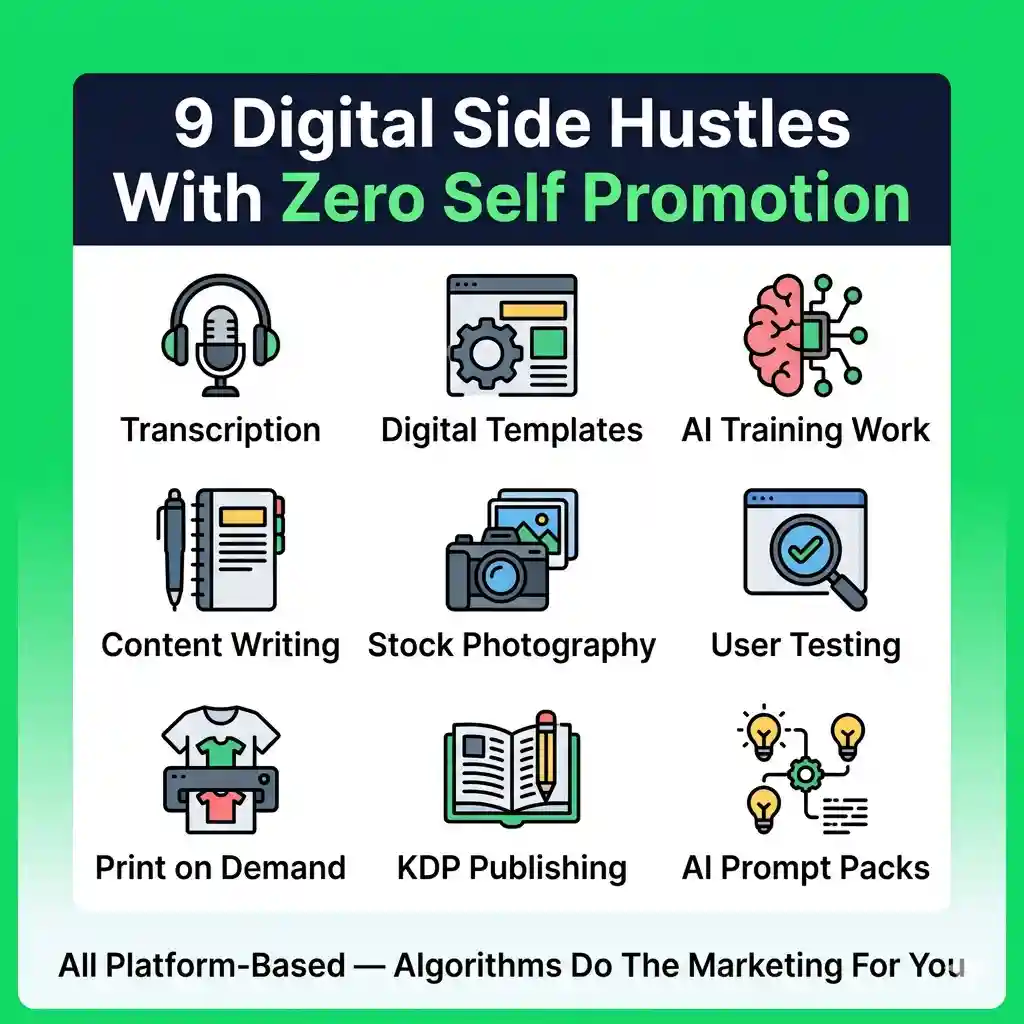
The One Thing That Connects All Nine of These
None of these hustles require you to promote yourself. But all of them require one thing that is easy to overlook: you need to be findable by the people who are already looking.
This means naming your Etsy listing with the exact words a buyer would type, not the words you would use to describe your work internally. It means uploading stock photos with accurate, specific keyword tags. It means titling your KDP book so that Amazon’s algorithm understands exactly who it is for. It means writing a DataAnnotation assessment as carefully as you would write a paid piece of work.
This is not self-promotion. It is signal clarity. You are not asking anyone to pay attention to you. You are making sure that when someone is already searching for what you offer, they can actually find it. That distinction — between promoting yourself and making yourself findable — is the entire foundation of earning online without ever having to pitch, post, or perform.
Honest Expectations: What This Actually Looks Like
Most people who succeed with these hustles do not start earning significant money in the first month. Etsy digital products typically take 3 to 6 months of consistent listing and optimization before generating reliable monthly income. KDP catalogs take 12 to 18 months to reach meaningful scale. Stock photography builds slowly over a year or more. Transcription and user testing produce income within days but have lower ceilings.
The pattern that works is choosing one or two from this list based on your existing skills, committing to them consistently for six months, and measuring what the data tells you rather than what your anxiety tells you. Most people who now earn $2,000 to $5,000 per month from no-promotion digital side hustles nearly quit at the 3-month mark when progress felt invisible. The people who pushed past that point are the ones whose products are now quietly selling while they sleep.
Digital Side Hustles Without Self-Promotion
Can I really earn money online without promoting myself at all?
Yes, and this is more common than most people realize. Platforms like Etsy, Amazon KDP, Shutterstock, Rev, and DataAnnotation are built specifically so that creators and workers never need to market themselves. The platform handles all customer acquisition through its own search engine and algorithm. Your job is to produce quality work and list it correctly. Thousands of people earn $500 to $3,000 per month from these platforms without a single social media post or personal brand.
Which no-promotion side hustle pays the fastest?
User testing on UserTesting.com and transcription on Rev are the two fastest. With UserTesting you can complete your first paid test within days of signing up and receive $10 per test via PayPal within 14 days. Rev approves new transcriptionists within 3 to 5 business days and pays weekly. Both require zero portfolio, zero reviews, and zero promotion to get started. If you need income within the first two weeks, these are your best options.
How much can a beginner realistically earn in the first 3 months?
It depends heavily on which hustle you choose. Active income models like transcription, AI training data work on DataAnnotation or Outlier, and user testing can produce $200 to $600 per month within the first 4 to 6 weeks. Passive models like Etsy digital templates, KDP publishing, and stock photography typically earn very little in the first 3 months while you build your catalog — but compound significantly after month 6. Most beginners who stick with one platform consistently for 6 months report earnings of $400 to $1,500 per month by that point.
Do these side hustles work for people outside the US — like in the UK, Canada, or Europe?
Most of them work globally. Etsy, Gumroad, KDP, Shutterstock, Adobe Stock, Redbubble, and PromptBase all accept international sellers and pay in USD or local currency via PayPal or direct bank transfer. Rev accepts freelancers from most English-speaking countries. DataAnnotation and Outlier AI have availability in the UK, Canada, Australia, and parts of Europe, though task volume can be lower outside the US. UserTesting.com is available in the UK, Canada, Australia, and several European countries. The passive income models like Etsy and KDP work identically regardless of where you live.
What is the single biggest mistake people make with these hustles?
Quitting too early. Every single passive income model on this list looks discouraging for the first 3 to 6 months. An Etsy shop with 10 listings and two sales feels pointless. A KDP catalog with four books earning $18 a month feels like a waste of time. A Shutterstock portfolio of 80 photos earning $12 a month feels embarrassing. These are all normal numbers at those stages. The people earning $2,000 to $5,000 per month from these platforms almost universally describe nearly quitting during exactly that window. Compound growth in platform-based income is back-loaded — it looks flat for months and then accelerates. The ones who get there are simply the ones who did not stop.

Portugal Work Visa for Foreigners 2026 Why the Job Offer Must Come Before the Plane Ticket
If you were planning to fly to Lisbon on a tourist stamp and hunt for…

How to Get a Canada Work Visa from China 2026 Step-by-Step Guide
Every year, thousands of skilled professionals across China begin searching for the same thing: how…
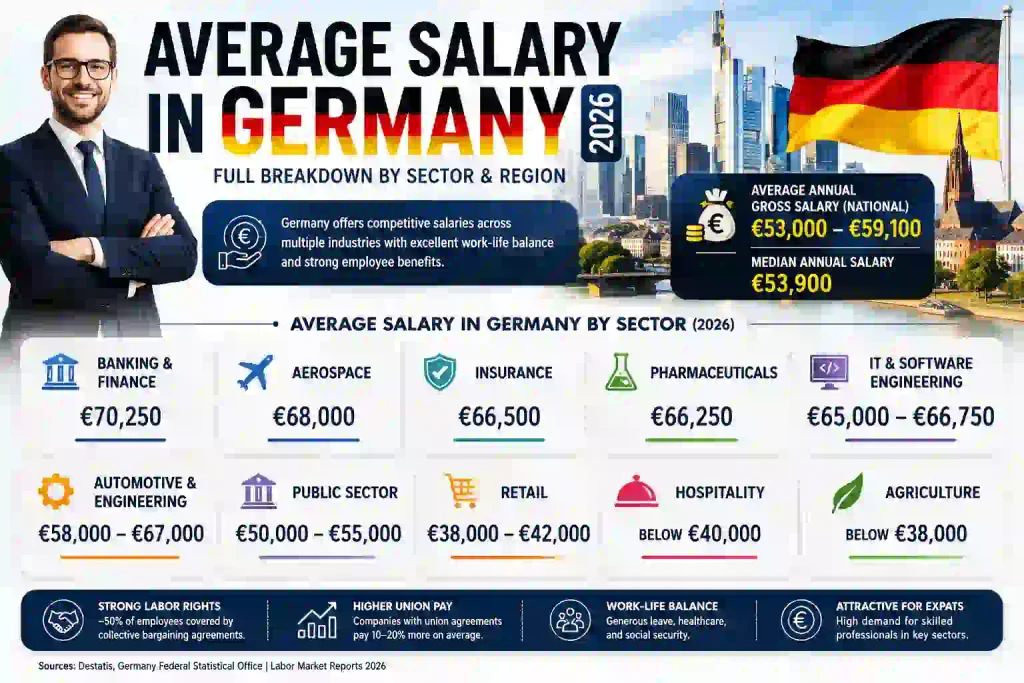
Average Salary in Germany 2026 Full Breakdown by Sector and Region
If you’re planning a move to Europe’s largest economy, one question comes up before anything…

Best Job Sites in Germany for Foreigners and Immigrants 2026
Moving to Germany for work sounds exciting until you actually sit down and start searching…

Netherlands Work Visa for Foreigners 2026: Step-by-Step Guide
Moving abroad for work is a big decision, and if the Netherlands is on your…

Virtual Assistant Jobs for Beginners 2026: How to Get Started Without Experience
The remote work industry has grown faster than anyone predicted, and one career path leading…