
If you’re planning a move to Europe’s largest economy, one question comes up before anything else: what’s the average salary in Germany really like once you break past the headline numbers? Germany is often described as expensive but well-paying, and in 2026 that reputation still holds — but the real picture depends heavily on which sector you work in, which region you live in, and whether you’re comparing gross pay or what actually lands in your bank account.
This guide breaks down the average salary in Germany for 2026 by industry, by region, and by experience level, using the latest available wage data from Germany’s own statistical authority alongside private labor-market reports. Whether you’re a skilled professional considering a move, a student weighing job offers, or simply curious how German pay compares internationally, this article gives you the full picture — no fluff, no guesswork.
Table of Contents
What Is the Average Salary in Germany in 2026?
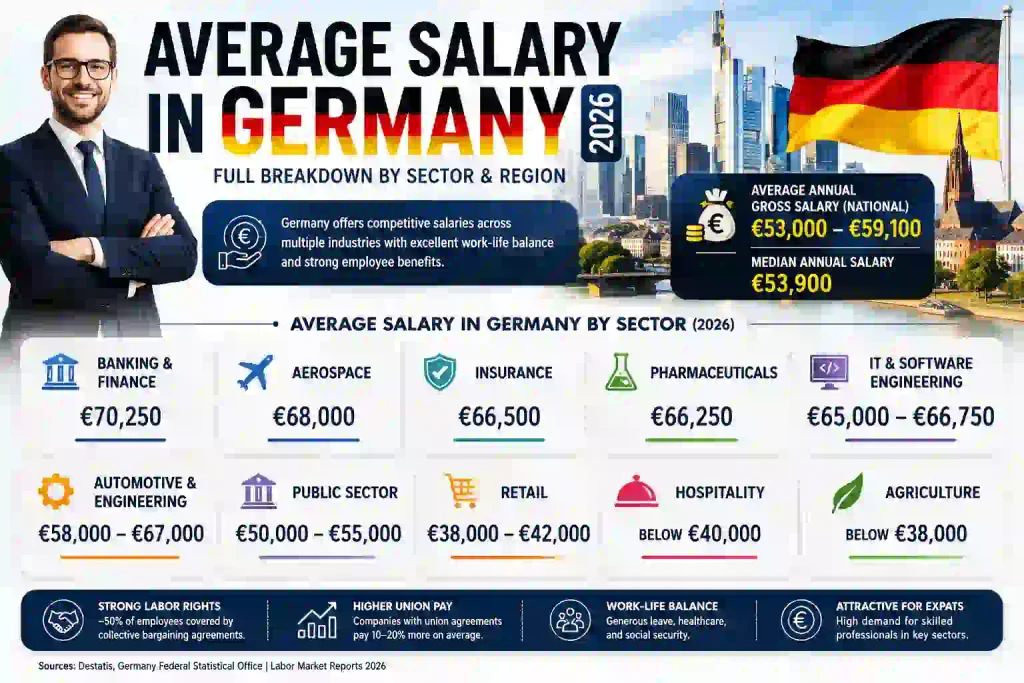
According to Destatis, Germany’s Federal Statistical Office, the average salary in Germany was €4,851 per month gross for full-time employees in the most recent full-year figures, with the median sitting lower because a smaller group of high earners in finance, medicine, and senior management pulls the average above what most employees actually take home. For 2026, most labor-market trackers put the national average salary in Germany somewhere between €53,000 and €59,100 a year gross, with the median figure — a more realistic middle-ground number — closer to €53,900 a year, or roughly €4,490 a month. ThisWorks
Why does the median matter more than the average? Because Germany’s income distribution is skewed by a relatively small group of very high earners in banking, aerospace, and pharma. The median tells you what a typical worker actually earns, while the average gets pulled upward by outliers. When people ask “what’s the average salary in Germany,” the honest answer is really two numbers, not one.
For context, you can check the official long-run wage series directly on Destatis’s English-language portal, which tracks gross and net earnings across sectors, gender, and region going back decades.
Average Salary in Germany by Sector (2026)
Industry is the single biggest factor separating a comfortable average salary in Germany from one that barely covers rent in a major city. Finance, aerospace, pharmaceuticals, and technology consistently sit at the top, while hospitality, retail, and agriculture sit well below the national median.
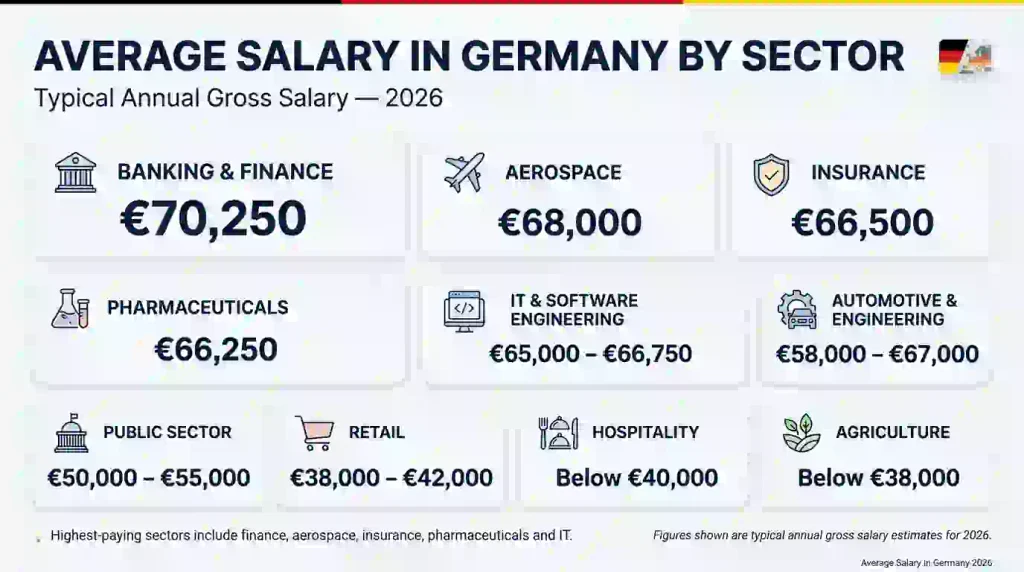
| Sector | Typical Annual Gross Salary (2026) |
|---|---|
| Banking & Finance | €70,250 |
| Aerospace | €68,000 |
| Insurance | €66,500 |
| Pharmaceuticals | €66,250 |
| IT & Software Engineering | €65,000 – €66,750 |
| Automotive & Engineering | €58,000 – €67,000 |
| Public Sector | €50,000 – €55,000 |
| Retail | €38,000 – €42,000 |
| Hospitality | Below €40,000 |
| Agriculture | Below €38,000 |
A few things stand out here. First, high-paying sectors in Germany include automotive engineering, finance and banking, pharmaceuticals — with a chemical and pharma cluster around Mannheim, Ludwigshafen, and Leverkusen — insurance, technology, and energy, while lower-paying sectors include hospitality, retail, agriculture, and personal services. Second, roughly half of German employees are covered by sector-level collective bargaining agreements, and companies bound by these agreements typically pay 10 to 20% more than comparable non-unionized companies for equivalent roles — which is one reason the average salary in Germany can vary so much even within the same job title. EmploysomeEmploysome
If you’re targeting IT specifically, it’s worth knowing that software engineers can expect starting offers well above the national median, with senior engineers in Munich or Frankfurt often clearing six figures. This is also the sector most open to skilled foreign workers, which brings us to visa thresholds — more on that below.
Average Salary in Germany by Region
Location is almost as important as industry when it comes to the average salary in Germany. Southern and western states — anchored by Munich, Frankfurt, and Stuttgart — consistently outpace the rest of the country, while the former East German states still lag behind despite more than three decades of reunification.
| Region / City | Typical Annual Gross Salary (2026) |
|---|---|
| Munich | €62,000 – €67,000 |
| Frankfurt | €62,000 – €65,000 |
| Stuttgart | €58,000 – €63,000 |
| Berlin | €52,000 – €56,000 |
| Western Germany (avg.) | €55,435 – €56,250 |
| Eastern Germany (avg.) | €46,013 – €48,750 |
Three and a half decades after reunification, a clear wage gap remains between the former East and West Germany. In 2026, the median in western states is about €55,435, versus €46,013 in the eastern states — a gap of roughly €9,400, or about 17%, which has narrowed since the 1990s but still persists, driven largely by where major corporate headquarters, industrial hubs, and finance centers happen to sit. Interestingly, Berlin falls between the two — statistically counted with the East but paying closer to western levels. Average Salary WorldAverage Salary World
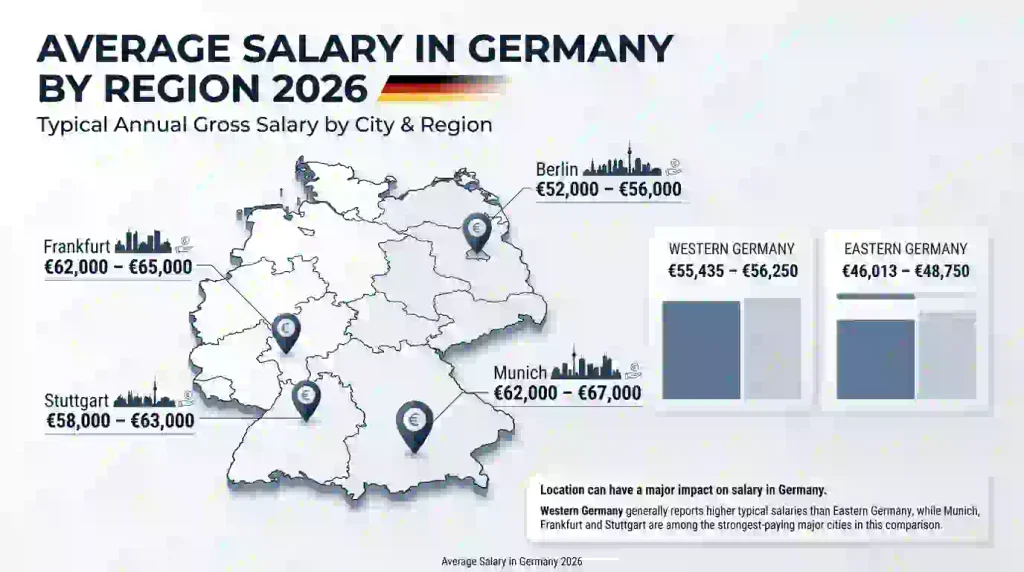
On the city level, Munich consistently ranks as Germany’s highest-paying city, with tech experts, automotive engineers, and business professionals earning between €62,000 and €67,000 a year — though it also carries the highest cost of living, with rents often twice as high as in smaller German cities. Frankfurt’s financial sector similarly pushes salaries up, with banking, insurance, and financial-services professionals earning 15–20% more than the national average. Berlin, meanwhile, has become one of the top-ranked European cities for tech talent and startups, even though its average salary of €52,000–€56,000 sits slightly below the national median. PeblPebl
If you’re also weighing North America against Europe, it’s worth comparing this against what’s on offer elsewhere — we’ve broken down the average salary in Canada for 2026 in a separate guide if you want a side-by-side view before deciding where to apply.
Minimum Wage and Entry-Level Pay in 2026
At the lower end of the scale, Germany’s statutory minimum wage rose meaningfully this year. The 2026 Mindestlohn is €13.90 per hour gross, up 8.4% from €12.82 in 2025 — equivalent to roughly €2,409 a month at a 40-hour week. Workers placed through temporary staffing agencies fall under a separate, higher floor: from 1 July 2026 it’s €14.96 per hour, rising to €15.33 from 1 September 2026 and €15.87 from 1 April 2027, taking precedence over the general minimum wage where it applies. ThisWorksThisWorks
For career starters more broadly, workers with less than one year of experience average around €46,250 a year, compared to €60,000 for senior professionals with 25-plus years in the field. Education plays an outsized role too: workers with a university degree earn a median of €68,250, versus €51,200 for those without an academic qualification. This gap is part of what makes Germany’s so-called “Diplom” culture distinctive compared to other European labor markets — formal qualifications translate directly into pay in a way that’s less pronounced elsewhere. MultiplierMultiplier
Average Salary in Germany vs. EU Blue Card Thresholds
If you’re a foreign professional hoping to work in Germany, the average salary in Germany isn’t just a curiosity — it directly determines whether you qualify for an EU Blue Card. The standard EU Blue Card salary threshold is €50,700 gross per year, dropping to €45,934 for shortage occupations, which typically includes IT and STEM roles. Because the median average salary in Germany across most professional sectors already clears this bar, skilled applicants in fields like engineering, healthcare, and software development are usually well-positioned to meet the requirement. Multiplier
The official government portal, Make it in Germany, is the best place to confirm current thresholds and recognized qualifications before you apply, since these figures are reviewed annually and can shift.
Before you get to the visa stage, though, you’ll need an offer in hand — and that starts with finding the right employer. If you haven’t started your search yet, our guide to the best job sites in Germany for foreigners and immigrants in 2026 walks through where international candidates are actually getting hired, rather than just where the listings are.
Gross vs. Net: What You Actually Take Home
One thing that consistently surprises newcomers is just how different gross and net pay look in Germany. After income tax and social contributions, a single worker in tax class I typically keeps roughly €2,800–€2,950 net per month out of the median gross salary — with married or dual-income households generally keeping more. As a rough example, a software engineer earning €70,000 gross in Berlin keeps around €3,500 net a month, and roughly €1,600 after rent and bills. EP AdvisoryEP Advisory
Germany sorts taxpayers into six tax classes (Steuerklassen) based on marital and family status, and this classification changes take-home pay significantly even when the gross average salary in Germany stays identical. A single person in Class I keeps the least of their gross pay; a married sole earner in Class III keeps noticeably more on the exact same salary. There’s also no statutory 13th-month payment in Germany, unlike some neighboring countries, though around 55% of employees receive a Christmas bonus (Weihnachtsgeld) worth anywhere from a quarter to a full month’s extra pay, and some also receive holiday pay (Urlaubsgeld), particularly in sectors covered by collective agreements. Average Salary World
Gender Pay Patterns
Gender still plays a measurable role in the average salary in Germany. Men averaged €5,046 per month in the latest full-year data, compared to €4,435 for women — a gap that narrows in unionized, collectively-bargained sectors but widens in industries with less formal wage structuring. This pattern is fairly consistent across most of Western Europe, and it’s one more reason sector choice matters as much as job title when negotiating pay. ThisWorks
You can dig deeper into sector-by-sector and gender breakdowns directly through Statista’s German wages and salaries data hub, which aggregates Destatis figures into an easier-to-browse format.
Getting Your Foot in the Door
Numbers aside, the practical challenge for most foreign applicants isn’t understanding the average salary in Germany — it’s landing an interview in the first place. German employers, especially in engineering and finance, tend to screen resumes strictly against local formatting expectations, and a CV that works for a UK or US employer often gets filtered out automatically by applicant tracking systems used in Germany. Building a clean, ATS-friendly resume before you start applying makes a measurable difference here — our free ATS resume builder is a good starting point if your current CV hasn’t been updated for the German market specifically.
Once you’ve got interest from an employer, the next hurdle is usually the visa itself. Germany’s work permit categories vary depending on your qualifications, and it’s worth reading through a full work visa guide before assuming any single path — like the EU Blue Card — is automatically the right one for your situation.
Final Thoughts on the Average Salary in Germany in 2026
Pulling all of this together, the average salary in Germany in 2026 sits somewhere between €53,000 and €59,000 a year at the national level, but that single number hides enormous variation. Finance, aerospace, and pharma professionals in Munich or Frankfurt are earning well above €60,000, while hospitality and retail workers, particularly in eastern states, often sit closer to €40,000 or below. Education, experience, collective bargaining coverage, and simple geography all shift the number substantially in either direction.
For anyone planning a move, the practical takeaway is this: don’t anchor your expectations to a single national average. Look at your specific sector, your target city, and — if you’re relocating from abroad — the EU Blue Card threshold that applies to your profession. Combined with a properly formatted resume and a clear-eyed read of the visa process, understanding exactly where your role and region fall on Germany’s salary map is the single most useful piece of preparation you can do before applying.
Frequently Asked Questions
What is the average salary in Germany in 2026?
The average salary in Germany in 2026 is around €53,000 to €59,100 per year gross, with the median sitting closer to €53,900 annually, or roughly €4,490 per month.
What is a good salary in Germany in 2026?
A good salary in Germany in 2026 is generally considered anything above €60,000 per year gross, since this comfortably clears the national median and typically reflects mid-to-senior roles in sectors like IT, finance, or engineering.
What is the minimum wage in Germany in 2026?
The statutory minimum wage in Germany in 2026 is €13.90 per hour gross, up from €12.82 in 2025, which works out to roughly €2,409 per month at a standard 40-hour week.
Which city in Germany pays the highest average salary?
Munich pays the highest average salary in Germany, with professionals in tech, automotive, and business roles typically earning between €62,000 and €67,000 per year, followed closely by Frankfurt’s finance sector.
What salary do I need for an EU Blue Card in Germany?
For an EU Blue Card in Germany, you generally need a gross annual salary of at least €50,700, though this threshold drops to €45,934 for shortage occupations such as IT and other STEM fields.