
Every year, thousands of skilled professionals across China begin searching for the same thing: how to get a Canada Work Visa from China without wasting months on paperwork that eventually gets rejected. Canada’s immigration system looks straightforward on the surface, but for applicants coming specifically from China, there are extra layers — document authentication, biometric requirements, and specific visa office processing — that most generic guides never explain. This guide breaks down exactly how to get a Canada Work Visa from China in 2026, step by step, with real details on eligibility, costs, timelines, and the mistakes that get Chinese applicants rejected most often.

Table of Contents
Why So Many Chinese Professionals Are Applying for a Canada Work Visa in 2026
Canada’s labor market is facing shortages in healthcare, IT, skilled trades, and manufacturing — sectors where Chinese professionals are already well represented globally. Combined with a transparent point-based immigration system and a clear path to permanent residency, it’s no surprise that interest in a Canada Work Visa from China has climbed sharply. Unlike some Western countries where work visas are tied entirely to one employer with no future security, Canada allows many work permit holders to later apply for permanent residency through programs like Express Entry or a Provincial Nominee Program (PNP).
If you’re planning to move from Guangzhou, Shanghai, Beijing, or any other Chinese city to work in Canada, understanding the correct pathway before you apply will save you significant time and money.
Types of Canada Work Visas Available to Chinese Citizens
Not every Canada Work Visa from China follows the same process. Your eligibility depends on your job offer, skill level, and whether an employer is sponsoring you. Below is a breakdown of the main pathways.
| Visa/Pathway Type | Best For | Employer Sponsorship Needed? | PR Pathway Available? |
|---|---|---|---|
| LMIA-Based Work Permit | Applicants with a Canadian job offer | Yes | Yes (via Express Entry later) |
| Global Talent Stream | Tech and specialized skill workers | Yes | Yes |
| Intra-Company Transfer (ICT) | Employees of multinational companies with a Canadian branch | Yes (internal transfer) | Yes |
| Express Entry (Federal Skilled Worker) | Skilled professionals without a job offer | No | Direct PR (not a work visa itself) |
| Provincial Nominee Program (PNP) | Applicants targeting a specific province | Sometimes | Yes |
For most first-time applicants pursuing a Canada Work Visa from China, the LMIA-based work permit is the most common starting point because it doesn’t require a minimum points score — only a genuine job offer from a Canadian employer.
Step-by-Step Process to Get a Canada Work Visa from China
Step 1: Secure a Genuine Job Offer From a Canadian Employer
This is the foundation of almost every Canada Work Visa from China application. Canadian employers who want to hire foreign workers usually need to prove no Canadian citizen or permanent resident was available for the role, which brings us to the next step.

Step 2: Employer Applies for a Labour Market Impact Assessment (LMIA)
In most cases, your future employer must apply for an LMIA through Employment and Social Development Canada, which assesses whether hiring a foreign worker will affect the Canadian job market. A positive LMIA is often required before you can move forward with your Canada Work Visa from China application. You can check current wage requirements for LMIA-based roles directly on the Government of Canada’s wage page.
Step 3: Gather and Authenticate Your Documents
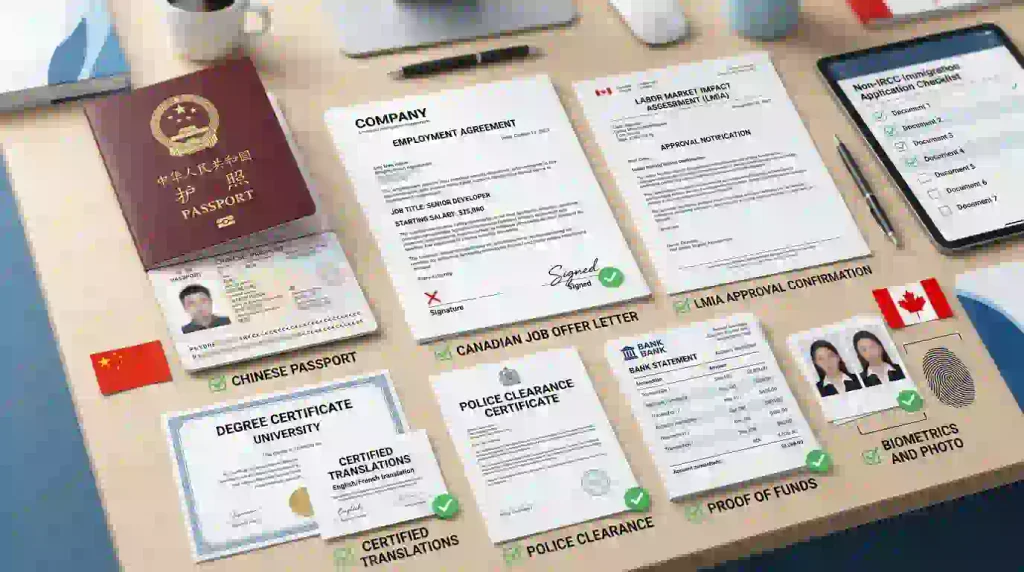
This is where most Canada Work Visa from China applications slow down. Chinese applicants typically need:
- A valid passport with at least 6 months validity beyond your planned stay
- Educational credential assessment (if applying through Express Entry alongside your work permit)
- Notarized translations of Chinese-language documents (birth certificate, marriage certificate, diplomas)
- Police clearance certificate from the Ministry of Public Security
- Proof of funds (bank statements from the past 4–6 months)
- Passport-sized photos meeting Canadian visa specifications
Since Chinese civil documents are issued in Mandarin, every document submitted with your Canada Work Visa from China application must include a certified English or French translation — this single step causes more delays than almost anything else in the process.
Step 4: Submit Your Application Online Through IRCC
Once your employer’s LMIA is approved (or your ICT/Global Talent Stream eligibility is confirmed), you’ll submit your Canada Work Visa from China application through the official IRCC work permit portal. Applicants from mainland China typically apply through the Visa Application Centre (VAC) in Beijing, Shanghai, or Guangzhou, which handles biometrics collection on Canada’s behalf.
Step 5: Give Your Biometrics
Almost all applicants seeking a Canada Work Visa from China must submit fingerprints and a photo at a designated VAC. This step is mandatory and cannot be skipped — appointments should be booked as early as possible since VACs in major Chinese cities often have multi-week waiting periods during peak season.
Step 6: Attend an Interview or Respond to Additional Document Requests (If Required)
Not every applicant is interviewed, but if the visa officer needs clarification about your job offer, funds, or ties to China, you may be asked to submit additional evidence. Responding quickly and accurately is critical — unanswered requests are one of the top reasons a Canada Work Visa from China gets refused.
Step 7: Wait for Processing and Visa Decision
Processing times fluctuate, but applicants from China should generally expect their Canada Work Visa to take longer than the published average due to added document verification. Track your file directly through your IRCC online account rather than relying on estimates from third parties.
Step 8: Enter Canada and Activate Your Work Permit
Once approved, you’ll receive a port of entry (POE) letter. Your actual work permit is issued when you arrive in Canada and present this letter, your passport, and your job offer to a Canada Border Services Agency officer.
Documents Checklist for a Canada Work Visa From China
| Document | Purpose | Notes for Chinese Applicants |
|---|---|---|
| Valid Passport | Identity and travel document | Must have 6+ months validity |
| Job Offer Letter | Proof of employment | Should match LMIA details exactly |
| LMIA Confirmation Number | Employer eligibility proof | Employer applies, not the worker |
| Educational Documents | Skill/qualification proof | Requires certified English translation |
| Police Clearance Certificate | Background check | Issued by local Public Security Bureau |
| Proof of Funds | Financial sufficiency | Bank statements, last 4-6 months |
| Biometrics Confirmation | Identity verification | Completed at VAC Beijing/Shanghai/Guangzhou |
Processing Time and Fees
Government processing fees for a Canada Work Visa from China typically include the work permit application fee, a biometrics fee, and — if applicable — an employer compliance fee paid separately by the hiring company. Processing time varies by visa office workload and season, so it’s worth checking the live processing time estimator on the IRCC website before finalizing travel or resignation plans with your current employer in China.
Common Mistakes Chinese Applicants Make When Applying
- Submitting untranslated documents — Any document not in English or French will delay your Canada Work Visa from China application immediately.
- Weak proof of funds — Bank statements that show sudden large deposits (rather than steady savings) often raise red flags with visa officers.
- Mismatched job details — If your job offer letter and LMIA application don’t match exactly (salary, job title, duties), your application can be refused.
- Ignoring dual intent concerns — Officers sometimes worry applicants won’t return to China if the visa is refused; showing genuine ties (property, family, ongoing obligations) helps.
- Applying without researching the employer — Some fraudulent Canadian “employers” target overseas applicants; always verify a company’s legitimacy through Canada’s official business registry before paying any fees.
Tips to Strengthen Your Canada Work Visa Application From China
- Apply for your LMIA-based job offer through verified platforms like Job Bank Canada rather than unofficial recruitment agencies.
- Keep all financial documents consistent and well-organized; visa officers reviewing a Canada Work Visa from China file often flag inconsistencies over amounts.
- Consider whether your long-term goal is permanent residency — if so, plan your <a href=”https://workercv.com/canada-work-visa-process/”>Canada work visa process</a> around occupations that also score well under Express Entry.
- Build a resume that matches Canadian hiring standards before you start applying for jobs — most Chinese CV formats look very different from what Canadian employers expect. A free tool like the <a href=”https://workercv.com/free-ats-resume-builder/”>ATS resume builder</a> can help format it correctly.
- Research realistic <a href=”https://workercv.com/average-salary-in-canada-2026/”>average salaries in Canada</a> for your occupation before accepting a job offer, so you know if the compensation actually supports your move.
What Happens After You Get Your Canada Work Visa From China
Once your Canada Work Visa from China is approved and you’ve landed, the real work begins — settling in, opening a bank account, applying for a Social Insurance Number (SIN), and understanding your rights as a temporary foreign worker. Many workers use their first year in Canada to explore additional job opportunities beyond their sponsoring employer, especially once they qualify for an open work permit or begin the transition toward permanent residency. If you’re still exploring your options before committing to one employer, it’s worth reviewing broader opportunities through a guide on <a href=”https://workercv.com/jobs-in-canada-for-foreigners-2026/”>how to get a job in Canada as a foreigner</a>, which covers additional entry points beyond LMIA-sponsored roles.
Final Thoughts
Getting a Canada Work Visa from China is achievable in 2026, but it rewards preparation over speed. Applicants who secure a genuine job offer, properly translate their documents, and understand which pathway fits their profile move through the Canada work visa process with far fewer delays. Whether you’re targeting an LMIA-based work permit or eventually permanent residency through Express Entry, the process is more transparent than ever — as long as you avoid common mistakes and make sure your job search strategy in Canada is just as prepared as your visa application.
Frequently Asked Questions
How long does it take to get a Canada Work Visa from China in 2026?
Processing times vary by visa office workload, but applicants from China should generally expect a longer timeline than the published average due to additional document verification and translation requirements. Checking the live IRCC processing time estimator before making travel plans is recommended.
Do I need a job offer before applying for a Canada Work Visa from China?
Yes, in most cases. The most common pathway, the LMIA-based work permit, requires a genuine job offer from a Canadian employer before you can apply. Some pathways, like Express Entry, don’t require a job offer but lead to permanent residency rather than a standard work permit.
What documents need to be translated for a Canada Work Visa application from China?
Any document issued in Mandarin — including birth certificates, marriage certificates, and diplomas — must include a certified English or French translation. Submitting untranslated documents is one of the most common reasons applications are delayed.
Can a Canada Work Visa from China lead to permanent residency?
Yes. Many work permit holders later apply for permanent residency through Express Entry or a Provincial Nominee Program, especially if their occupation qualifies under Canada’s skilled worker points system.
Where do Chinese applicants submit biometrics for a Canada Work Visa?
Applicants typically submit biometrics at a Visa Application Centre (VAC) in Beijing, Shanghai, or Guangzhou. Booking early is recommended since these centers often face multi-week waiting periods during peak application season.