
If you were planning to fly to Lisbon on a tourist stamp and hunt for a job once you landed, 2026 is the year that plan officially died. Portugal has rebuilt its immigration system around one idea: your legal route to work must be settled before you arrive. That single shift changes everything about how the Portugal Work Visa for Foreigners works today, and it is why so many older blog posts are now dangerously out of date.

This guide walks you through the current reality: which visas exist, who qualifies, what paperwork is needed, how long things take, and where applicants quietly lose months. Whether you are a nurse from Pakistan, a welder from India, a developer from Nigeria or a chef from the Philippines, the logic is the same.
Table of Contents
What Changed: The Rules Behind the Portugal Work Visa for Foreigners in 2026
Two developments shape every application right now.
First, immigration is handled by AIMA (Agência para a Integração, Migrações e Asilo), the agency that replaced the old SEF in 2023. You can find its official information on the AIMA website. Residence permits, renewals and family reunification all pass through this body.
Second, Law No. 61/2025, which took effect on 23 October 2025, tightened the Foreigners’ Law. The traditional job-seeker visa was discontinued, and the old habit of entering Portugal and regularising your status afterwards (the “manifestação de interesse” route) was effectively closed. A replacement visa for highly qualified job seekers was created, but at the time of writing it depends on implementing rules, so do not build a plan around it until your nearest consulate confirms it is accepting applications.
The practical result: the Portugal Work Visa for Foreigners is now overwhelmingly a contract-first system. You secure an employer, the employer’s paperwork is in order, and only then do you apply at a Portuguese consulate in your home country.
Who Needs a Work Visa, and Who Does Not
Citizens of the EU, EEA and Switzerland can live and work in Portugal without any visa. Everyone else, including people from Pakistan, India, Bangladesh, the Philippines, Nigeria, Brazil and the United States, needs permission before starting work.
Citizens of Portuguese-speaking countries (CPLP) used to enjoy easier access, but under the 2025 changes they must also obtain a residence visa before travelling. If you belong to this group, do not assume the old shortcuts still apply.
The Main Visa Routes at a Glance
Portugal offers several doors. The right one depends on how you earn your living.
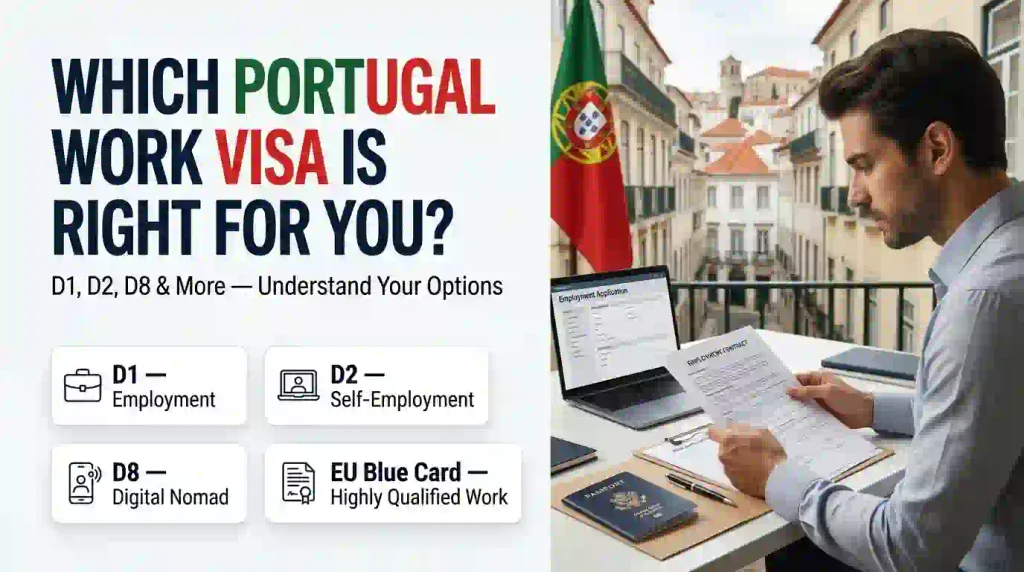
| Visa Route | Who It Is For | Key Requirement | Typical Starting Point |
|---|---|---|---|
| D1 – Subordinate Work | Employees with a Portuguese job offer or contract | Signed contract, compliant employer | Consulate in your home country |
| D2 – Self-Employment | Freelancers, contractors, entrepreneurs | Business plan or service contracts, proof of funds | Consulate, then AIMA |
| D8 – Digital Nomad | Remote workers paid by foreign companies | Stable remote income well above the Portuguese minimum wage | Consulate or temporary stay |
| EU Blue Card / Highly Qualified | Degree holders and specialists with high salaries | Higher salary threshold, recognised qualifications | Employer-led application |
| Temporary Stay / Seasonal | Agriculture, tourism, short projects | Contract for a limited period | Consulate |
For most readers searching for the Portugal Work Visa for Foreigners, the D1 route is the one that matters, so the rest of this guide concentrates on it while touching on alternatives where useful.
Salary and Contract Rules You Cannot Ignore
Portugal’s national minimum wage in 2026 is €920 per month (before deductions). A contract offering less than this will not survive scrutiny, and consulates and AIMA compare your contract against employer records and labour databases. A mismatch between what you submit and what the employer has declared is one of the most common reasons applications stall.
Your contract should clearly state:
- Your job title and a real description of duties
- Gross monthly salary and any allowances
- Start date and, if fixed-term, the end date
- The employer’s tax number and registered address
- Working hours and place of work
Be wary of vague “offer letters” with no legal weight. A serious Portugal Work Visa for Foreigners application is built on a proper employment contract or a binding promise of one.
Step-by-Step: How the Process Actually Works
Here is the sequence most successful applicants follow.
Step 1: Find an employer willing to hire from abroad. Use the EU’s EURES job portal and Portugal’s public employment service, IEFP, alongside private job boards. Sectors with chronic shortages include healthcare, construction, hospitality, logistics, agriculture and IT.
Step 2: Employer prepares the file. The employer must be properly registered, up to date with tax and social security, and able to show that the hiring complies with labour market rules. Some companies use accelerated “green lane” arrangements for recruiting foreign staff, which can shorten decision times, but this depends on the employer being enrolled.
Step 3: Gather your personal documents. More on this below, but start early. Police certificates and translations take longer than people expect.

Step 4: Book a consular appointment. Applications are made through the Portuguese consulate or its authorised visa centre. Check the official Portuguese visa portal for the correct form and current instructions for your country.
Step 5: Receive the visa and travel. A work residence visa lets you enter Portugal and then complete your residence permit. Treat the visa as an entry ticket, not the final status.
Step 6: Apply for your residence permit with AIMA. After arrival you must finalise the process, including biometrics. This is the document that truly gives you the right to live and work long-term.
Step 7: Register for the practical basics. Get your NIF (tax number) through the Portal das Finanças, your social security number via Segurança Social, and open a Portuguese bank account.
Documents Checklist for the Portugal Work Visa for Foreigners
Requirements vary slightly by consulate, so always confirm locally, but this table covers what is typically expected.
| Document | Notes |
|---|---|
| Valid passport | Usually must be valid well beyond your planned stay, with blank pages |
| Visa application form | Completed and signed |
| Passport photos | Recent, meeting ICAO standards |
| Employment contract or binding offer | Must match employer records |
| Criminal record certificate | From your country of residence, often legalised and translated |
| Proof of accommodation | Rental contract, employer-provided housing or host letter |
| Travel/health insurance | Valid for the initial period until you access the national health system |
| Proof of qualifications | Degrees or trade certificates, translated if required |
| Proof of means | Savings or employer support for the initial period |
| Fee payment receipt | Fees change, so check the current amount with the consulate |
A tip from experience: build your folder in the exact order the consulate lists, label every page, and keep both originals and clean copies. Reviewers move quickly, and a tidy file earns goodwill.
How Long Does It Take?
There is no single timeline. Consular decisions can take several weeks, sometimes longer in busy locations, while AIMA appointments after arrival have historically involved delays. Employers using fast-track mechanisms may see decisions in a matter of weeks, but you should plan for a total process of a few months from job offer to residence card in hand. Anyone promising guaranteed approval in 15 days is not being honest with you.
A residence permit linked to work is generally issued for an initial period and then renewed, provided you keep your employment conditions. Change jobs or lose your contract without informing the authorities and you risk your status. Under current reporting, long-term residents may apply for citizenship after about ten years of legal residence, subject to language and integration requirements, but nationality rules have been under political debate, so verify through official channels.
Costs You Should Budget For
Applicants often focus on the visa fee and forget everything around it. Realistic expenses include:
- Consular or visa-centre fees
- Document legalisation, apostilles and certified translations
- Medical or travel insurance
- Flights and first-month accommodation (often a deposit plus rent)
- Residence permit fees paid to AIMA
- A small reserve for the weeks before your first salary arrives
Never pay anyone who claims they can “buy” you a job contract or a guaranteed slot. Genuine employers pay recruitment costs themselves in most regulated situations.
Taxes, Social Security and Take-Home Pay
Once employed, you will pay Portuguese income tax (IRS) and social security contributions through payroll. The old NHR tax regime has been replaced by a narrower incentive scheme aimed at certain scientific and technology roles, so do not assume you will receive special treatment. For most workers the sensible approach is to look at your net salary, not the headline figure, and compare it with Lisbon and Porto rents, which have risen sharply. Smaller cities and regions often give a better quality of life on a modest income.
Bringing Family Along
Family reunification is now stricter than before. Spouses and partners generally need to be adults and legally recognised, and there are residence-time requirements in some cases, with exemptions for situations such as couples with minor or dependent children and highly qualified professionals. If your family plans matter to you, raise this at the start and confirm the current rules before accepting any offer, since this part of the law has shifted recently.
Mistakes That Sink Applications
After reviewing how this process typically fails, a handful of errors stand out:
- Relying on outdated blog posts. Anything describing the open job-seeker route or regularisation after arrival is obsolete.
- Arriving on a tourist visa to “sort it out later.” This is no longer a safe strategy and can leave you without status.
- Contract and records that do not match. Even small differences in salary or job title cause delays.
- Weak documents. Unclear scans, missing apostilles or untranslated papers get returned.
- Trusting unofficial agents. Verify any recruiter independently and insist on written contracts.
- Ignoring deadlines. Missing AIMA appointments or submission dates after arrival can cancel the progress you made.
Smart Ways to Strengthen Your Chances
You can improve your odds long before you apply. Tailor your CV to European standards, keep it concise and focused on measurable results, and prepare a short, honest cover message for each employer. If you want practical help with this, the career guides on WorkerCV.com cover CV writing and job-search preparation for international applicants. Learning basic Portuguese also sets you apart, since many employers value candidates who can communicate with colleagues and customers.
If you are comparing destinations, it helps to understand how Portugal fits with other options. You can explore broader migration and job-search advice in the immigration and work guides on WorkerCV, and if you are also considering other countries, the UK, Canada and Europe job guides give a useful side-by-side view. Before sending any application, run through the CV and career tips section to make sure your documents look professional.
Is the Portugal Work Visa for Foreigners Worth It in 2026?
For skilled and semi-skilled workers with a genuine job offer, yes, but with realistic expectations. Portugal offers a mild climate, a growing job market in several sectors, a relatively safe society and a pathway to long-term residence. On the other side, wages are lower than in much of Northern Europe, housing is expensive in major cities, and bureaucracy can be slow.
The winners are the people who treat the process like a project: they research the official rules, secure a legitimate employer, prepare documents carefully and keep a buffer of time and money. The Portugal Work Visa for Foreigners rewards preparation far more than speed.
Final Checklist Before You Apply
- Confirm your route (D1, D2, D8 or another) with the official consulate
- Secure a written contract that meets or exceeds the 2026 minimum wage
- Check that your employer is registered and compliant
- Order and translate your police certificate and qualifications early
- Arrange insurance and initial accommodation
- Book your consular appointment through official channels only
- Plan for your AIMA residence permit appointment after arrival
- Keep copies of everything and track every deadline
Immigration rules in Portugal continue to evolve, so confirm final details with the Portuguese consulate in your country and the official AIMA website before submitting anything. Handled carefully, the Portugal Work Visa for Foreigners can be the first step toward a stable career and a long-term life in Europe.
Sources: AIMA, Portuguese visa portal, IEFP, Segurança Social, Portal das Finanças, EURES
Frequently Asked Questions
Can I get a Portugal work visa without a job offer?
For most non-EU citizens, no. Since the October 2025 law changes, the old open job-seeker route has ended and a work visa is generally based on a signed employment contract. A new visa for highly qualified job seekers exists in law, but it depends on implementing rules, so confirm with your nearest Portuguese consulate whether it is open.
How long does it take to get a Portugal work visa?
Consular decisions can take several weeks, and the residence permit step with AIMA adds more time. Overall, plan for a few months from job offer to residence card. Employers using fast-track arrangements may see quicker decisions.
What is the minimum salary for a Portugal work visa in 2026?
Your contract must at least meet Portugal’s national minimum wage, which is €920 per month in 2026. Some routes, such as highly qualified or Blue Card applications, require higher salaries.
Can I bring my family with a Portugal work visa?
Yes, through family reunification, but the rules became stricter in 2025. Spouses and partners generally must be adults and legally recognised, and some cases have extra residence requirements with exemptions, for example for couples with minor children. Check current rules before you apply.
Can I apply for Portuguese citizenship after working there?
Possibly. Legal residents can apply after a qualifying period of residence, currently reported as around ten years, along with language and integration requirements. Nationality rules have been under political debate, so verify them with official sources before planning around them.