If you have ever dreamed of building a better life in Canada, you are not alone. Every year, hundreds of thousands of people from Pakistan, India, the Philippines, Nigeria, and dozens of other countries apply for a Canadian work visa. And in 2026, Canada is still one of the most welcoming countries in the world for skilled foreign workers.
But here is the truth — the process is not as simple as filling out a form and waiting. Canada’s immigration system has specific rules, categories, and requirements. If you miss even one step or submit the wrong document, your application can be delayed or refused.
This guide will walk you through the entire Canada Work Visa Process 2026 — from understanding the types of visas to submitting your application — in simple, clear steps that anyone can follow.

Table of Contents
What Is a Canada Work Visa?
A Canada work visa — officially called a Work Permit — is a legal document that allows a foreign national to work in Canada for a specific employer, in a specific job, for a specific period of time.
Without a valid work permit, you cannot legally work in Canada, even if a Canadian employer has already offered you a job.
In 2026, Canada issues two main types of work permits:
- Employer-Specific Work Permit — also called a Closed Work Permit
- Open Work Permit — allows you to work for almost any employer in Canada
Understanding which one applies to you is the very first step.
Types of Canada Work Visas in 2026
1. Employer-Specific (Closed) Work Permit
This is the most common type. It ties you to one specific employer. If you want to change your job or employer, you must apply for a new work permit.
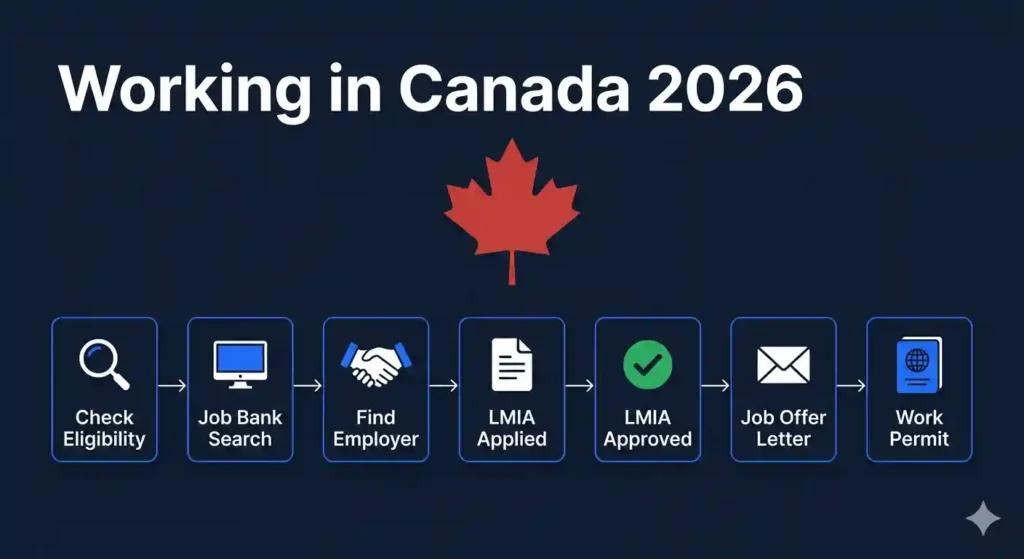
To get this permit, your employer usually needs to get an LMIA (Labour Market Impact Assessment) — a document that proves no Canadian citizen or permanent resident was available for that job.
2. Open Work Permit
An open work permit gives you the freedom to work for almost any employer in Canada. You do not need a job offer to apply for some open work permits.
Who can get an Open Work Permit in 2026?
- Spouses or partners of skilled workers already in Canada
- International students who have graduated from a Canadian institution (Post-Graduation Work Permit)
- Refugees and protected persons
- Applicants who have applied for permanent residence and are waiting for a decision
3. International Mobility Program (IMP) Work Permit
Under the IMP, certain workers do not need an LMIA. This includes workers covered under free trade agreements like CUSMA (formerly NAFTA), intra-company transferees, and workers in certain specialized fields like tech and healthcare.
4. Temporary Foreign Worker Program (TFWP)
This program is for workers whose employers have obtained an LMIA. In 2026, the Canadian government has made the TFWP slightly stricter for low-wage positions but has kept strong pathways open for high-skilled workers.
Who Is Eligible for a Canada Work Visa in 2026?
Before you apply, you must meet the basic eligibility requirements set by Immigration, Refugees and Citizenship Canada (IRCC). Here is what you generally need:
- A valid job offer from a Canadian employer (for most permit types)
- Proof that you will leave Canada when your permit expires (unless you apply for PR)
- Enough money to support yourself and your family during your stay
- No criminal record — a clean police clearance certificate
- Good health — you may need a medical exam
- Valid passport with at least 6 months of remaining validity
- Proof of language skills — English or French (IELTS or TEF in most cases)
One important point for 2026 — Canada has become stricter about proof of ties to your home country. Immigration officers want to see that you have strong reasons to return home after your work permit expires, such as family, property, or a job waiting for you back home.
Step-by-Step Canada Work Visa Process 2026
Now let us go through the exact steps you need to follow.
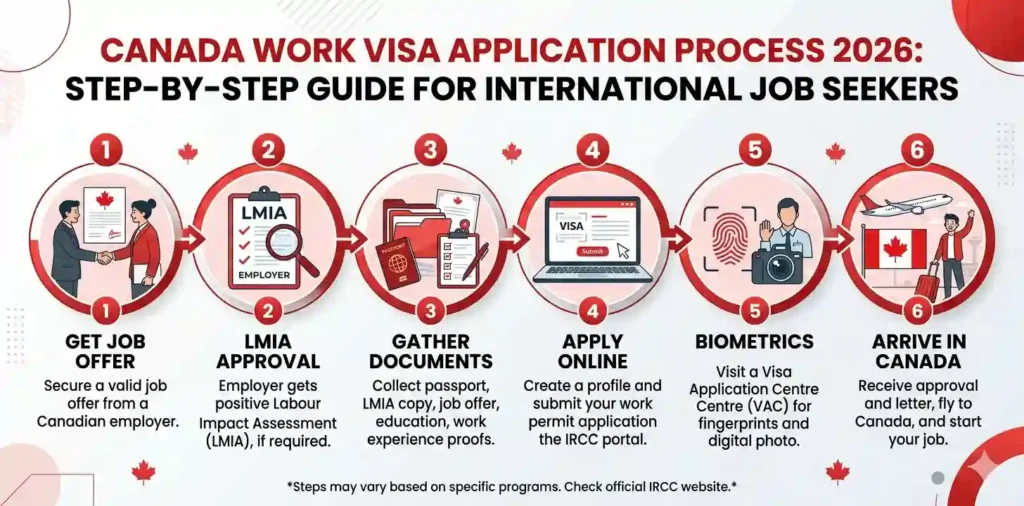
Step 1 — Get a Valid Job Offer from a Canadian Employer
For most work permit categories, the first thing you need is a genuine job offer from a Canadian employer. The employer must be legitimate and registered in Canada.
The best platforms to find Canadian job offers in 2026 are:
- Job Bank Canada — the official government job portal
- LinkedIn Canada — for professional and skilled roles
- Indeed Canada (ca.indeed.com) — for high-volume job listings across all provinces
When you receive a job offer, make sure it includes:
- Job title and description
- Salary and working hours
- Start date and contract duration
- Employer’s business number
Step 2 — Employer Gets LMIA (If Required)
If your job offer does not fall under the IMP or any LMIA-exempt category, your employer must apply for an LMIA from Employment and Social Development Canada (ESDC). This process can take 4 to 12 weeks depending on the job category and province.
A positive LMIA is essentially Canada saying — “Yes, this foreign worker is needed here.”
If your job falls under an LMIA-exempt category — such as a free trade agreement or intra-company transfer — you can skip this step entirely.
Step 3 — Gather Your Documents
This is one of the most important steps. A missing or incorrect document is the number one reason for delays and refusals. Here is a complete list of documents you will typically need:
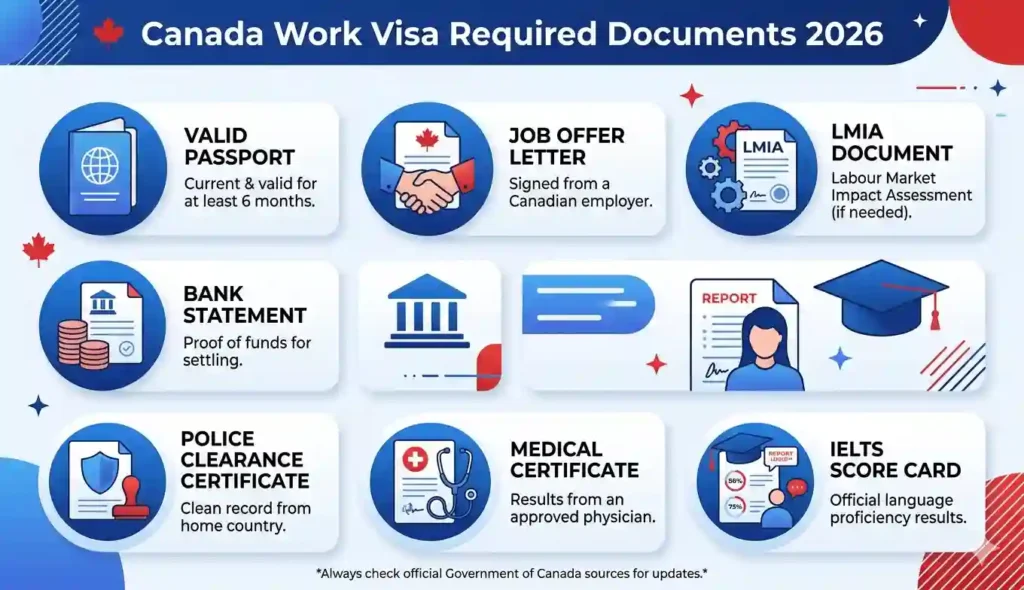
Personal Documents:
- Valid passport (minimum 6 months validity)
- Recent passport-size photographs
- Police Clearance Certificate (PCC) from every country you lived in for 6+ months
- Medical exam results (if required — done through a designated IRCC physician)
Job-Related Documents:
- Job offer letter from Canadian employer
- LMIA approval number (if applicable)
- Your updated CV or resume in Canadian format
- Educational certificates and transcripts
- Work experience letters from previous employers
Financial Documents:
- Bank statements showing sufficient funds
- Proof of assets (property, investments)
Language Proof:
- IELTS General Training results (minimum CLB 7 for most skilled roles)
- Or TEF/TCF results for French-speaking applicants
Step 4 — Create Your IRCC Online Account
All Canada work permit applications in 2026 are submitted online through the official IRCC Secure Account Portal. You will need to:
- Create a new account using your email
- Fill in the application form (IMM 1295 for work permits)
- Upload all required documents in the accepted formats (PDF, JPEG)
- Pay the application fee
Step 5 — Pay the Application Fees
As of 2026, the standard fees for a Canadian work permit are:
| Fee Type | Amount (CAD) |
|---|---|
| Work Permit Application Fee | $155 |
| Open Work Permit Holder Fee | $100 |
| Biometrics Fee (first time) | $85 |
These fees are non-refundable, so make sure your application is complete before you pay.
Step 6 — Submit Biometrics
If you are applying from outside Canada and it is your first time, you will need to provide biometrics — your fingerprints and a digital photo. After you pay the biometrics fee, you will receive a Biometric Instruction Letter (BIL). Take this letter to the nearest Visa Application Centre (VAC) in your country to have your biometrics collected.
Step 7 — Wait for Processing
Processing times for Canadian work permits vary depending on your country and the type of permit. As of 2026, typical processing times are:
| Application Type | Average Processing Time |
|---|---|
| Standard Work Permit (online) | 8 to 16 weeks |
| Global Talent Stream (Tech) | 2 weeks |
| CUSMA / Free Trade Agreement | 2 to 4 weeks |
| Post-Graduation Work Permit | 3 to 5 months |
You can check your application status anytime through your IRCC online account.
Step 8 — Receive Your Port of Entry (POE) Letter
If your application is approved, IRCC will send you a Port of Entry Letter of Introduction. This is not your actual work permit — it is the document you present to the Canada Border Services Agency (CBSA) officer when you arrive at the Canadian border or airport.
The officer will then issue your official work permit stamp in your passport.
Step 9 — Arrive in Canada and Start Working
Once you arrive in Canada and receive your work permit at the port of entry, you are legally allowed to begin working for your employer on the start date mentioned in your permit.
Make sure you:
- Carry all your original documents when entering Canada
- Keep a copy of your work permit safe at all times
- Understand the conditions of your permit — job, employer, location, and expiry date
How to Increase Your Chances of Approval
Getting a Canadian work permit in 2026 is competitive. Here are practical tips that genuinely improve your chances:
Have a complete and error-free application. Even a small spelling mistake on your form can cause delays. Double-check every field before submitting.
Apply early. Processing times can be unpredictable. Apply at least 3 to 4 months before your intended start date.
Use a Canadian-format CV. Your resume should be clean, ATS-friendly, with no photo, no date of birth, and focused on achievements rather than just duties.
Show strong ties to your home country. Provide evidence like property documents, family photos, or a letter from your current employer showing you have a job to return to.
Target LMIA-exempt categories. If your skills fall under tech, healthcare, or a free trade agreement, explore IMP pathways — they are faster and often easier.
Work with a regulated immigration consultant. If your case is complex, consider hiring a RCIC (Regulated Canadian Immigration Consultant) registered with the College of Immigration and Citizenship Consultants (CICC). Avoid illegal consultants who charge money upfront without credentials.
Common Mistakes to Avoid
Many applicants make the same avoidable mistakes. Here is what to watch out for:
Submitting incomplete documents — Always use the official IRCC document checklist for your specific permit type.
Choosing the wrong permit category — Applying under the wrong stream wastes time and money. Research your NOC TEER code carefully before applying.
Ignoring medical exam requirements — Some applicants forget that a medical exam is required for work permits longer than 6 months. Book your appointment with a designated IRCC physician early.
Not disclosing previous visa refusals — If you have been refused a visa to Canada or any other country before, you must declare it. Hiding this information is considered misrepresentation and can lead to a permanent ban.
Falling for immigration scams — In 2026, there are thousands of fake consultants and fraudulent job offers targeting foreign workers. Always verify any consultant on the CICC official website and any employer on the Canada Business Registry.
Final Thoughts
The Canada Work Visa Process 2026 is detailed, but it is absolutely manageable if you follow each step carefully and prepare your documents well. Canada is actively looking for skilled workers to fill gaps in healthcare, technology, construction, and transportation. If your skills match what Canada needs, your chances are genuinely good.
The most important thing is to be honest, be thorough, and be patient. Thousands of people successfully get their Canadian work permits every single month — and with the right preparation, you can be one of them.
Start by finding a legitimate job offer, understand which permit category applies to you, and then follow the steps in this guide one by one. Canada is waiting
Frequently Asked Questions
How long does it take to get a Canada work visa in 2026?
Processing times depend on the type of work permit and your country of application. A standard online work permit application typically takes 8 to 16 weeks. However, if you qualify for the Global Talent Stream (tech and highly skilled workers), your permit can be processed in as little as 2 weeks. Always apply at least 3 to 4 months before your planned start date to avoid delays.
Can I apply for a Canada work visa without a job offer in 2026?
Yes, in some cases. If you are applying for an Open Work Permit — for example, as a spouse of a skilled worker already in Canada, or as a recent graduate from a Canadian institution — you do not need a job offer. However, for most standard work permits under the Temporary Foreign Worker Program (TFWP), a valid job offer and LMIA from your employer is required.
How much money do I need to show for a Canada work visa application?
There is no fixed amount required specifically for a work permit application. However, immigration officers want to see that you can financially support yourself when you arrive. Most applicants show 3 to 6 months of bank statements with a healthy balance. If you already have a job offer with a confirmed salary, this significantly strengthens your application.
Can my family come with me on a Canada work visa in 2026?
Yes. If you have a valid Canadian work permit, your spouse or common-law partner may be eligible for an Open Work Permit, and your dependent children can apply for a study permit to attend school in Canada. You will need to include your family members in your application or apply separately for their permits at the same time.
What happens if my Canada work visa application is refused?
If your application is refused, IRCC will send you a refusal letter explaining the reasons. You have a few options. You can reapply with stronger documentation addressing the reasons for refusal. You can also request reconsideration if you believe a mistake was made. In some cases, you may be able to apply for a Judicial Review through the Federal Court of Canada. It is strongly recommended to consult a registered RCIC consultant before reapplying.