
Moving abroad for work is a big decision, and if the Netherlands is on your radar, you are not alone. Every year, thousands of skilled professionals from outside the European Union apply for a Netherlands Work Visa because the country offers strong salaries, excellent work-life balance, and one of the fastest visa processing systems in Europe. But between salary thresholds, sponsor requirements, and MVV rules, the process can feel confusing if you don’t know where to start. This guide breaks down everything you need to know about getting a Netherlands Work Visa in 2026, step by step, in plain language.

Table of Contents
Why the Netherlands Is a Top Choice for Foreign Workers
The Netherlands has built a reputation as one of the most welcoming countries in Europe for international talent. English is widely spoken, the economy is stable, and industries like IT, engineering, healthcare, finance, and logistics are actively looking for skilled foreign workers. If you are comparing options across Europe, you will notice that a Netherlands Work Visa is often easier to obtain than permits in many neighboring countries, mainly because the Dutch Immigration and Naturalisation Service (IND) has streamlined the sponsorship system for employers.
Compared to other popular routes — for example the Ireland Work Permit for Foreigners or the Portugal Job Seeker Visa — the Netherlands Work Visa process tends to move faster once you have a sponsoring employer lined up. This makes it especially attractive for professionals who already have a job offer in hand and simply need to understand the paperwork.
Types of Netherlands Work Visas You Should Know About
Before applying for a Netherlands Work Visa, it’s important to understand that “work visa” is actually an umbrella term. The Dutch system offers several distinct routes depending on your profession, salary, and circumstances.
1. Highly Skilled Migrant Visa (Kennismigrant)
This is the most popular type of Netherlands Work Visa, designed for professionals with a job offer from an IND-recognized sponsor. It does not require a labor market test, which means your employer does not need to prove that no EU candidate was available for the role. This is what makes this particular Netherlands Work Visa route so fast — the IND typically decides within two weeks once your application is complete.
2. EU Blue Card
The EU Blue Card is another route to a Netherlands Work Visa, aimed at highly qualified non-EU professionals. It carries similar salary requirements to the Highly Skilled Migrant permit but offers additional mobility benefits if you ever want to work in another EU country later.
3. Regular Work Permit (GVVA / TWV)
If your employer is not an IND-recognized sponsor, or your role does not meet the highly skilled migrant salary threshold, you may need a combined residence and work permit. This version of the Netherlands Work Visa does require a labor market test, meaning the employer must first advertise the position to EU/EEA candidates for at least five weeks.
4. Orientation Year Visa
Recent graduates from a Dutch university, or from a qualifying top-200 university abroad, can apply for a one-year Orientation Year permit. It’s not technically a Netherlands Work Visa on its own, but it lets you search for a job without a work permit, and afterward you can switch into a Highly Skilled Migrant Netherlands Work Visa at a reduced salary threshold.
5. Startup Visa
Entrepreneurs planning to launch an innovative business in the Netherlands can apply through the startup visa route, working alongside an approved mentor before eventually transitioning to a self-employed Netherlands Work Visa.
Netherlands Work Visa Salary Requirements for 2026
Salary thresholds are the single most important eligibility factor for most Netherlands Work Visa applications. The IND raises these figures every January to account for inflation, and 2026 brought an increase of roughly 4.46% compared to the previous year. Here’s what you need to know for a Netherlands Work Visa application in 2026:
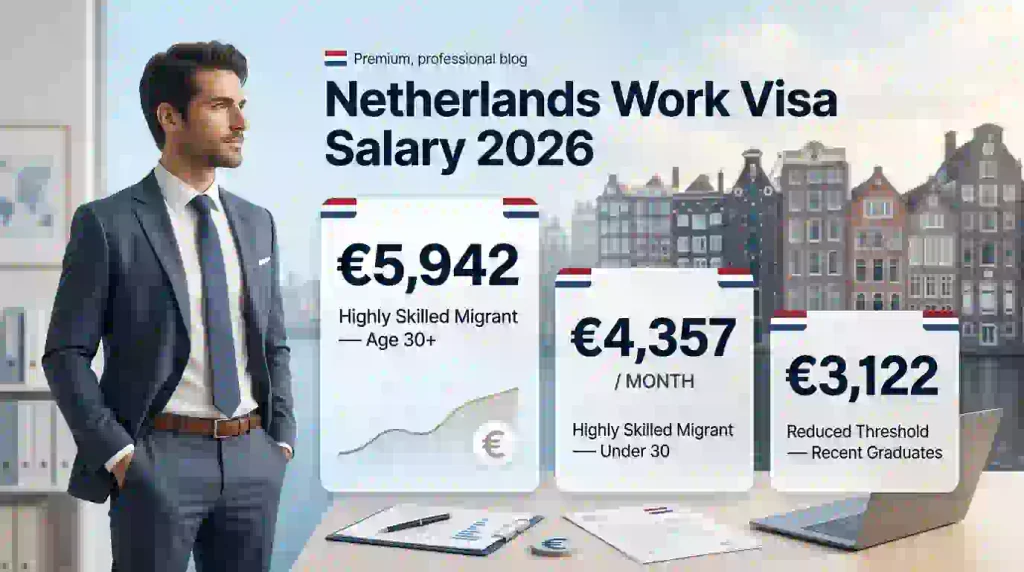
- Highly Skilled Migrant (age 30 and above): approximately €5,942 gross per month
- Highly Skilled Migrant (under age 30): approximately €4,357 gross per month
- Reduced threshold for recent graduates (Orientation Year switch): approximately €3,122 gross per month
- EU Blue Card: approximately €5,942 gross per month
These figures exclude the mandatory 8% holiday allowance that Dutch employers must add on top. If you are negotiating a job offer, make sure your employer builds the salary structure around these numbers, because falling even slightly below the threshold will get your Netherlands Work Visa application rejected outright.
Documents You Need for a Netherlands Work Visa
Every Netherlands Work Visa application requires a specific set of documents, and missing even one can delay your case by weeks. Generally, you will need:
- A valid passport with at least six months remaining validity
- A signed employment contract from your Dutch sponsor
- Proof that your employer is an IND-recognized sponsor
- Educational certificates and, where relevant, degree verification
- A recent passport-style photograph meeting Dutch biometric standards
- Proof of relevant work experience (for certain visa categories)
- A completed application form submitted by the employer, not the applicant directly
One important detail many first-time applicants miss: for the Highly Skilled Migrant route, you cannot apply for the Netherlands Work Visa yourself. Your sponsoring employer submits the application on your behalf directly to the IND.
Step-by-Step Netherlands Work Visa Application Process
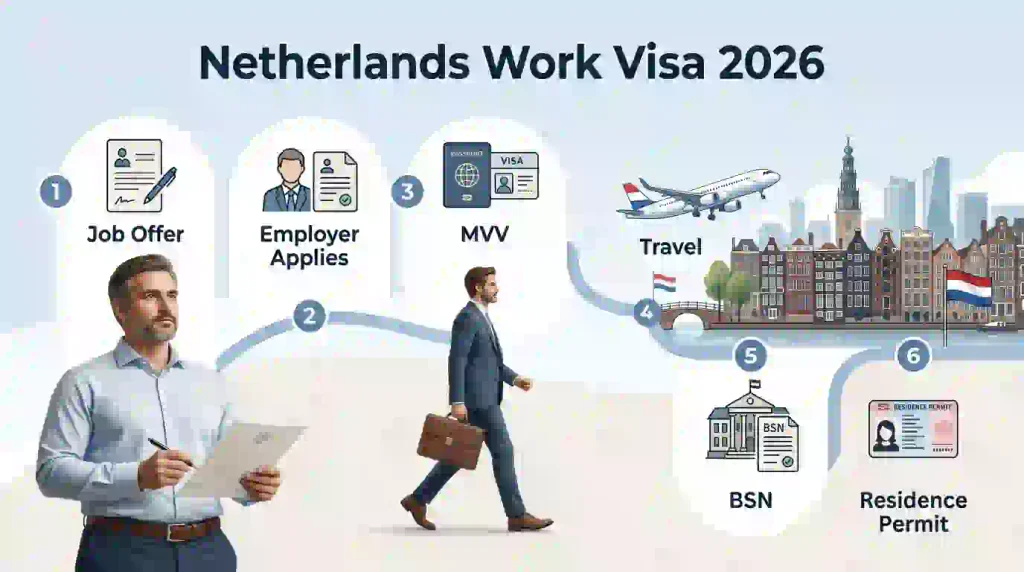
Step 1: Secure a Job Offer from a Recognized Sponsor
Before anything else, you need a job offer from a company registered as an IND-recognized sponsor. You can actually check the IND’s public register of recognized sponsors before accepting an offer, so you know your Netherlands Work Visa application will be handled by an eligible employer.
Step 2: Employer Submits the Combined Application
Your employer files the application for your residence permit (and MVV provisional visa, if your nationality requires one) directly with the IND. This is where the Highly Skilled Migrant route becomes a genuine Netherlands Work Visa fast-track, since the IND aims to issue a decision within two weeks of receiving a complete file.
Step 3: Collect Your MVV (If Required)
If you come from a country that requires an MVV entry visa, you’ll need to collect it from a Dutch embassy or consulate abroad after approval. As of April 2026, the IND removed the extra MVV issuance form that used to slow this step down, so the process is now noticeably smoother than it was previously.
Step 4: Travel to the Netherlands
Once your MVV is issued, you can travel to the Netherlands. You typically have a limited window to enter the country after visa issuance, so plan your travel dates carefully.
Step 5: Register with the Municipality
Within days of arriving, you must register with your local municipality (gemeente) and receive your BSN (citizen service number). You cannot open a Dutch bank account, get paid, or access healthcare without this step.
Step 6: Collect Your Residence Permit Card
Finally, you’ll pick up your physical residence document, which confirms your Netherlands Work Visa status and work authorization.
Netherlands Work Visa Processing Time and Fees
One of the biggest advantages of the Netherlands Work Visa system compared to other European countries is speed. The Highly Skilled Migrant application is typically processed within two weeks, while other categories can take up to 90 days. As for costs in 2026:
- Highly Skilled Migrant / EU Blue Card / combined permit application fee: approximately €423
- Orientation Year or seasonal labor permit fee: approximately €254
- Becoming a recognized sponsor (paid by the employer, not the applicant): €5,080, or €2,539 for smaller or newer companies
Since applicants are not responsible for sponsor registration fees, the actual out-of-pocket cost of a Netherlands Work Visa for the individual worker is relatively low compared to countries like Canada, where the Canada Work Visa process can involve significantly higher combined fees.
The 30% Ruling: A Major Financial Perk
If you qualify for a Netherlands Work Visa as a Highly Skilled Migrant, you may also be eligible for the 30% ruling — one of the most attractive tax benefits in Europe. Under this scheme, your employer can pay up to 30% of your gross salary as a tax-free allowance for a period of years, which substantially increases your net take-home pay. Not everyone automatically qualifies, so it’s worth discussing this with your employer’s HR or payroll team as soon as your Netherlands Work Visa is approved, since the application for the ruling has its own separate deadline.
Bringing Your Family Along
A Netherlands Work Visa holder under the Highly Skilled Migrant or Blue Card route can generally bring a spouse and minor children through family reunification. Partners are typically allowed to work in the Netherlands without needing a separate work permit, which makes relocating as a family much simpler than in many other countries. Processing for dependent applications usually takes two to three months and requires documents like a legalized marriage certificate and proof of stable housing.
Path to Permanent Residency and Citizenship
Holding a Netherlands Work Visa is usually just the first stage. After five years of continuous legal residence, most Highly Skilled Migrants become eligible to apply for Dutch permanent residency. Citizenship can be possible in as little as three to seven years, depending on integration requirements and Dutch language proficiency. This long-term pathway is one of the reasons professionals choose a Netherlands Work Visa over shorter-term options in other countries.
Common Mistakes to Avoid
Many Netherlands Work Visa applications get delayed or rejected because of avoidable errors:
- Accepting a job offer without confirming the employer is an IND-recognized sponsor
- Signing a contract with a salary just under the required threshold
- Assuming the applicant can submit the visa application personally
- Forgetting to register with the municipality within the required window after arrival
- Not building an internationally formatted resume before applying, which can slow down the job search stage entirely — using a free ATS resume builder before you start applying can help your application actually reach Dutch hiring managers
Avoiding these mistakes can save you months of back-and-forth with the IND and your employer’s HR department.
Final Thoughts
A Netherlands Work Visa remains one of the most efficient and financially rewarding ways for skilled foreign professionals to build a career in Europe. With fast processing times, a clear salary-based eligibility system, and benefits like the 30% ruling and family reunification, it’s easy to see why so many professionals from the UK, USA, Canada, and beyond are choosing the Netherlands. If you already have the right qualifications and a job offer from a recognized sponsor, your Netherlands Work Visa could be approved faster than almost anywhere else in Europe — so make sure your documents, resume, and employer paperwork are ready before you begin.
Official Resources:
How long does it take to get a Netherlands Work Visa in 2026?
If you’re applying through the Highly Skilled Migrant route with an IND-recognized sponsor, the IND typically decides within two weeks of receiving a complete application. Other permit categories, like the regular work permit, can take up to 90 days.
Can I apply for a Netherlands Work Visa without a job offer?
No, not for the standard employer-sponsored routes. However, recent graduates from qualifying universities can apply for the Orientation Year Visa, which allows a year of job searching without needing a work permit first.
What is the minimum salary for a Netherlands Work Visa in 2026?
For the Highly Skilled Migrant permit, the minimum gross monthly salary is approximately €5,942 for applicants aged 30 and above, and €4,357 for those under 30, excluding the 8% holiday allowance.
Can my family join me on a Netherlands Work Visa?
Yes. Highly Skilled Migrants and EU Blue Card holders can generally bring a spouse and minor children through family reunification, and partners are usually allowed to work without needing a separate permit.
Do I need to speak Dutch to get a Netherlands Work Visa?
No, Dutch language skills are not required to obtain the visa itself. Most sponsoring companies operate in English, though basic Dutch may help with long-term integration and citizenship applications later on.