If you have been searching for the Portugal Job Seeker Visa, you have probably noticed that the information online is confusing right now — and there is a good reason for that. Portugal’s immigration rules changed in a major way in October 2025, and as of mid-2026, the situation around this visa is still evolving. This guide breaks down exactly where things stand, who will qualify once the route reopens, what documents you should start preparing, and what alternatives exist if you need to move faster.
Whether you are a software developer in Lahore, a nurse in Manila, or an engineer in Karachi dreaming of a life in Lisbon or Porto, this article gives you the real, updated picture of the Portugal Job Seeker Visa — without the recycled misinformation floating around other blogs.
Table of Contents
What Is the Portugal Job Seeker Visa?
The Portugal Job Seeker Visa is a national Type D visa that allows citizens of non-EU, non-EEA countries to travel to Portugal and search for a job on the ground, instead of needing a signed contract before they arrive. It was originally introduced in October 2022 as part of Portugal’s push to fill labour shortages and attract international talent to sectors like technology, healthcare, engineering, and hospitality.
Unlike a standard work visa that requires an employer to sponsor you from day one, the Portugal Job Seeker Visa flips the process: you enter the country first, attend interviews, meet employers face-to-face, and only then convert your status into a full work and residence permit once you land a job.
Important Update: What Changed in 2025–2026
This is the part most other articles about the Portugal Job Seeker Visa get wrong or leave out entirely, so pay close attention.
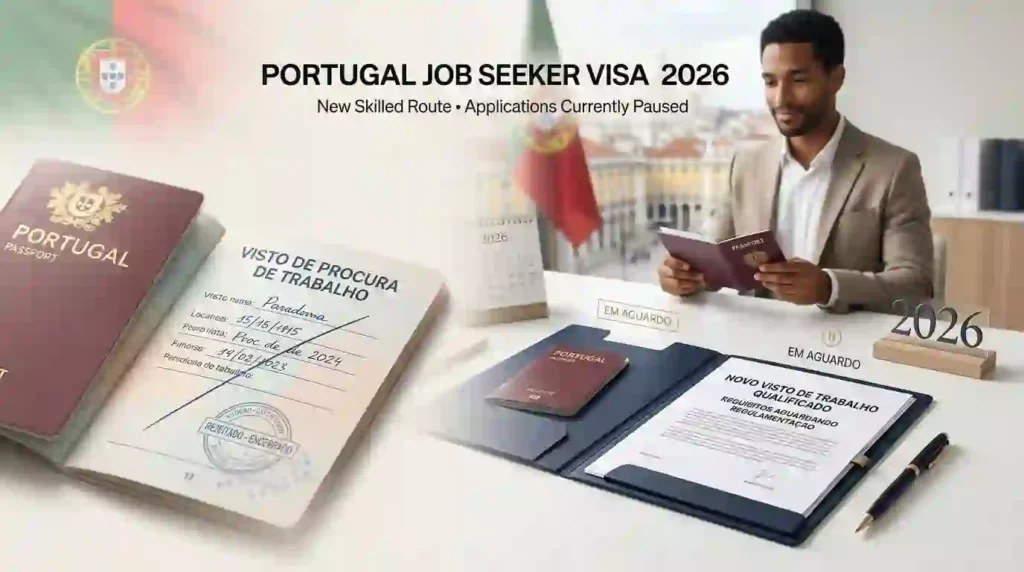
On 22 October 2025, Portugal published Law No. 61/2025 in its Official Gazette, amending Article 57-A of the Foreigners’ Law. From 23 October 2025 onward, Portuguese consulates and visa application centres (VFS Global, BLS International, and TLScontact) stopped accepting applications under the old Portugal Job Seeker Visa category. Every appointment booked after that date was cancelled.
The law did not remove the concept of a job-seeking visa — it replaced it with a new, more selective category called the Skilled Job Seeker Visa (still governed by Article 57-A). On paper, this new Portugal Job Seeker Visa is meant to be reserved for applicants with a recognised university degree or strong professional experience in occupations facing genuine shortages, such as IT, engineering, healthcare, and life sciences.
The catch: the new visa needs an implementing regulation (a joint ministerial ordinance, or “Portaria”) that spells out exactly which professions qualify, what documents are needed, and how consulates should process applications. As of the time of writing, that regulation has still not been published, and Portugal’s official visa portal continues to state that the skilled route is not yet available at consular offices. In practical terms, this means no embassy or visa centre anywhere in the world is currently accepting a fresh Portugal Job Seeker Visa application — even though the visa exists in law.
If you are researching the Portugal Job Seeker Visa today, the smartest move is to prepare your eligibility and documents in advance so you can apply the moment the route opens, rather than waiting until the announcement and then starting from zero.
Who Will Qualify for the Portugal Job Seeker Visa
Based on the text of Article 57-A and the reforms under Law No. 61/2025, here is who is expected to be eligible once applications reopen:
- Nationality: You must be a citizen of a country outside the European Union, the European Economic Area, and Switzerland.
- Education or experience: You need a recognised higher-education degree (at minimum a bachelor’s), or you must be able to demonstrate equivalent professional competence through certifications and substantial work experience in a designated shortage occupation.
- Shortage occupation list: Your profession must appear on the official list of eligible skilled roles, expected to cover technology, engineering, healthcare, life sciences, and select creative and technical industries.
- Clean criminal record: A criminal record certificate from your home country (and any country you’ve lived in for an extended period) is mandatory.
- Registration intent: Applicants are expected to register, or show willingness to register, with IEFP (Instituto do Emprego e Formação Profissional), Portugal’s national employment service.
These criteria mean the new Portugal Job Seeker Visa is noticeably narrower than the old, more open version. Casual applicants without a degree or verifiable skilled experience are unlikely to qualify once the door reopens.
Financial Requirements
Money proof is one of the strictest parts of any Portugal Job Seeker Visa application. You will typically need to show:
- Savings equal to roughly three times Portugal’s national minimum wage for the length of your stay — commonly cited as being in the range of €2,700 to €3,300, depending on the year’s minimum wage figure.
- Alternatively, a formal sponsorship letter from a legal resident of Portugal, along with proof that the sponsor earns enough to support you.
- A bank statement history (usually the last three to six months) showing the funds are genuinely yours and not a last-minute deposit.
Immigration officers scrutinise financial documents closely, so it is worth building this savings history early rather than scrambling right before your interview.
Documents You Will Likely Need
While the final document checklist depends on the pending regulation, based on the law and past practice, expect to prepare:
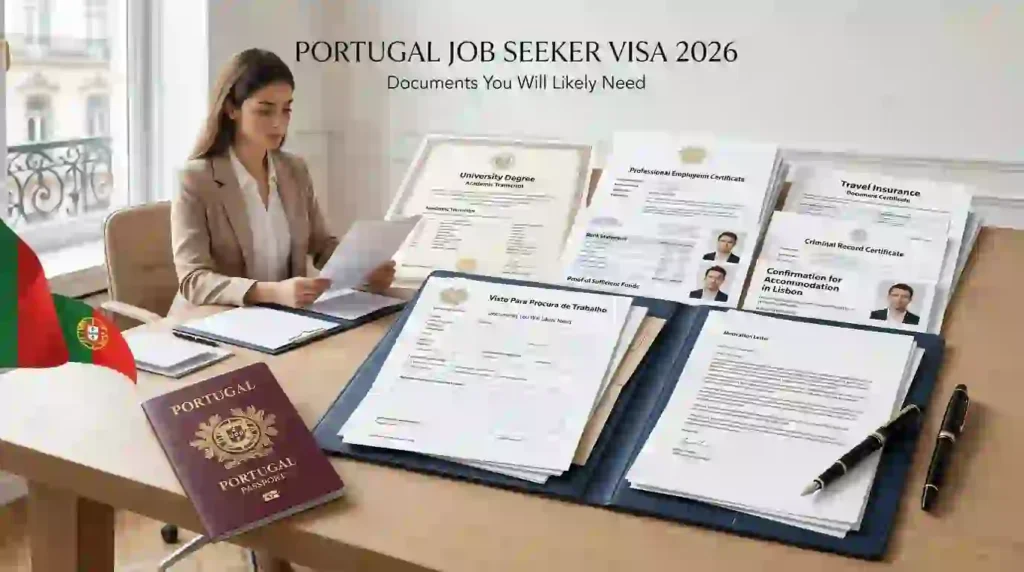
- A completed national visa application form
- A valid passport with at least 90 days of validity beyond your intended stay
- Proof of academic qualifications (degree certificates, transcripts, and their certified translations)
- Proof of relevant work experience where a degree isn’t the primary qualifying factor
- Bank statements or a sponsorship letter showing financial means
- Valid travel/health insurance covering the full duration of your stay in Portugal
- Criminal record certificate, apostilled or legalised as required
- Passport-sized photographs meeting Portuguese visa photo standards
- Proof of accommodation in Portugal for at least the initial period
- A motivation letter outlining your career background and job-search plan
Getting your documents translated, apostilled, and formatted correctly is one of the most common reasons Portugal Job Seeker Visa applications get delayed or rejected, so start this process well ahead of time.
Step-by-Step: How the Application Process Will Work
Once consulates begin accepting applications again, the Portugal Job Seeker Visa process is expected to follow this general path:
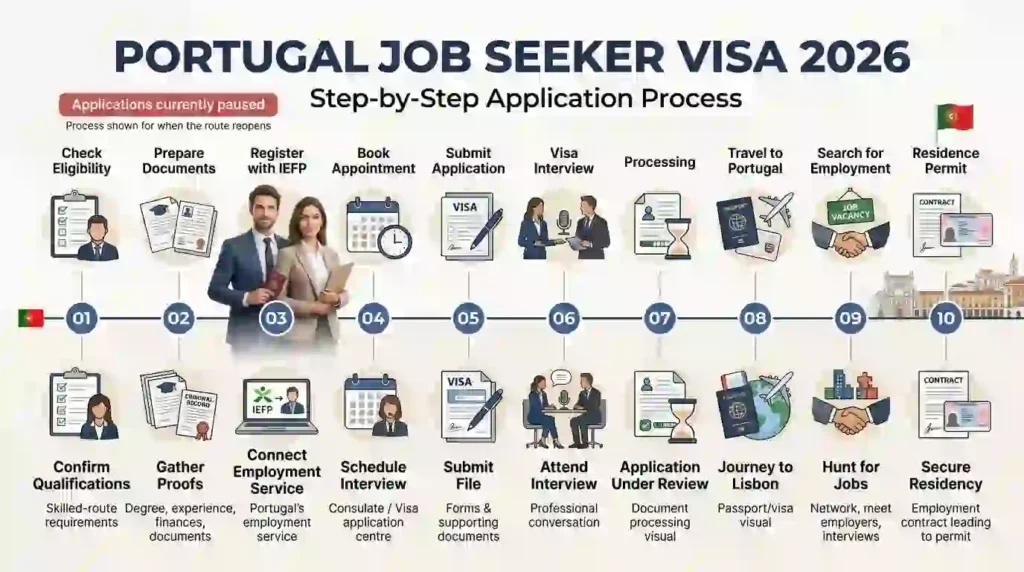
- Confirm eligibility against the published shortage occupation list and check that your profession qualifies.
- Gather and legalise documents — degree certificates, criminal record checks, and financial proof, translated into Portuguese where required.
- Register your interest with IEFP, Portugal’s employment service, as part of the pre-application screening.
- Book an appointment at your nearest Portuguese consulate or an authorised visa application centre.
- Submit your application along with the visa fee and supporting documents.
- Attend a visa interview, if required, and answer questions about your intended job search and finances.
- Wait for processing, which historically took anywhere from 30 to 90 days for the older version of the visa.
- Travel to Portugal once your visa is approved, and register your address within the required timeframe.
- Search for employment, network with employers, and attend interviews during your stay.
- Convert to a residence permit through AIMA (Agência para a Integração, Migrações e Asilo) once you secure a signed job contract.
How Long Can You Stay?
Under the previous framework, the Portugal Job Seeker Visa granted an initial stay of 120 days, with the option of a 60-day extension — giving applicants up to 180 days total to find work. Early indications suggest the new skilled version will keep a similar structure, though the exact figures will only be confirmed once the implementing regulation is published. If you don’t secure a job offer and apply for a residence permit within the allowed window, you are generally required to leave Portugal and cannot reapply for the same visa type for a set period, usually around one year.
What Happens After You Land a Job
This is where the Portugal Job Seeker Visa becomes genuinely powerful compared to other European work-entry routes. Once you sign an employment contract, you don’t need to leave Portugal to switch status. Instead, you book an appointment with AIMA and convert your visa into a full work and residence permit while remaining in the country. From there, time spent in Portugal — including the job-seeking period — generally counts toward the country’s long-term residency and citizenship timelines, which is a major advantage compared to countries that require you to restart your clock after switching visa categories.
Alternatives While You Wait
Since the Portugal Job Seeker Visa is currently paused pending regulation, it’s worth knowing your other options if you need to move sooner:
- EU Blue Card: For highly qualified professionals with a confirmed job offer and a minimum salary threshold.
- D3 Highly Qualified Activity Visa: Requires a signed contract with a Portuguese employer before you apply.
- D2 Entrepreneur Visa: For those planning to start or invest in a business in Portugal.
- D8 Digital Nomad Visa: For remote workers employed by a company outside Portugal.
None of these fully replace the flexibility of the Portugal Job Seeker Visa, but they can get you into the country legally while the skilled route remains on hold.
Tips for a Stronger Application
- Start your document collection now. Apostilles and certified translations take weeks, not days.
- Build a targeted, ATS-friendly resume. Portuguese employers, like most of Europe, increasingly use applicant tracking systems to filter candidates before a human ever sees your CV. You can use WorkerCV’s free ATS resume builder to create a clean, professional resume that passes these filters.
- Track the profession shortage list closely once it’s published — your eligibility for the Portugal Job Seeker Visa hinges entirely on where your role falls.
- Network before you travel. LinkedIn outreach to Portuguese companies in your field can put you ahead of other applicants once you land.
- Check WorkerCV’s Work Visa section regularly for updated guides as Portugal’s regulation develops, alongside our broader Jobs category for country-specific hiring guides.
Final Thoughts
The Portugal Job Seeker Visa remains one of the most attractive routes into Europe for skilled non-EU professionals — but 2026 has been a transition year. The old, broader version is gone, and the new, more selective Skilled Job Seeker Visa is legally in place but administratively paused until the government publishes its implementing regulation. The smartest approach right now is preparation: confirm you meet the education and experience bar, build your savings proof, get your documents translated and legalised, and keep a close eye on Portugal’s official visa portal for the announcement.
When the Portugal Job Seeker Visa does reopen, applicants who are already document-ready will move through the process far faster than those starting cold — so use this waiting period to your advantage.
Frequently Asked Questions
Is the Portugal Job Seeker Visa still open in 2026?
No. The original Portugal Job Seeker Visa stopped accepting applications on 23 October 2025. It was replaced by a new Skilled Job Seeker Visa under Article 57-A, which legally exists but is still waiting for its implementing regulation before consulates can accept applications.
How long can you stay in Portugal on a Job Seeker Visa?
The visa typically allows an initial stay of 120 days, with a possible 60-day extension — giving applicants up to 180 days total to secure a job offer and convert to a residence permit.
Do you need a degree to qualify for the Portugal Job Seeker Visa?
Generally yes. You need a recognised higher-education degree, or you must show equivalent professional experience and certifications in a designated shortage occupation such as IT, engineering, or healthcare.
How much money do you need to show for the Portugal Job Seeker Visa?
You typically need savings equal to about three times Portugal’s national minimum wage, or a sponsorship letter from a Portugal-based resident with proof of sufficient income.
What happens if you don’t find a job during the visa period?
If you don’t secure employment and apply for a residence permit within the allowed window, you must leave Portugal and generally cannot reapply for the same visa type for around one year.