Looking for a job in Canada can feel like a full-time job in itself. Between updating your resume, researching companies, and figuring out visa sponsorship, one document often gets rushed at the last minute: the cover letter. That’s a mistake. A well-written cover letter is often the difference between your application landing in the “interview” pile or getting buried under hundreds of others.
If you’re applying for jobs in Canada in 2026, whether you’re a local candidate or an immigrant navigating the job market from abroad, this guide will walk you through exactly how to write a cover letter that Canadian employers actually want to read. You’ll also get a free, ready-to-use template at the end. How to Write a Cover Letter for Canada Jobs
Table of Contents
Why a Cover Letter Still Matters in 2026
Some job seekers assume cover letters are outdated, especially with applicant tracking systems (ATS) scanning resumes automatically. That assumption is wrong, particularly in the Canadian job market.
Canadian employers, especially small and mid-sized businesses, still read cover letters closely. According to guidance published by the Government of Canada’s Job Bank, a strong cover letter helps employers understand not just what you’ve done, but why you want this specific role and how you’ll fit into their workplace. Unlike a resume, which lists facts, a cover letter tells a story. It’s your chance to explain gaps in your work history, highlight a career change, or show enthusiasm that a bullet-pointed resume simply can’t convey.
If you’re an international applicant trying to break into the Canadian market, your cover letter carries even more weight. It’s often the first place you can address questions employers may have, such as your current location, your eligibility to work in Canada, or your understanding of Canadian workplace culture.
If you haven’t sorted out your work eligibility yet, it’s worth reading our guide on Canada’s Job Offer and LMIA Process before you start applying, so you know exactly what employers will expect from you.
What Canadian Employers Look For in a Cover Letter
Before jumping into the structure, it helps to understand what actually gets a Canadian hiring manager’s attention. Based on common hiring practices across Canadian industries, here’s what stands out:
Localization. Employers can immediately tell when a cover letter has been copy-pasted for multiple countries. Mentioning the company by name, referencing something specific about their business, and using Canadian spelling (colour, organize as “organise” is UK style, not Canadian) all signal genuine interest.
Directness with warmth. Canadian business writing tends to be polite but efficient. Long, flowery introductions are less effective than a clear, warm opening that gets to the point quickly.
Evidence, not claims. Saying “I am a hard worker” means nothing without proof. Canadian employers respond much better to short, specific examples: numbers, outcomes, and results.
Cultural fit signals. Many Canadian workplaces value teamwork, adaptability, and diversity. If you can naturally show these qualities through an example, it strengthens your application significantly.
The Ideal Cover Letter Structure for Canada
A Canadian cover letter typically fits on one page and follows a clear structure. Here’s how to break it down.
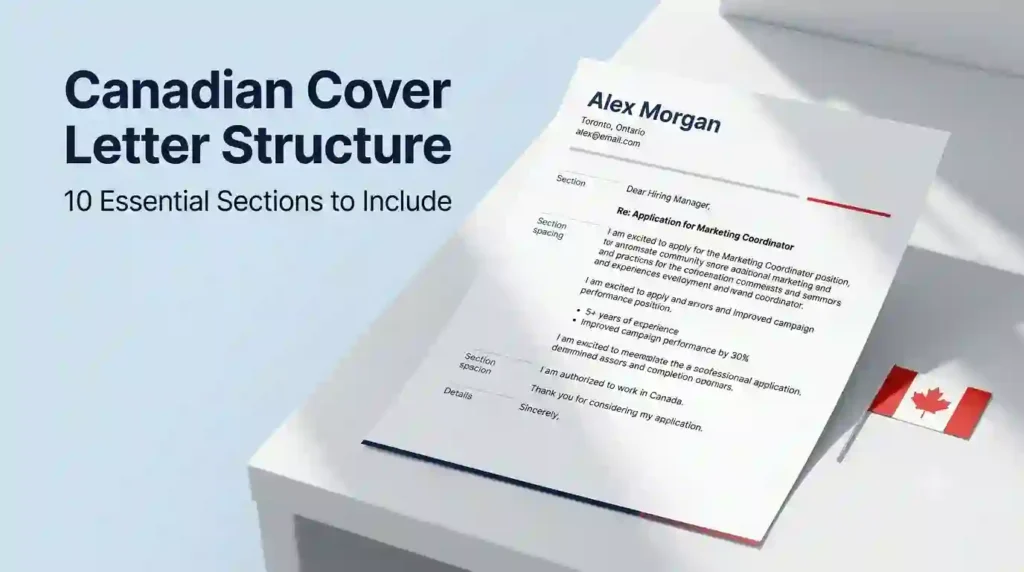
1. Header and Contact Information
Start with your name, phone number, email, and location (city and province, or country if applying from abroad) at the top. If you have a LinkedIn profile, include it too, since many Canadian recruiters check it before responding.
2. A Personalized Greeting
Avoid “To Whom It May Concern.” If the job posting doesn’t list a hiring manager’s name, check the company website or their LinkedIn page. A greeting like “Dear Hiring Manager” is acceptable as a backup, but a real name always performs better.
3. A Strong Opening Paragraph
This is the most important part of the letter. You have about three seconds to hook the reader. Instead of starting with “I am writing to apply for the position of…”, try opening with a specific achievement or a genuine connection to the company.
For example: “When I saw that Maple Leaf Logistics was expanding its Toronto distribution centre, I knew my five years of supply chain experience in high-volume warehouses could help support that growth.”
4. The Body: Show, Don’t Tell
This section, usually one or two paragraphs, is where you connect your experience directly to the job description. Pick two or three requirements from the job posting and address them with real examples.
Instead of writing “I have strong communication skills,” write something like: “In my previous role, I trained six new team members on our inventory system, reducing onboarding time by 30%.”
If you’re new to Canada and don’t yet have Canadian work experience, don’t hide it. Instead, focus on transferable skills and be upfront about your work authorization status. Something like: “I recently relocated to Canada under the Federal Skilled Worker Program and hold full authorization to work in Ontario” removes any ambiguity for the employer right away.
5. Closing Paragraph
End with confidence, not desperation. Reiterate your interest, mention your enthusiasm for a conversation, and thank the reader for their time. Avoid generic lines like “I hope to hear from you soon.” Instead, try: “I’d welcome the chance to discuss how my background in retail management can support your team’s goals for this season.”
6. Sign-Off
Use “Sincerely” or “Best regards,” followed by your full name.
Common Mistakes Canadian Employers Notice Immediately
Even strong candidates lose opportunities because of small, avoidable errors. Here are the most common ones seen in cover letters submitted to Canadian companies:
- Using US spelling in a Canadian application. Canada generally follows British-influenced spelling (favour, centre, organise/organize is flexible, but “colour” and “cheque” are standard). Small inconsistencies suggest a lack of attention to detail.
- Repeating the resume word-for-word. The cover letter should add context, not duplicate your resume.
- Overly long letters. Stick to 300–400 words. Hiring managers often review dozens of applications in one sitting.
- Ignoring the job posting’s specific language. If the posting emphasizes “customer-first culture,” and your letter never mentions customer service, it signals you didn’t read carefully.
- Forgetting to mention work eligibility. For newcomers to Canada, this is one of the most overlooked details, and one of the most important.
Free Cover Letter Template for Canada Jobs
Here’s a simple, adaptable template you can customize for any Canadian job application:
[Your Full Name]
[City, Province] | [Phone Number] | [Email Address] | [LinkedIn URL]
[Date]
[Hiring Manager’s Name]
[Company Name]
[Company Address, if known]
Dear [Hiring Manager’s Name],
When I saw [Company Name]’s posting for [Job Title], I was excited to apply because [specific reason tied to the company or role]. With [X years] of experience in [your field/industry], I’ve developed strong skills in [key skill relevant to the job] that I believe would add real value to your team.
In my most recent role at [Previous Company], I [specific achievement with a number or result, e.g., “managed a team of 8 and improved order accuracy by 20%”]. I also [second relevant achievement or skill], which directly aligns with the requirements outlined in your job posting.
[If applicable: I recently moved to Canada and hold full authorization to work in [Province]. I’m eager to bring my background in [industry] to the Canadian job market and contribute to [Company Name]’s continued growth.]
I’d welcome the opportunity to discuss how my experience in [industry/skill] can support [Company Name]’s goals for [team/department/project]. Thank you for considering my application, and I look forward to the possibility of speaking with you.
Sincerely,
[Your Full Name]
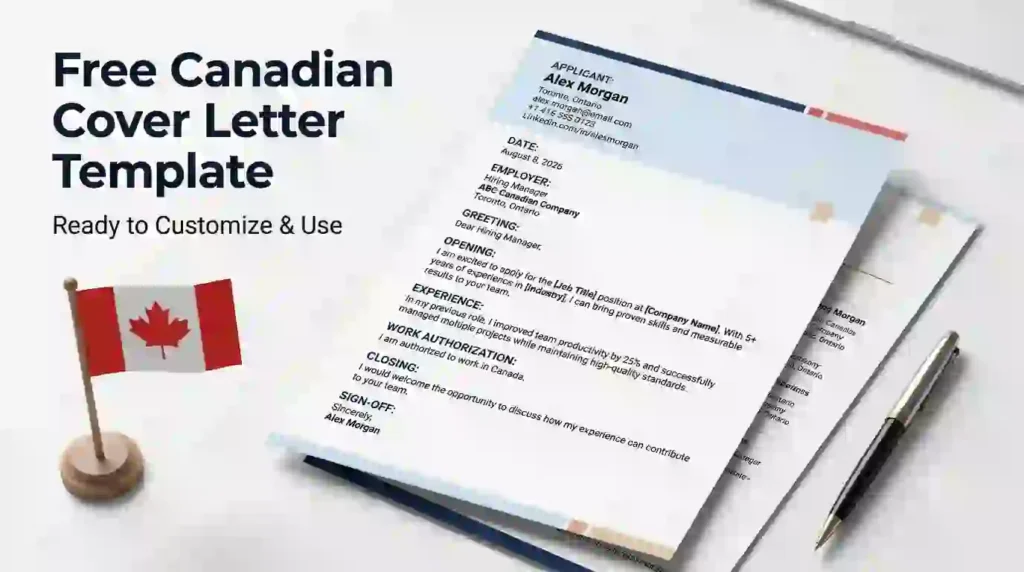
Feel free to copy this template directly and adjust the bracketed sections for each application. Keep a master version saved, then tweak two or three lines per job so it still feels personal.
Tailoring Your Cover Letter for Different Provinces and Industries
Canada’s job market isn’t uniform. Hiring norms vary slightly by province and industry, and it’s worth adjusting your approach depending on where you’re applying.
In tech-heavy markets like Toronto or Vancouver, cover letters can be slightly more casual and direct, focusing heavily on measurable impact and projects. In more traditional industries like finance or government roles in Ottawa, a more formal tone tends to perform better.
If you’re applying for skilled trades or labour positions, especially through programs tied to provincial nominee streams, keep the letter shorter and more practical, emphasizing certifications, safety training, and reliability over storytelling.
For a deeper look at how provincial hiring and immigration pathways differ, check the official Government of Canada Provincial Nominee Program guide, which breaks down eligibility requirements and application steps for each province and territory.
Using AI Tools to Improve, Not Replace, Your Cover Letter
AI writing tools can be genuinely useful for catching grammar mistakes, tightening sentences, or brainstorming ways to phrase an achievement. Used correctly, they save time. Used carelessly, they produce cover letters that sound robotic and generic, which experienced Canadian recruiters can usually spot within seconds.
The best approach is to write your first draft yourself, focusing on real details from your own experience, and then use an AI tool only to polish tone, fix grammar, or shorten overly long sentences. Never let a tool write your achievements for you; specific, personal details are exactly what makes a cover letter convincing.
If your resume also needs work, it’s worth pairing this cover letter with a properly formatted resume. Our free ATS-friendly resume builder is built specifically to pass through Canadian applicant tracking systems without losing formatting.
Final Thoughts
A great Canadian cover letter isn’t about sounding impressive. It’s about being specific, showing genuine interest in the company, and making it easy for a hiring manager to see why you’re worth an interview. Skip the generic templates that could apply to anyone, and instead take fifteen extra minutes to tailor each letter to the actual role and company.
Combined with a strong resume and a clear understanding of your work eligibility in Canada, a well-written cover letter significantly improves your chances of landing interviews in 2026’s competitive job market.
Frequently Asked Questions
Do I need a cover letter for every job application in Canada?
Yes, unless the job posting specifically says it’s optional or not required. Even when it’s not mandatory, including one shows initiative and gives you a chance to stand out, especially in competitive industries like tech, finance, and healthcare.
How long should a Canadian cover letter be?
A Canadian cover letter should be one page, ideally between 300 and 400 words. Hiring managers usually spend less than a minute scanning it, so keeping it short and focused works far better than a lengthy letter.
What if I don’t have Canadian work experience?
Focus on transferable skills, relevant achievements from your home country, and be upfront about your work authorization status. Mentioning your visa or PR status clearly early in the letter removes doubt and shows you understand Canadian hiring requirements.
Can I use the same cover letter for multiple job applications?
It’s not recommended. While you can use a template as a base, each letter should be customized with the company name, specific role details, and at least one or two personalized lines that show you researched the employer.
Should I mention salary expectations in a cover letter?
Generally no, unless the job posting specifically asks for it. Save salary discussions for the interview stage or a separate section of your application, since bringing it up too early can come across as presumptuous.