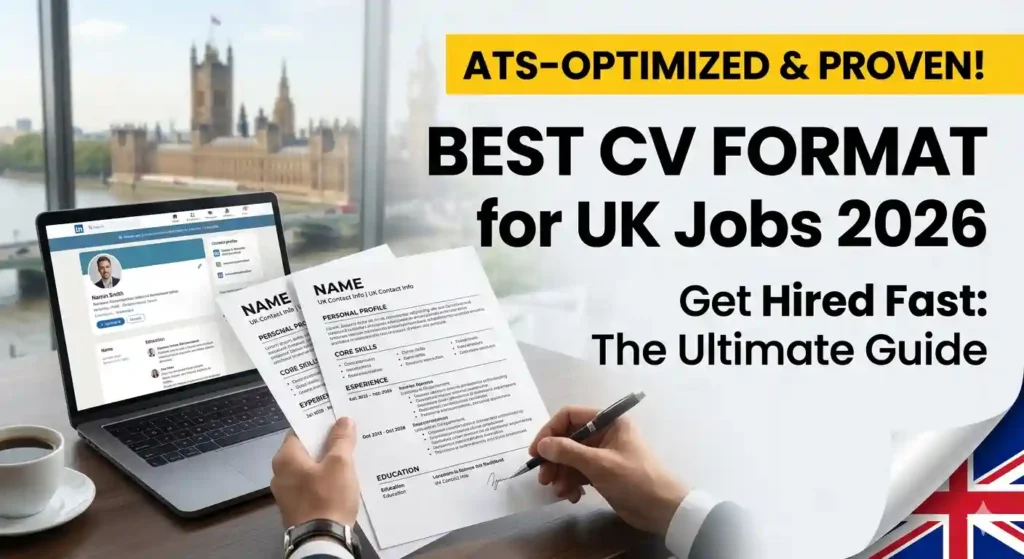
You spent hours writing your resume. You applied for dozens of jobs in Canada. And you heard nothing back.
This is not always about your experience or your qualifications. Most of the time, it comes down to one simple thing — your resume format is wrong for the Canadian job market.
Canada has specific expectations when it comes to resumes. What works in Pakistan, India, or even the UK does not automatically work here. Canadian employers, and the Applicant Tracking Systems (ATS) that screen resumes before any human even looks at them, expect a very particular style. Getting this right is literally the difference between getting called for an interview and being filtered out in seconds.

This guide breaks down exactly what the best resume format for Canada jobs 2026 looks like — section by section, with real tips for foreigners applying from abroad.
Table of Contents
Why Canadian Resume Format Is Different from Other Countries
Before getting into the structure, it helps to understand why Canada has its own rules.
Canada has strict human rights and anti-discrimination laws that apply to hiring. Because of this, Canadian employers do not want — and in many cases legally cannot use — certain personal information in hiring decisions. This is why a Canadian resume looks very different from resumes in most South Asian, Middle Eastern, or even European countries.
Here is what you must never include on a Canadian resume:
- Your photograph
- Date of birth or age
- Marital status
- Nationality or immigration status
- Religion
- National ID number or passport number
If your current resume has any of these — remove them right now before applying to Canada. Including a photo alone can get your resume rejected without any explanation.
Canada is also inviting 1.45 million new permanent residents by 2026 to fill labor shortages. This means competition is real and growing. A properly formatted resume is no longer optional — it is your entry ticket.
The Best Resume Format for Canada Jobs 2026
Canadian employers almost universally prefer one format above all others: the reverse-chronological format. This means your most recent job comes first, followed by previous jobs going backward in time.
This format works because it immediately tells a recruiter where you are right now in your career. It also happens to be the format that ATS systems read most accurately.
The overall structure of a strong Canadian resume in 2026 looks like this:
- Header (Contact Information)
- Professional Summary
- Core Skills
- Work Experience
- Education
- Additional Sections (Certifications, Languages, Volunteer Work)
Let us go through each one.
Section 1: Header — Keep It Clean and Simple
Your header should have only what is necessary. Nothing more.
Include:
- Full name (in bold, slightly larger font)
- City and Province (example: Toronto, ON)
- Phone number
- Professional email address
- LinkedIn profile URL (highly recommended in 2026)
Do not include: your full home address, date of birth, photo, or immigration status.
A clean header example looks like this:
Ahmed Raza Toronto, ON | +1 647 XXX XXXX | ahmed.raza@email.com | linkedin.com/in/ahmedraza
That is it. Simple, professional, and ATS-friendly.
Section 2: Professional Summary — Your First Impression in 3 Lines
The professional summary sits right below your header. It is 2 to 4 sentences that tell the recruiter exactly who you are, what you do, and what value you bring.
Most people either skip this section or write something so vague it says nothing. Do not do that.
A weak summary sounds like:
“Hardworking professional looking for opportunities to grow in a challenging environment.”
A strong summary sounds like:
“Civil engineer with 7 years of experience in infrastructure and project management across South Asia and the Middle East. Delivered projects worth over $12M on time and under budget. Seeking to bring technical expertise and leadership skills to Canadian construction firms.”
See the difference? The second one is specific, quantified, and tells the recruiter immediately whether this person is relevant for the role.
For foreigners: This is also a good place to briefly mention your international experience in a positive, professional way — not as an apology but as a strength.
Section 3: Core Skills — For ATS Scanning
This section is purely for passing the ATS resume format Canada 2026 requirements. Canadian employers increasingly use software to scan resumes before a human sees them. That software looks for specific keywords from the job description.
List 8 to 12 skills in a clean, single-column format. Always match these to the actual job posting you are applying for. If the job says “project coordination” — use those exact words, not “managing projects.”
Examples of strong skills for Canadian job applications:
- Budget forecasting and financial analysis
- Cross-functional team leadership
- Stakeholder communication
- ATS-optimized resume writing
- Data analysis (Excel, Power BI, Tableau)
- Bilingual communication (English/French)
Do not use skill bars, icons, or ratings like “Excel: ★★★★☆”. These confuse ATS systems and add no real information.
Section 4: Work Experience — The Heart of Your Resume
This is the most important section. Canadian recruiters spend about 6 to 10 seconds scanning a resume when it first lands in front of them. Your work experience needs to be immediately clear and impressive.
Format each job like this:
Job Title — Company Name, City, Country Month Year – Month Year
- Achievement bullet 1
- Achievement bullet 2
- Achievement bullet 3
The golden rule: Write achievements, not duties. Every person who had your job had the same duties. What makes you different is what you actually achieved.
Weak bullet: “Responsible for managing a sales team.” Strong bullet: “Led a 12-person sales team that exceeded quarterly targets by 34% for three consecutive quarters.”
Start every bullet with a strong action verb: led, managed, developed, increased, reduced, delivered, implemented, negotiated, trained, launched.
For foreigners: If you worked for a company that Canadian employers may not recognize, add one brief line of context. For example: “TechSolutions Ltd. (mid-sized IT services firm with 800+ employees serving Gulf and South Asian markets).” This removes any confusion and shows you are aware of Canadian expectations.
Also — do not hide international experience. Present it clearly and confidently. Canadian employers value global exposure, especially in 2026 when companies are more international than ever.
Section 5: Education
List your highest degree first. Include:
- Degree name
- Institution name and location
- Year of graduation
If your foreign degree has been assessed by a recognized body like World Education Services (WES) — mention this. It adds significant credibility for Canadian employers who may not be familiar with your institution.
Example:
Bachelor of Engineering (Civil) — University of Engineering & Technology, Lahore, Pakistan — 2018 WES Evaluated: Canadian Equivalency — Bachelor’s Degree
World Education Services (WES) is the most widely recognized credential assessment body for Express Entry and employer verification in Canada.
Section 6: Additional Sections Worth Adding
Once your core sections are complete, these additions can make your resume stand out:
Certifications: Any professional certifications — PMP, Google Analytics, AWS, IELTS score — should be listed here with the year earned.
Languages: Canada values bilingualism. If you speak French alongside English, mention your proficiency level clearly. Even partial French skills can open doors, especially for roles in Quebec or federal government positions.
Volunteer Experience: This one surprises many international applicants. Canadian employers genuinely value community involvement. If you have done any volunteer work — even if unpaid — include it. It shows cultural integration and soft skills that hiring managers look for.
References: You do not need to list references on the resume itself. A simple line — “References available upon request” — at the bottom is enough.

ATS Resume Format Canada 2026 — The Rules You Cannot Break
Since most Canadian employers use ATS software to filter resumes before human review, your formatting must be ATS-safe. Here is what that means in practice:
Use a single-column layout. Two-column resumes look modern but many ATS systems scramble the text when reading them. Stick to one column.
Use standard section headings. Words like “Summary,” “Work Experience,” “Education,” and “Skills” are what ATS systems are programmed to find. Creative headings like “My Journey” or “What I Bring” will be missed entirely.
Save and send as PDF. In 2026, most Canadian ATS systems handle PDF reliably. Save your file as: Firstname-Lastname-Resume.pdf
Use a clean font. Calibri, Arial, or Garamond at 10 to 12pt. No decorative fonts.
No tables, no text boxes, no graphics. These elements break ATS parsing completely.
Use Canadian English spelling. Words like “colour,” “centre,” “programme,” and “organise” follow Canadian/British spelling conventions. Set your word processor to “English (Canada)” before writing to catch these automatically.
Resume Length — How Long Should a Canadian Resume Be?
For most applicants: 1 to 2 pages maximum.
If you have less than 10 years of experience, aim for 1 page. If you have more, 2 pages is perfectly acceptable — but never go to 3 unless you are applying for an academic or research position, in which case you would submit a CV, not a resume.
Submitting a 4 or 5 page resume — common in some countries — is one of the fastest ways to get rejected in Canada. It signals to the recruiter that you do not understand the local market.

One Last Thing Before You Apply
A perfectly formatted resume will not help you if it has not been tailored for the specific job you are applying for. Before sending any application, re-read the job posting and adjust your professional summary, skills section, and experience bullets to mirror the language used in that posting.
This takes 15 to 20 minutes per application. It feels slow. But it dramatically increases your callback rate compared to sending the same generic resume to 100 employers and hearing nothing.
And when you are ready to build your Canadian resume — use our Free ATS Resume Builder at WorkerCV. No account needed, no payment required, instant PDF download. It is built specifically for foreigners applying to jobs in Canada, UK, and Europe — and it follows every formatting rule covered in this guide.
Your Canadian career starts with one good resume. Make it count.
For official immigration and credential information, visit Immigration, Refugees and Citizenship Canada (IRCC) and World Education Services (WES).
What is the best resume format for Canada jobs in 2026?
The reverse-chronological format is the best resume format for Canada jobs in 2026. It lists your most recent job first and works backward. This format is preferred by Canadian recruiters and is also the easiest for ATS systems to read and process correctly.
Should I include a photo on my Canadian resume?
No. Never include a photo on a Canadian resume. Canada has strict anti-discrimination hiring laws, and adding a photo can actually get your resume rejected immediately. Keep your header clean with only your name, city, phone number, email, and LinkedIn profile.
How long should a resume be for Canada jobs?
For most applicants, a Canadian resume should be 1 to 2 pages maximum. If you have under 10 years of experience, stick to 1 page. More than 10 years, 2 pages is fine. Submitting a 4 or 5 page resume — common in many countries — is one of the fastest ways to get rejected by Canadian employers.
How do I make my resume ATS friendly for Canada?
To make your resume ATS friendly for Canada, use a single-column layout, standard section headings like Summary, Work Experience, Skills and Education, save it as a PDF, use a clean font like Arial or Calibri, and avoid tables, graphics, or text boxes. Always include keywords directly from the job posting you are applying for.
Can foreigners use their existing resume for Canada job applications?
Not directly. Foreign resumes often include personal details like photos, date of birth, nationality, and marital status which should never appear on a Canadian resume. Foreigners need to reformat their resume to match Canadian standards — single column, achievement-focused bullets, no personal details, and ATS-optimized keywords — before applying to any Canadian employer.

Portugal Work Visa for Foreigners 2026 Why the Job Offer Must Come Before the Plane Ticket
If you were planning to fly to Lisbon on a tourist stamp and hunt for…

How to Get a Canada Work Visa from China 2026 Step-by-Step Guide
Every year, thousands of skilled professionals across China begin searching for the same thing: how…
Average Salary in Germany 2026 Full Breakdown by Sector and Region
If you’re planning a move to Europe’s largest economy, one question comes up before anything…

Best Job Sites in Germany for Foreigners and Immigrants 2026
Moving to Germany for work sounds exciting until you actually sit down and start searching…

Netherlands Work Visa for Foreigners 2026: Step-by-Step Guide
Moving abroad for work is a big decision, and if the Netherlands is on your…

Virtual Assistant Jobs for Beginners 2026: How to Get Started Without Experience
The remote work industry has grown faster than anyone predicted, and one career path leading…