
If you have been researching where to build your future, there is a good chance Canada and Europe have both crossed your mind. They are two of the most talked-about destinations for immigrants right now — and for good reason. Both offer stable economies, real pathways to permanent residency, and a quality of life that draws people from every part of the world.

But here is the thing: they are very different in how they work, what they offer, and who they are best suited for. In 2026, both destinations have also changed in ways that matter. Canada has tightened its immigration targets after years of rapid expansion. Several European countries, meanwhile, have actively redesigned their immigration systems to attract more skilled workers. The balance has shifted, and the decision is not as straightforward as it used to be.
This guide covers everything — immigration pathways, jobs, salaries, cost of living, language, and citizenship — so you can figure out which option actually fits your situation.
Canada vs Europe for Immigrants in 2026
Table of Contents
Immigration Pathways: How Easy Is It to Get In?
Canada runs one of the most transparent immigration systems in the world, and that is genuinely one of its biggest advantages. The Express Entry system manages applications through a points-based process called the Comprehensive Ranking System, or CRS. Your score is calculated based on your age, education, language test results, and work experience. The government holds regular draws and invites the highest-scoring candidates to apply for permanent residency. You always know where you stand, you can improve your score over time, and the rules are publicly available and consistent.
On top of Express Entry, every province runs its own Provincial Nominee Program. If a specific province needs workers in your field — nursing in Saskatchewan, tech in Ontario, trades in Alberta — you may be nominated directly, which adds significant points to your CRS score and fast-tracks your application. Full details on Express Entry draws, CRS cut-offs, and current provincial streams are available on the official Government of Canada immigration website at canada.ca/en/immigration-refugees-citizenship.
That said, 2026 has brought real changes. Canada significantly reduced its temporary resident intake targets compared to the peak years of the early 2020s, after housing and public services came under pressure. The Mark Carney government has taken a more cautious approach to overall immigration numbers. This does not mean the door is closed — it means competition for spots is more serious, and your profile needs to be strong.
Europe works very differently. There is no single European immigration system. Each of the 27 EU member states sets its own rules, visa categories, and residency requirements. This creates both opportunity and complexity. For some people, it is actually an advantage — if one country is difficult to enter, another may be much more accessible for your specific skill set.
The EU Blue Card is the closest thing Europe has to a unified skilled worker visa. It has been updated in recent years with lower salary thresholds and faster processing, and it allows qualified non-EU professionals to live and work in participating EU countries. Germany has gone even further by introducing the Opportunity Card, known as the Chancenkarte, which allows skilled workers to enter Germany and search for a job on the ground without needing an offer before they arrive. This is a meaningful change. More information on Germany’s visa options is available directly at make-it-in-germany.com, the official German government portal for international skilled workers.
The Netherlands, Ireland, and Portugal have all similarly improved their skilled worker pathways in the past two years, responding to genuine labour market shortages across the continent.
Job Market: Where Are the Real Opportunities?
Canada’s job market in 2026 remains strong in several key areas. Technology roles — software development, data engineering, cybersecurity, and cloud infrastructure — are consistently in demand in Toronto, Vancouver, and increasingly in Calgary and Ottawa. Healthcare is a national priority: nurses, physicians, pharmacists, and personal support workers are actively recruited across every province. The skilled trades face one of the most serious shortages in the country, with electricians, plumbers, welders, and heavy equipment operators needed from British Columbia to Nova Scotia. Natural resources, agriculture, and financial services also continue to drive significant employment.
Canada’s Job Bank, available at jobbank.gc.ca, is the government’s official platform for job listings and labour market information. It also provides a useful tool called the Job Match feature for Express Entry candidates, which can strengthen your immigration application if you match with Canadian employers.
In Europe, the shortages are just as real, though spread across different countries. Germany needs workers in engineering, manufacturing, IT, and healthcare, and has built its visa system around that reality. The Netherlands is short roughly 130,000 technical workers, with Amsterdam and Eindhoven serving as major hubs for tech and logistics. Sweden has an acute need for around 100,000 healthcare professionals. Ireland, as an English-speaking EU member state, has become a hub for large tech companies and financial services firms, making it particularly attractive for professionals in those fields.
For anyone in tech, healthcare, or engineering, demand is high in both destinations. The practical difference is that Canada’s provincial nomination system can direct you toward specific regions where your skills are especially needed, while Europe gives you access to a broader combined market of 27 countries once you are established in one of them.
Salaries and Cost of Living: The Numbers That Actually Matter
A high salary in the wrong city can leave you financially stressed. This comparison only makes sense when salary and cost of living are looked at together.
In Canada, average annual salaries sit roughly between CAD $58,000 and $65,000 across sectors, though this varies significantly. Software engineers in Toronto typically earn between CAD $85,000 and $130,000. Registered nurses can expect CAD $70,000 to $95,000 depending on province and experience. Skilled tradespeople often earn more than many university graduates — journeyman electricians regularly earn over CAD $80,000 in high-demand provinces.
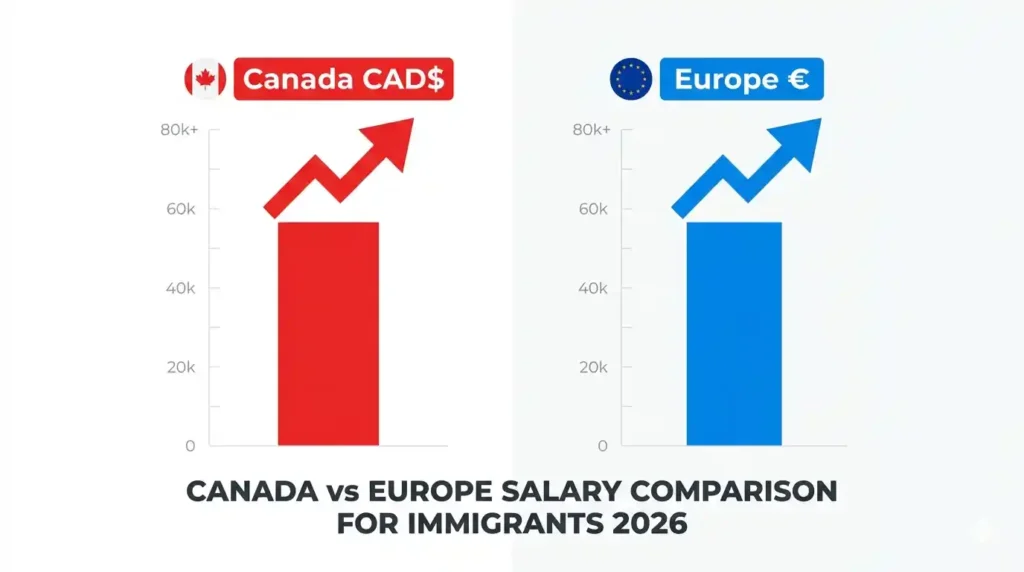
The cost of living challenge in Canada is real, particularly in its largest cities. A one-bedroom apartment in central Toronto currently averages around CAD $2,300 to $2,600 per month in rent. Vancouver is comparable. However, cities like Calgary, Halifax, Winnipeg, and Ottawa offer considerably better affordability while still providing strong job markets. For a realistic picture of what your money goes to across Canadian cities, Numbeo’s Canada cost of living tool at numbeo.com is one of the most practical free resources available.
In Europe, salaries vary enormously by country. The EU-wide average net salary was approximately €2,120 per month as of early 2026 — but that single number masks a wide range. A software engineer in Amsterdam or Munich can earn €5,000 to €8,000 per month net. The same role in Warsaw or Bucharest might pay €1,500 to €2,500. Western Europe pays more. Eastern Europe costs less. Southern Europe — Portugal, Spain, Greece — offers a lower cost of living that partially compensates for more modest wages.
Germany offers arguably the most balanced proposition in Europe right now. IT and engineering salaries in Germany typically range from €50,000 to €80,000 annually before tax, with Munich and Frankfurt at the upper end. Berlin remains more affordable than most comparable European capitals — a one-bedroom apartment in a good Berlin neighbourhood averages around €1,400 to €1,700 per month in 2026. Germany’s public health insurance is employer-funded and comprehensive, which adds real value beyond the salary figure.
For a direct city-to-city cost comparison, Expatistan at expatistan.com is another strong resource that breaks down expenses in detail.
Permanent Residency and Citizenship: The Long-Term View
For most immigrants, the end goal is not just a work permit. It is stability — the right to stay, build a life, and not worry about whether your visa will be renewed. This is where Canada and Europe differ most meaningfully.
Canada’s system is built around permanent settlement. Express Entry leads directly to Permanent Residency, typically within six to twelve months of receiving an invitation to apply. Once you hold Canadian PR, you are not tied to a single employer. You can change jobs freely, move between provinces, access the public healthcare system, and send your children to public schools. After accumulating three years of physical presence in Canada as a PR holder, you are eligible to apply for citizenship. The Government of Canada’s official citizenship guide is available at canada.ca/en/immigration-refugees-citizenship/services/canadian-citizenship.
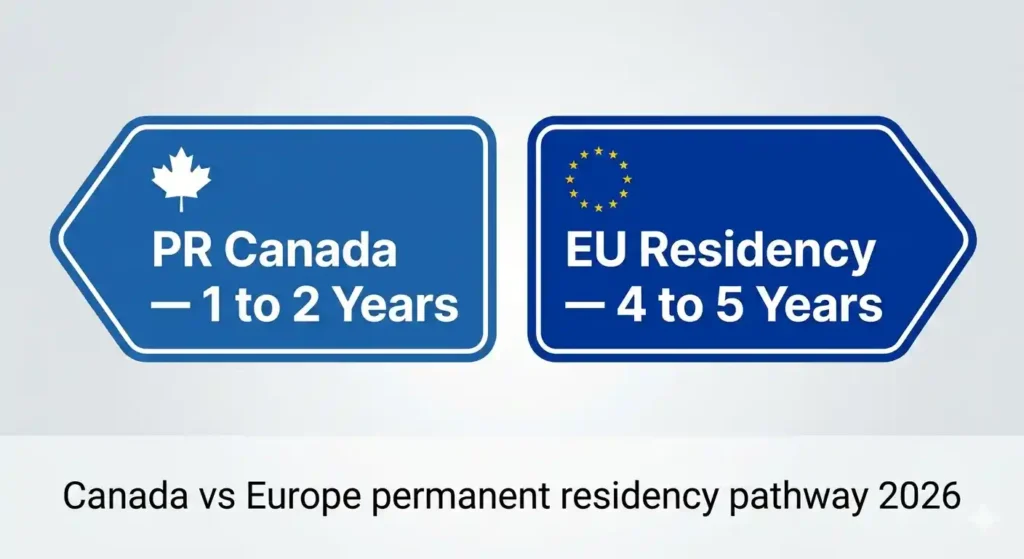
Europe’s timelines are longer and more varied. Germany requires four years of legal employment before you can apply for permanent residency, though this can drop to 21 months if you have strong German language skills and meet pension contribution requirements. The Netherlands grants permanent residency after five years. Ireland, which many English-speaking immigrants overlook as a European option, also offers PR after five years with a relatively accessible process.
Citizenship timelines in Europe are typically longer than Canada’s. Germany requires eight years of legal residence, reducible to five or six years under certain integration conditions. The Netherlands and Ireland sit around five years. France and Spain require ten years.
One significant advantage Canada holds is simplicity. There is one national immigration authority, one set of rules, and one citizenship process. In Europe, if you relocate from Germany to the Netherlands midway through your residency, your clock generally resets in the new country.
Quality of Life: Healthcare, Safety, and Work-Life Balance
Both Canada and Western Europe offer a high standard of living, but there are differences worth understanding.
Remitly’s 2026 Immigration Index, which scored 82 countries across 34 different metrics including healthcare, safety, earning potential, family support, and environmental quality, placed Switzerland at the top globally. Germany entered the global top five for the first time in 2026, climbing dramatically from 14th place the previous year. Iceland, Luxembourg, and Australia followed. Canada placed respectably but outside the top ten.
Healthcare in Canada is provincially funded and covers most medical needs at no direct cost to residents, though wait times in certain specialties can be long. Germany’s statutory health insurance system — Gesetzliche Krankenversicherung — is widely regarded as one of the best in the world, with fast access to specialists and comprehensive coverage. The Netherlands, Denmark, and Sweden operate similarly excellent systems.
On safety, both destinations are strong. Canada has consistently low violent crime rates, particularly outside specific urban areas. Germany, the Netherlands, Austria, and the Nordic countries are among the safest places to live globally by most measurements.
Work-life balance is an area where Europe has a genuine edge. Workers in Germany average around 27 hours per week and benefit from legally protected vacation allowances, typically 20 to 30 paid days per year, and a deeply ingrained culture of not working outside office hours. Canada offers solid labour protections, but working hours in sectors like tech and finance tend to run longer than their European equivalents.
Language: A Practical Consideration
Language is often underestimated as a factor until you are actually living somewhere.
Canada removes almost all language barriers for English speakers immediately. French is required in Quebec for some immigration pathways, but across the rest of the country English is fully sufficient for work, daily life, and integration. If your English is strong, you will not feel like a foreigner in a Canadian workplace from day one.
In Europe, the situation is more varied. The Netherlands is the most accessible option for English speakers — it consistently ranks first globally in English proficiency, and professional life in Amsterdam and Eindhoven functions almost entirely in English. Ireland is fully English-speaking and EU-based, which is a combination that few people stop to fully appreciate. Germany and the Scandinavian countries have high English proficiency in professional environments, but German or Swedish language skills become increasingly important for long-term integration, citizenship applications, and navigating everyday systems like healthcare and local government. France, Spain, and Italy expect local language ability much sooner in the process.
2026 Challenges You Should Know About
No honest comparison leaves out the current challenges.
In Canada, the immigration system is under real pressure. Housing costs in major cities remain very high, and the government has responded by reducing temporary resident targets. If you are applying through Express Entry, your CRS score needs to be competitive. Rural and smaller city pathways remain more accessible and are worth researching if you are flexible about location.
In Europe, Germany faces a potential political shift — a referendum on population caps, if passed, could affect immigration policy from 2027 onward. Portugal, which became extremely popular with remote workers and digital nomads in recent years, has been managing growing demand on its immigration processing system with some delays. And while the EU Blue Card has improved, navigating each country’s specific bureaucracy — especially for people from outside the EU — still requires preparation and ideally professional guidance.
Canada or Europe: Which One Is Right for You?
This comes down to your profile, your priorities, and your five-year vision.
Canada makes the most sense if you want a clear, predictable path to permanent residency and citizenship without navigating multiple country systems. It is especially well-suited for families, for healthcare workers, for skilled tradespeople, and for anyone who wants the security of knowing exactly how their immigration journey will unfold. The English-language environment and deeply multicultural cities make settling in easier from the start.
Europe makes the most sense if you are a skilled professional — particularly in tech, engineering, or healthcare — who values quality of life, work-life balance, and access to a broader continental market. Germany’s Opportunity Card, the Netherlands’ Highly Skilled Migrant Visa, and Ireland’s combination of English and EU membership all represent genuinely strong options. If you are open to learning a language and want access to the wider EU job market over time, Europe rewards that investment well.
The honest answer is that neither destination is universally better. The one that fits your skills, language ability, and long-term goals is the right one.
Final Thoughts
In 2026, both Canada and Europe remain genuinely good destinations for immigrants — but neither is perfect. Canada has tightened its intake and competition is real, but the clarity of its system and the directness of its PR pathway still make it one of the world’s most accessible destinations for long-term settlement. Europe, led by Germany, the Netherlands, and Ireland, offers outstanding quality of life and growing immigration infrastructure for skilled workers, though the multi-country complexity requires more research upfront.
The smartest approach is to assess your specific skills, language abilities, and five-year goals before choosing. A software engineer with no language constraints may thrive in Berlin or Amsterdam. A nurse with a family may find Canada’s settlement-first system more suitable. The destination that fits your life is almost always the right one.
For further reading, explore our related guides on the best countries to immigrate to in 2026, LMIA job offers in Canada, and high-paying jobs in the UK without a degree.
Frequently Asked Questions
Is Canada better than Europe for immigrants in 2026?
It depends on your goals. Canada offers a faster path to permanent residency — typically 6 to 12 months through Express Entry. Europe, particularly Germany, the Netherlands, and Ireland, offers excellent quality of life but PR timelines are longer at 4 to 5 years. For quick settlement choose Canada. For work-life balance and EU market access, Europe is a strong option.
Which European country is easiest to immigrate to in 2026?
Germany, the Netherlands, and Ireland are the most accessible for skilled workers. Germany’s Opportunity Card lets you enter without a job offer. The Netherlands processes the Highly Skilled Migrant Visa in 2 to 4 weeks. Ireland is fully English-speaking and EU-based — a combination most immigrants overlook.
How long does it take to get PR in Canada vs Europe?
Canada typically grants PR within 6 to 12 months through Express Entry. In Europe, Germany requires 4 years of legal employment, the Netherlands and Ireland both require 5 years before permanent residency eligibility.
Is cost of living cheaper in Canada or Europe?
It depends on the city. Toronto and Vancouver are expensive. Berlin, Lisbon, and Warsaw are far more affordable. However, Zurich, Amsterdam, and Dublin are comparable to or more expensive than major Canadian cities. Always compare salary alongside cost of living.
What jobs are most in demand for immigrants in Canada and Europe in 2026?
Canada needs healthcare workers, skilled tradespeople, and tech professionals most urgently. In Europe, Germany needs engineers and IT workers, the Netherlands is short 130,000 technical workers, and Sweden needs 100,000 healthcare professionals. Both regions have real shortages — match your skills to the right destination.