If you have typed “Minimum Wage in Canada” into Google, you are probably trying to figure out one simple thing: how much you (or someone you know) is legally allowed to be paid per hour in 2026. The honest answer is that there is no single number. Canada does not have one national minimum wage that applies to everyone. Instead, the Minimum Wage in Canada is set separately by each province and territory, plus a separate federal rate for a small group of industries. That means the Minimum Wage in Canada can be $15.00 an hour in one province and nearly $20.00 an hour in another, depending entirely on where you live and work.

This guide breaks down the Minimum Wage in Canada province by province for 2026, explains why the rates are so different, and shows you exactly what this means if you are a worker, a job seeker, a newcomer, or an employer trying to stay compliant.
Table of Contents
Why the Minimum Wage in Canada Is Not the Same Everywhere
Under Canada’s constitution, employment standards — including minimum wage — fall mostly under provincial and territorial jurisdiction, not federal jurisdiction. This is the single biggest reason the Minimum Wage in Canada looks so different from region to region. Each provincial government reviews its own labour market, cost of living, and inflation data, then sets (and updates) its own rate on its own schedule.
Only workers employed in federally regulated industries — banks, airlines, telecommunications companies, interprovincial trucking, postal services, and a few others — fall under the separate federal minimum wage. As of April 1, 2026, that federal rate under the Canada Labour Code sits at $18.15 per hour. If a province’s minimum wage is higher than the federal rate, federally regulated employers in that province must pay the higher provincial rate instead. You can read the official federal rules directly on the Government of Canada’s federal minimum wage page.
For everyone else — which is the vast majority of Canadian workers — the Minimum Wage in Canada is determined entirely by their province or territory of employment.
Minimum Wage in Canada 2026 — Province by Province
Here is the current Minimum Wage in Canada broken down by province and territory, based on official rates in effect as of mid-2026:
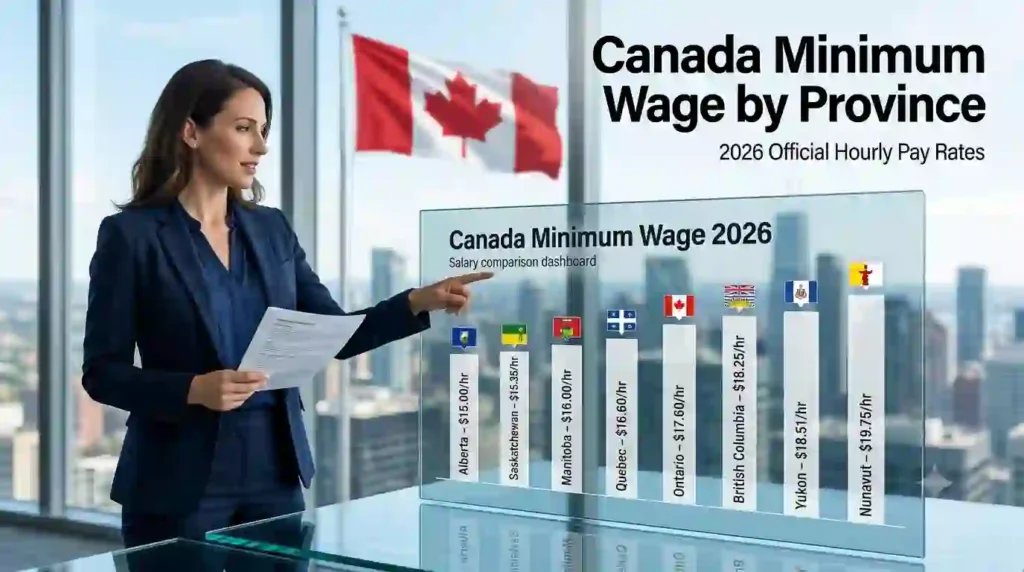
- Alberta — $15.00 per hour (unchanged since October 2018, the lowest general rate in the country)
- Saskatchewan — $15.35 per hour
- New Brunswick — $15.90 per hour
- Manitoba — $16.00 per hour, rising to $16.40 on October 1, 2026
- Newfoundland and Labrador — $16.35 per hour
- Quebec — $16.60 per hour (increased May 1, 2026)
- Northwest Territories — $16.95 per hour
- Nova Scotia — $16.75 per hour, rising to $17.00 on October 1, 2026
- Prince Edward Island — $17.00 per hour, rising to $17.30 on October 1, 2026
- Ontario — $17.60 per hour, rising to $17.95 on October 1, 2026
- Yukon — $18.51 per hour
- British Columbia — $18.25 per hour (effective June 1, 2026)
- Nunavut — $19.75 per hour, the highest Minimum Wage in Canada
If you compare this list closely, you will notice a clear pattern: the Minimum Wage in Canada tends to be higher in provinces and territories with a higher cost of living, and lower in provinces that have either frozen their rates or index them less aggressively to inflation.
British Columbia and Ontario: The Highest Provincial Rates
British Columbia currently has the highest Minimum Wage in Canada among the provinces at $18.25 per hour, a rate that took effect June 1, 2026. BC now automatically indexes its minimum wage to the provincial Consumer Price Index every year, so workers there can expect a small annual bump rather than the sudden multi-year jumps seen in some other provinces. BC also sets a distinct, higher minimum wage for app-based ride-hailing and food delivery drivers during “engaged time.”
Ontario is close behind. The Minimum Wage in Canada’s most populous province currently sits at $17.60 per hour, with a confirmed increase to $17.95 per hour effective October 1, 2026. Ontario also maintains a separate, lower student minimum wage for workers under 18 who work limited hours during the school year. You can verify current and upcoming rates directly on the Ontario government’s minimum wage page.
Alberta and Saskatchewan: The Lowest Rates
At the opposite end, Alberta has held its general Minimum Wage in Canada steady at $15.00 per hour since October 2018, with no further increase currently scheduled. Alberta also has a separate, lower student minimum wage for workers under 18. Despite having the lowest minimum wage in the country, Alberta offsets some of the cost of living through the fact that it has no provincial sales tax. Official figures are published on the Alberta government’s minimum wage page.
Saskatchewan was tied with Alberta for years but has since moved slightly ahead, with its Minimum Wage in Canada currently sitting at $15.35 per hour. Saskatchewan reviews and adjusts its rate every October, tying changes to inflation.
Quebec and Manitoba: Mid-Range Rates With Annual Reviews
Quebec adjusts its Minimum Wage in Canada every year on May 1, earlier than most other provinces. As of May 1, 2026, the general rate is $16.60 per hour. Quebec also sets a separate, lower rate specifically for employees who receive tips, so hospitality workers in the province need to check which category applies to them.
Manitoba currently sits at $16.00 per hour and is scheduled to rise to $16.40 per hour on October 1, 2026. Like most provinces, Manitoba ties its annual adjustment to the Consumer Price Index.
Atlantic Canada: Nova Scotia, New Brunswick, PEI, and Newfoundland
The Atlantic provinces generally sit in the middle of the national range for Minimum Wage in Canada, and most of them update their rates on April 1 or October 1 each year.
- Nova Scotia moved to $16.75 per hour on April 1, 2026, with a second increase to $17.00 per hour scheduled for October 1, 2026 — meaning Nova Scotia gets two minimum wage bumps in a single year.
- New Brunswick’s general rate currently stands at $15.90 per hour.
- Prince Edward Island is at $17.00 per hour, rising to $17.30 per hour on October 1, 2026.
- Newfoundland and Labrador raised its Minimum Wage in Canada to $16.35 per hour effective April 1, 2026, with its next review scheduled for April 1, 2027.
The Territories: Yukon, Northwest Territories, and Nunavut
Canada’s three territories consistently post some of the highest minimum wage figures in the country, largely because of the significantly higher cost of living, transportation, and housing in the north.
- Yukon’s Minimum Wage in Canada rose to $18.51 per hour effective April 1, 2026, calculated using the Whitehorse Consumer Price Index.
- The Northwest Territories currently sits at $16.95 per hour, reviewed annually on September 1.
- Nunavut holds the title for the highest Minimum Wage in Canada at $19.75 per hour, reflecting the extremely high cost of goods, food, and housing across the territory.
Minimum Wage vs. Living Wage: An Important Distinction
A common mistake job seekers make is assuming the Minimum Wage in Canada automatically covers a reasonable standard of living. It usually does not. The minimum wage is simply the lowest amount an employer is legally allowed to pay. The “living wage,” on the other hand, is a separate, independently calculated figure that estimates what a worker actually needs to earn to cover rent, food, transportation, and basic expenses in a specific city.
In nearly every major Canadian city — Toronto, Vancouver, Calgary, Montreal — the living wage is noticeably higher than the legal Minimum Wage in Canada. This gap is exactly why understanding average salaries by occupation matters so much more than just knowing the minimum hourly rate. If you want a full breakdown of what workers actually earn across different industries and provinces, our guide on Average Salary in Canada 2026 goes far beyond the minimum wage numbers and shows real earning potential by role and region.
What This Means If You’re Planning to Work in Canada
If you are a newcomer, foreign worker, or immigrant researching the Minimum Wage in Canada before relocating, keep these points in mind:

Location matters more than you think. A minimum-wage job in Nunavut pays almost $5.00 more per hour than the same type of job in Alberta. But higher wages in the north also come with a much higher cost of living, so the comparison is never as simple as “higher number equals better deal.”
Minimum wage jobs are usually a starting point, not the goal. Most foreign workers use entry-level, minimum-wage positions as a bridge while they build Canadian work experience, gather references, and eventually move into higher-paying roles. If you are exploring entry points into the Canadian job market, our guide on the best job sites in Canada for foreigners and immigrants is a good next step.
Some sectors pay well above minimum wage even for newcomers. Skilled trades, healthcare support roles, and transportation are examples where wages regularly sit far above the provincial Minimum Wage in Canada. Truck driving, for instance, is one of the fastest routes to both a solid wage and, in many cases, an LMIA-backed job offer — you can read the full breakdown in our guide to truck driving jobs in Canada for immigrants.
An LMIA job offer changes your leverage. If your goal is permanent residency through an employer-supported pathway, understanding how wage requirements factor into LMIA approvals is essential. Our guide on how to get an LMIA job offer in Canada explains exactly how employers and wage thresholds interact in that process.
Employer Compliance: Why the Minimum Wage in Canada Trips People Up
For employers — especially ones running operations across more than one province — the fact that the Minimum Wage in Canada changes on different dates in different provinces is one of the most common sources of payroll mistakes. British Columbia updates on June 1, Quebec on May 1, most other provinces on October 1, and the federal rate on April 1. Missing even one of these dates can result in underpayment and back-pay claims. Employers should always confirm the current Minimum Wage in Canada directly with the relevant provincial labour ministry before running payroll, rather than relying on older articles or outdated payroll software defaults.
Building a Resume That Gets You Past Minimum Wage
Whether you are entering the Canadian job market for the first time or trying to move up from an entry-level role, your resume is what determines whether you get seen at all — especially since most Canadian employers now filter applications through Applicant Tracking Systems before a human ever reads them. If your resume isn’t formatted correctly, even strong experience can get filtered out automatically. Our free ATS resume builder is built specifically to pass these systems, and our guide on the best resume format for Canada jobs walks through exactly what Canadian employers expect to see.
Final Thoughts on the Minimum Wage in Canada 2026
The Minimum Wage in Canada is not a single, fixed number — it is a patchwork of thirteen different provincial and territorial rates, plus a separate federal rate, each updated on its own schedule and tied to its own cost-of-living formula. In 2026, the range runs from $15.00 per hour in Alberta to $19.75 per hour in Nunavut, with British Columbia and Ontario leading among the provinces.
If you’re planning to live, work, or hire in Canada this year, always confirm the exact Minimum Wage in Canada for the specific province where the work is performed, since even a few months can bring a scheduled increase. And if your goal is to earn well above the minimum wage, the smartest first steps are a properly formatted resume, a clear understanding of which provinces and sectors pay the most, and a realistic plan for how minimum-wage work fits into your bigger picture — whether that’s permanent residency, a career change, or simply your first paycheque in Canada.
Frequently Asked Questions
What is the minimum wage in Canada in 2026?
There is no single national rate. The minimum wage in Canada ranges from $15.00 per hour in Alberta to $19.75 per hour in Nunavut, depending on the province or territory. The federal minimum wage for federally regulated industries is $18.15 per hour.
Which province has the highest minimum wage in Canada?
Nunavut has the highest minimum wage in Canada at $19.75 per hour, followed by British Columbia at $18.25 per hour and Yukon at $18.51 per hour.
Which province has the lowest minimum wage in Canada?
Alberta has the lowest minimum wage in Canada at $15.00 per hour, a rate that has remained unchanged since October 2018.
Does Canada have a federal minimum wage?
Yes, but it only applies to federally regulated industries such as banks, airlines, and telecommunications. As of April 1, 2026, the federal minimum wage is $18.15 per hour. All other workers follow their provincial or territorial rate.
When does the minimum wage in Canada increase?
Most provinces review and adjust their minimum wage annually, commonly on April 1, May 1, June 1, or October 1, tied to inflation or Consumer Price Index data.
Is the minimum wage in Canada enough to live on?
In most major Canadian cities, the minimum wage is lower than the calculated “living wage,” which accounts for real rent, food, and transportation costs. Minimum wage is the legal floor, not a guaranteed livable income.