
Canada is short on truck drivers — badly short. Industry estimates put the shortage at anywhere between 25,000 and 54,000 drivers over the coming years, and that gap isn’t closing on its own. For immigrants looking for a realistic, no-degree-required path into Canada, truck driving jobs in Canada for immigrants have quietly become one of the most practical routes available in 2026 — offering steady pay, visa sponsorship, and a genuine road to permanent residency.
This guide breaks down everything you need to know: why the demand exists, how much you can actually earn, how the visa process works, and how to avoid the scams that plague this space.
Table of Contents
Why Truck Driving Jobs in Canada for Immigrants Are in High Demand
Three things are colliding at once in Canada’s trucking industry. First, the average Canadian truck driver is over 45 years old, and retirements are happening faster than new drivers are entering the field. Second, e-commerce and cross-border trade with the US keep growing, which means more freight needs to move. Third, domestic training programs simply can’t produce enough licensed drivers fast enough to keep up.
That combination is exactly why truck driving jobs in Canada for immigrants exist in such large numbers right now. Under Canada’s National Occupational Classification system, truck driving falls under NOC 73300 (Transport Truck Drivers) — a Skill Level B occupation, which matters a lot because it’s eligible for several immigration pathways that many other jobs aren’t.
How Much Do Truck Driving Jobs in Canada for Immigrants Actually Pay?
Numbers vary by province, route length, and experience, but truck driving jobs in Canada for immigrants generally pay between CAD $60,000 and $95,000 per year, with long-haul and specialized drivers (reefer, flatbed, oversized loads) often earning more through overtime and bonuses.
| Province | Avg. Hourly Wage (CAD) | Avg. Annual Salary (CAD) | Demand Level |
|---|---|---|---|
| Alberta | $28 – $36 | $65,000 – $85,000 | Very High |
| Saskatchewan | $27 – $34 | $62,000 – $80,000 | Very High |
| Manitoba | $26 – $33 | $60,000 – $78,000 | High |
| British Columbia | $27 – $35 | $63,000 – $82,000 | High |
| Ontario | $25 – $32 | $58,000 – $78,000 | Moderate–High |
| Atlantic Canada | $25 – $30 | $55,000 – $72,000 | Moderate |
If you want a broader sense of how truck driver pay compares to other occupations across the country, our Average Salary in Canada 2026 guide breaks it down province by province.
Note that many employers pay long-haul drivers by kilometre rather than by the hour. If you’re offered a kilometre-based pay structure, make sure the effective hourly rate — total earnings divided by total hours worked, including loading and waiting time — still meets or beats the provincial prevailing wage. This matters because it affects LMIA compliance on the employer’s end, and a driver paid below the threshold is a red flag.
What Is an LMIA, and Why Does It Matter for Truck Driving Jobs in Canada for Immigrants?
Almost every conversation about truck driving jobs in Canada for immigrants eventually comes back to one term: LMIA, or Labour Market Impact Assessment. It isn’t a visa itself — it’s a document the Canadian employer applies for through Employment and Social Development Canada (ESDC) to prove they couldn’t find a Canadian citizen or permanent resident to fill the role first.
Because the driver shortage is so well documented, LMIAs for NOC 73300 are among the more commonly approved categories under the Temporary Foreign Worker Program. Once an employer gets a positive LMIA, they pass it to you so you can apply for a closed, employer-specific work permit through IRCC.
Step-by-Step: How to Get Truck Driving Jobs in Canada for Immigrants
- Secure a genuine job offer from a licensed Canadian trucking company willing to sponsor foreign drivers.
- Employer applies for LMIA through ESDC — this typically takes four to eight months, though priority streams move faster.
- You apply for a work permit through the IRCC Secure Account Portal once the LMIA is approved, submitting your job offer letter and supporting documents.
- Complete biometrics and a medical exam if applying from outside Canada.
- Arrive and begin work under the terms of your permit, which usually lasts one to two years and is often renewable.
- Build Canadian work experience toward permanent residency — most drivers become eligible after 12 months of full-time work.
If you want the fuller mechanics of how work permits function in Canada more broadly — document checklists, biometrics, common refusal reasons — our Canada Work Visa Process 2026 guide walks through it in detail.
Eligibility Requirements
Not everyone qualifies automatically for truck driving jobs in Canada for immigrants. Employers and IRCC generally expect:
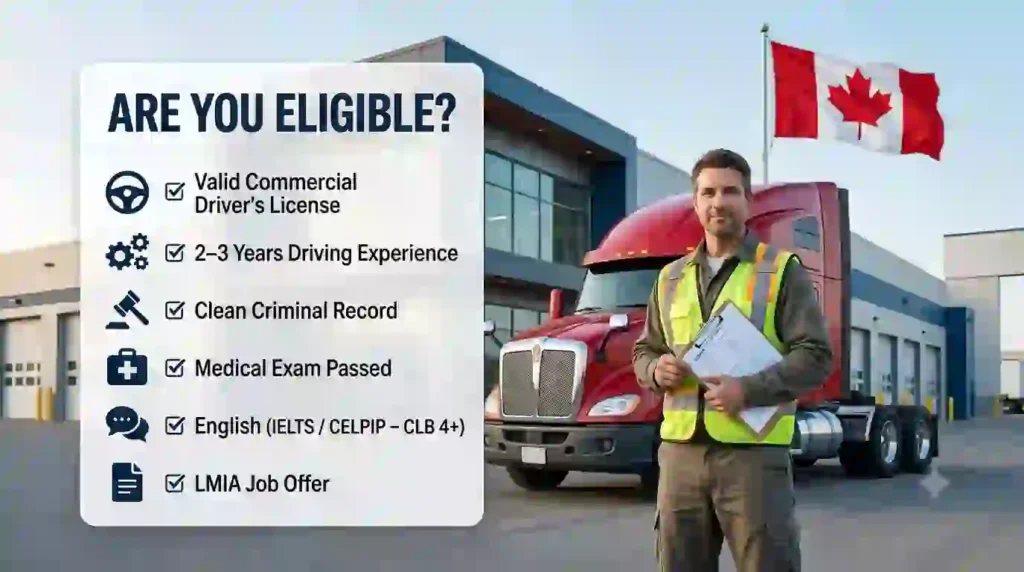
- A valid commercial driver’s license from your home country, plus 2–3 years of verifiable driving experience
- A clean criminal record and passed medical examination
- Basic English proficiency, usually demonstrated through IELTS or CELPIP (minimum CLB 4 for most pathways)
- A valid job offer backed by a positive LMIA from a Canadian employer
Permanent Residency Pathways After Truck Driving Jobs in Canada for Immigrants
This is the part that makes truck driving jobs in Canada for immigrants genuinely different from a lot of other foreign-worker routes — there’s a well-established bridge from temporary work permit to permanent residency:
- Federal Skilled Trades Program (FSTP), part of Express Entry — NOC 73300 drivers with two years of experience and CLB 4 language scores are eligible
- Canadian Experience Class (CEC) — available after roughly 12 months of full-time Canadian work experience
- Provincial Nominee Programs (PNPs) — Saskatchewan, Alberta, Manitoba, and British Columbia all run transportation-specific streams that actively target drivers
- Atlantic Immigration Program (AIP) — for drivers willing to settle in Atlantic Canada
Drivers who plan their immigration strategy from day one of their work permit, rather than treating PR as an afterthought, tend to have the smoothest path through this system.
Where to Find Legitimate Truck Driving Jobs in Canada for Immigrants
Stick to verifiable sources rather than random Facebook or WhatsApp job ads:
- Job Bank — the Government of Canada’s official portal, consistently listing over a thousand transport truck driver vacancies
- Major carriers with international recruitment pipelines, including Bison Transport, Day & Ross, and Challenger Motor Freight — all of which post openings directly on their own careers pages
- Search terms like “transport truck driver LMIA” or “Class 1 driver visa sponsorship” on Indeed.ca, filtering by province
Always cross-check that a listed employer actually has, or is eligible for, LMIA processing before investing time in an application.
Avoiding Scams Targeting Truck Driving Jobs in Canada for Immigrants
This niche attracts more than its share of bad actors, so a few rules are worth repeating:
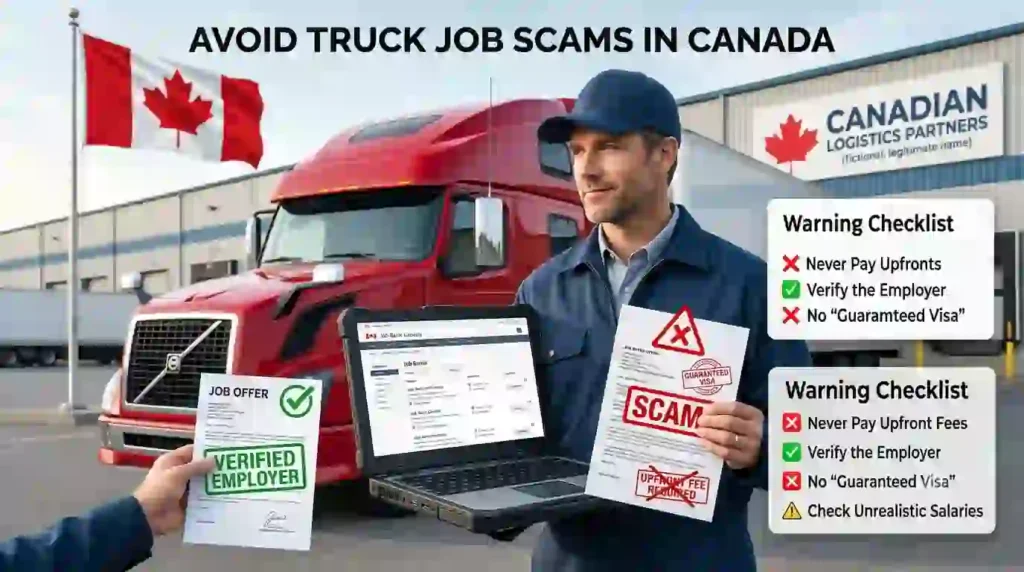
- Never pay upfront fees. Legitimate employers do not charge job seekers to “guarantee” an LMIA or job offer.
- Verify the employer through the Job Bank listing or provincial trucking associations before sharing documents or money.
- Don’t trust “guaranteed visa” language. No recruiter or employer can guarantee an IRCC decision — only IRCC can approve a work permit.
- Watch for unrealistic wages. If a general trucking role advertises far above the provincial median, treat it as a warning sign, not a windfall.
Is It Worth It?
Truck driving jobs in Canada for immigrants come with real trade-offs. Long-haul routes mean extended time away from family, unpredictable schedules, and physically demanding work. But set against that: stable, above-average pay for a no-degree occupation, a labour shortage that gives you real negotiating leverage, and — unlike a lot of temporary foreign worker categories — a clearly mapped route to permanent residency within one to two years.
For immigrants weighing their options against other Canadian pathways, it’s worth comparing this against broader salary data across occupations in our Average Salary in Canada 2026 breakdown, and reviewing the general Canada Work Visa Process 2026 guide before you commit to a specific employer or province.
Do truck driving jobs in Canada for immigrants really offer visa sponsorship?
Yes. Canadian trucking companies regularly sponsor foreign drivers through the LMIA process, which allows them to apply for a work permit and, eventually, permanent residency after gaining Canadian work experience.
How much do truck driving jobs in Canada for immigrants pay in 2026?
Most drivers earn between CAD $60,000 and $95,000 per year, depending on province, route length, and experience, with Alberta and Saskatchewan offering the highest average wages.
Do I need a degree to qualify for truck driving jobs in Canada for immigrants?
No degree is required. Employers typically ask for 2-3 years of commercial driving experience, a valid license, a clean record, and basic English proficiency through IELTS or CELPIP.
Can truck driving jobs in Canada for immigrants lead to permanent residency?
Yes. After about 12 months of full-time Canadian work experience, drivers can apply for PR through the Federal Skilled Trades Program, Canadian Experience Class, or province-specific nominee streams.
Where can I find legitimate truck driving jobs in Canada for immigrants?
The safest sources are Canada’s official Job Bank and the careers pages of major carriers like Bison Transport, Day & Ross, and Challenger Motor Freight. Avoid recruiters who ask for upfront fees.