
Spain Digital Nomad Visa 2026 Complete Work Visa Guide
Spain has quietly become the most talked-about country in Europe for people who want to work remotely while living somewhere with sunshine, good food, and a lower cost of living. If you’re researching the Spain Digital Nomad Visa, you’re probably one of thousands of professionals from the UK, USA, Canada, or elsewhere in Europe trying to figure out whether this visa is actually worth the paperwork. Short answer: for most remote workers, yes. Long answer: it depends on your income, your employment setup, and how much patience you have for Spanish bureaucracy.
This guide breaks down everything you need to know about the Spain Digital Nomad Visa in 2026 — who qualifies, how much you need to earn, what documents you’ll need, how long the process takes, and how it compares to other ways of moving to Spain. Spain Digital Nomad Visa 2026 Complete Work Visa Guide
Table of Contents
What Is the Spain Digital Nomad Visa?
The Spain Digital Nomad Visa was introduced under Spain’s Startup Act to let non-EU citizens live in Spain while working remotely for companies or clients based outside the country. It’s not a tourist visa, and it’s not a traditional work visa either — it sits in its own category designed specifically for people whose income comes from abroad.
Unlike the old days when remote workers had to enter Spain on a 90-day tourist stamp and leave before overstaying, the Spain Digital Nomad Visa gives you a legal, long-term way to live in the country. You get access to public services, the ability to open a Spanish bank account properly, and in many cases a path toward longer-term residency.
The visa is open to employees working for foreign companies, freelancers with international clients, and business owners running a company registered outside Spain. If you’re an American consultant, a Canadian software developer, a UK-based marketing freelancer, or basically anyone earning money online from clients who aren’t Spanish, this visa was built with you in mind.
Who Can Apply for the Spain Digital Nomad Visa
Before you get excited about beach views and tapas, check whether you actually qualify. The Spain Digital Nomad Visa requirements are fairly specific:
- You must be a non-EU/EEA citizen (UK, USA, and Canadian citizens all qualify under this category)
- Your work must be done remotely using digital tools — laptop, internet, video calls, the usual
- If you’re employed, your company must be based outside Spain
- If you’re a freelancer or self-employed, no more than 20% of your income can come from Spanish clients
- You need proof that you’ve worked remotely for your current company or clients for at least 3 months before applying
- You’ll need a clean criminal record from any country you’ve lived in over the past 5 years
- You must have private health insurance that meets Spain’s requirements
If you tick these boxes, you’re already most of the way to being eligible for the Spain Digital Nomad Visa.
Income Requirements for the Spain Digital Nomad Visa in 2026
This is the part everyone actually cares about. Spain ties the income threshold to its national minimum wage (SMI), which gets adjusted every year. For 2026, after the minimum wage increase, the income requirement for the Spain Digital Nomad Visa works out to roughly €2,750–€2,850 per month for a single applicant, depending on exactly when you apply and which consulate processes your case.
Here’s a clearer breakdown of what you’ll need to show:
| Applicant Type | Approx. Monthly Income Required (2026) | Approx. Annual Equivalent |
|---|---|---|
| Single applicant | €2,750 – €2,850 | €33,000 – €34,200 |
| + First dependent (spouse/partner) | + €1,030 – €1,070 | + €12,400 – €12,800 |
| + Each additional dependent | + €340 – €360 | + €4,100 – €4,300 |
So if you’re applying with a partner and one child, you’re looking at a combined household income requirement somewhere around €4,100–€4,300 per month before tax. These numbers shift slightly based on the official minimum wage update, so always double-check the most current figure before you submit anything.
You’ll need to prove this income through bank statements (usually the last 3–6 months), an employment contract or freelance agreement, and in some cases a letter from your employer confirming you’re allowed to work remotely from Spain.
Documents You Need for the Spain Digital Nomad Visa
Paperwork is where most applications fall apart, so it’s worth getting this right the first time. A typical Spain Digital Nomad Visa application includes:
- Completed visa application form
- Valid passport (with at least one year of remaining validity)
- Passport-sized photos
- Proof of remote work (employment contract, freelance contracts, or business registration documents)
- Proof of income meeting the minimum threshold
- Private health insurance with no co-payments, covering the full duration of your stay
- Criminal background check, apostilled and translated into Spanish
- Proof of accommodation in Spain (this can be a rental agreement or even an initial hotel booking for the first weeks)
- Proof of qualifications — either a university degree or at least 3 years of relevant professional experience
- Social Security registration or proof you’ll be covered under your home country’s system
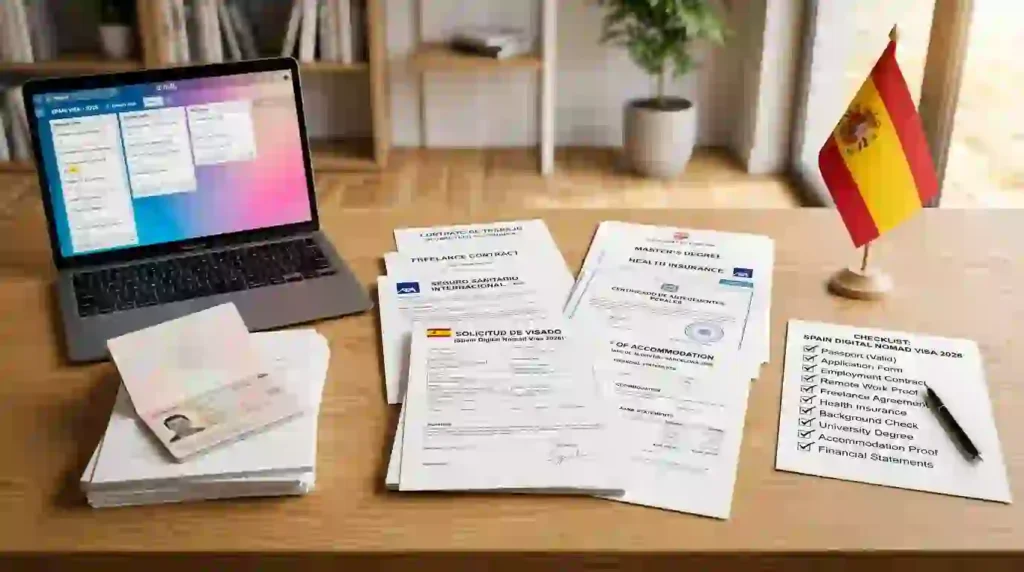
Most consulates also want everything translated into Spanish by a certified translator, and some documents need an apostille stamp depending on your home country. This part takes time, so start collecting paperwork well before you plan to apply.
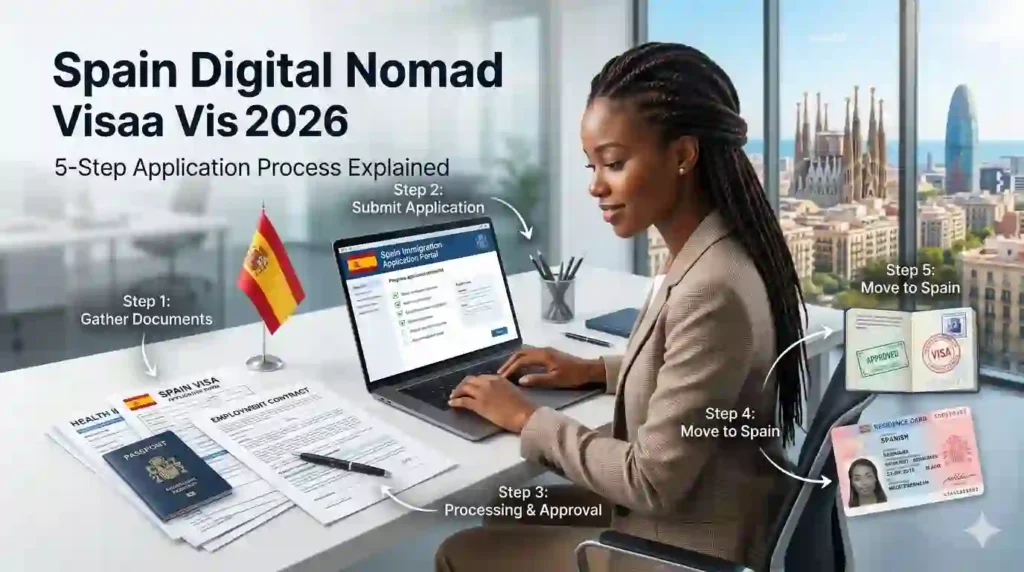
How to Apply: Step-by-Step Process
You can apply for the Spain Digital Nomad Visa in two ways — from outside Spain through a Spanish consulate, or from inside Spain if you’re already there legally on a valid visa-free stay.
Applying from outside Spain:
- Gather all required documents and get translations/apostilles sorted
- Book an appointment at your nearest Spanish consulate
- Submit your application along with the visa fee (roughly €75–€80, though this varies by consulate)
- Wait for processing — typically 15 to 45 days, though it can run longer during busy periods
- Once approved, you receive a visa allowing entry into Spain, valid for up to one year
- Within 30 days of arrival, register and get your foreigner ID card (TIE)
Applying from inside Spain:
- Enter Spain on a valid visa-free stay (most Western passport holders get 90 days automatically)
- Submit your application through Spain’s immigration portal (UGE-CE) rather than a consulate
- Processing tends to be faster — often within 15–20 working days
- If approved, you’re granted a residence permit valid for up to three years, renewable afterward
Applying from inside Spain generally gets you a longer initial permit (3 years instead of 1), which is why many applicants choose to enter as tourists first and apply once they’re settled.
How Long Does the Spain Digital Nomad Visa Last
This trips a lot of people up because the rules genuinely differ based on where you apply:
- Applying through a consulate abroad: visa valid for 1 year, renewable for up to 5 years total
- Applying from inside Spain: residence permit valid for 3 years, renewable for an additional 2 years
After 5 years of continuous legal residence, you become eligible to apply for long-term residency in Spain, and eventually citizenship if you meet the additional requirements (which usually include a longer residency period and a basic Spanish language exam).
Taxes Under the Spain Digital Nomad Visa
One of the genuine perks of this visa is the tax treatment. Spain Digital Nomad Visa holders can apply for a special tax regime, often called the “Beckham Law,” which sets a flat income tax rate of 24% on earnings up to €600,000 per year — significantly lower than Spain’s standard progressive tax rates, which can climb past 45% for higher earners.
This special regime typically applies for up to 5–6 years, and during that time you’re also exempt from Spanish wealth tax on assets held outside Spain. It’s one of the more generous arrangements in Europe for remote workers, and it’s a major reason Spain keeps showing up at the top of digital nomad rankings year after year.
Keep in mind you’ll still need to handle tax obligations in your home country depending on your citizenship and tax residency rules — Americans in particular should talk to a tax advisor familiar with US-Spain tax treaties before assuming everything is simple.
Spain Digital Nomad Visa vs Other Options
If you’re weighing Spain against other countries, here’s a quick side-by-side:
| Visa | Min. Monthly Income (approx.) | Initial Validity | Path to Residency |
|---|---|---|---|
| Spain Digital Nomad Visa | €2,750–€2,850 | 1–3 years | Yes, after 5 years |
| Portugal D8 Visa | €3,280 | 1 year | Yes, after 5 years |
| Italy Digital Nomad Visa | €2,700+ | 1 year | Yes, renewable |
| Spain Non-Lucrative Visa | €2,400 | 1 year | Yes, but no work allowed |
Compared to Portugal, Spain’s income threshold is slightly lower, and the option to apply from inside the country for a 3-year permit gives it an edge for people who want stability sooner rather than later.
Common Mistakes That Get Spain Digital Nomad Visa Applications Rejected
Spain’s immigration office has tightened scrutiny in 2026, especially around fraudulent contracts and unregistered Social Security status. The most common reasons applications get rejected:
- Income proof that doesn’t clearly show 3+ months of consistent earnings
- Employment letters that don’t explicitly state remote work is authorized
- Missing or incorrectly apostilled criminal background checks
- Trying to convert directly from a Non-Lucrative Visa to a Digital Nomad Visa without leaving Spain first (this is no longer permitted)
- Health insurance policies that include co-payments or waiting periods, which don’t meet Spain’s standards
Double-checking every document against the official checklist before submission saves you weeks of delays.
Is the Spain Digital Nomad Visa Worth It?
For most remote professionals from the UK, USA, and Canada, the Spain Digital Nomad Visa is one of the more practical ways into Europe right now. The income threshold is achievable for most mid-career remote workers, the tax benefits are real, and Spain’s lifestyle — good weather, strong infrastructure, lower cost of living than most Western capitals — is hard to compete with.
That said, it’s not a casual decision. Between gathering documents, getting translations done, and waiting on processing times, expect the whole process to take a few months from start to finish. If you’re earning enough and your work genuinely lets you log in from anywhere, the Spain Digital Nomad Visa is worth the effort it takes to get one.
For official and up-to-date requirements, you can also check Spain’s Ministry of Foreign Affairs website and the official Spanish government portal, since visa thresholds and document requirements get updated periodically.
Comparing Spain to Other European and North American Options
Spain isn’t the only country offering a clear path for remote workers and skilled professionals, so it’s worth seeing how it stacks up before committing. If staying closer to home is more appealing, our Canada Work Visa Process 2026 guide breaks down a completely different route — one based on job offers and points systems rather than remote income thresholds. For a side-by-side look at lifestyle, taxes, and long-term residency timelines, our Canada vs Europe for Immigrants comparison is a useful read before you lock in your decision.
Frequently Asked Questions
How much money do I need for the Spain Digital Nomad Visa in 2026?
You need to show a minimum monthly income of around €2,750–€2,850 for a single applicant in 2026, which is tied to 200% of Spain’s national minimum wage. This amount increases if you’re bringing a spouse or children.
Can I apply for the Spain Digital Nomad Visa from inside Spain?
Yes. If you enter Spain on a valid visa-free stay, you can apply for the Digital Nomad Visa from within the country through the UGE-CE portal. This route typically grants a 3-year residence permit instead of the 1-year visa you’d get applying from abroad.
Do freelancers qualify for the Spain Digital Nomad Visa?
Yes, freelancers and self-employed professionals can apply, as long as no more than 20% of their total income comes from Spanish clients. The rest must come from clients or companies based outside Spain.
How long does it take to process a Spain Digital Nomad Visa application?
Processing usually takes 15–45 days when applying through a consulate abroad, and often faster (15–20 working days) when applying from inside Spain.
What tax benefits come with the Spain Digital Nomad Visa?
Visa holders can apply for Spain’s special tax regime (Beckham Law), which offers a flat 24% tax rate on income up to €600,000 for several years, instead of Spain’s standard progressive tax rates.