
If you have typed “Average Salary in Australia” into Google, you are probably trying to answer one of two questions. Either you are already living in Australia and want to know how your paycheck compares, or you are in the UK, USA, Canada, or somewhere in Europe and are seriously weighing up a move. Either way, the national headline number will only get you halfway there. The real answer depends heavily on your occupation, and that is exactly what this guide breaks down.

Table of Contents
What Is the Average Salary in Australia in 2026?
According to the Australian Bureau of Statistics, full-time adult average weekly ordinary time earnings reached $2,051.10 in the November 2025 reference period. Annualised, that works out to roughly $106,657 a year. This is the figure most commonly quoted as the average salary in Australia, and it grew 3.8% over the previous year, which is a faster pace of wage growth than the country has seen in some time.
But there is an important catch. The average salary in Australia is pulled upward by a relatively small group of very high earners, particularly in mining and senior professional roles. The median tells a more honest story. Median weekly earnings across all employees sit at $1,436 a week, or about $74,672 annually. Split by gender, that works out to $1,674 a week for men ($87,048 a year) and $1,250 a week for women ($65,000 a year), a gap the ABS puts at 11.5%, the lowest it has been in the history of the series, though it has not closed completely.
So when people talk about the average salary in Australia, they are usually citing the inflated mean. If you want a realistic benchmark for what most working Australians actually take home, aim for somewhere between $74,000 and $90,000 a year, not the headline $106,000 figure.
Why the Average Salary in Australia Varies So Much by Occupation
The single biggest reason the average salary in Australia swings so wildly between individuals is industry, not location. Mining sits at the very top of the pay scale, with average weekly earnings around $3,174.50, more than double what someone in accommodation or food services typically earns in the same country. That gap alone tells you why a single national number is nearly useless for personal planning. You need to look at your specific field.
Average Salary in Australia by Occupation: Full Breakdown
Here is where the average salary in Australia actually becomes useful — broken down field by field, using current market data and shortage patterns tracked by Jobs and Skills Australia.
Healthcare
Registered nursing is the single largest skilled occupation in the country outside retail, with more than 340,000 people currently employed in the role. The average salary in Australia for a registered nurse typically sits between $75,000 and $95,000 a year, climbing past $110,000 for senior, specialist, and nurse practitioner roles. Aged care and disability support workers, another occupation facing constant shortages, average closer to $70,000 to $75,000 annually. General practitioners remain persistently short across the country and command some of the highest healthcare salaries outside surgical specialties.
Technology and IT
If you are comparing the average salary in Australia across sectors, technology consistently comes out near the top. Software engineers and developers typically earn $90,000 to $150,000 a year depending on seniority and specialisation. Data scientists and ICT security specialists often clear $110,000 to $160,000, database administrators sit around $90,000 to $130,000, and ICT business analysts average $100,000 to $140,000. Software programming specifically has been flagged as a shortage occupation year after year, which keeps salaries competitive even for mid-level roles.
Engineering
Civil, mechanical, and electrical engineers generally earn between $85,000 and $130,000 a year, making engineering one of the more reliably well-paid fields when discussing the average salary in Australia. Mining engineers sit well above the rest of the pack, frequently earning $120,000 to $180,000 a year, a direct reflection of how much the resources sector pays across every level.
Skilled Trades
Trades are an underrated part of the average salary in Australia conversation, and they consistently outperform expectations. Electricians and plumbers typically earn $75,000 to $110,000 a year. Carpenters average $65,000 to $95,000, and welders sit around $65,000 to $100,000. These roles show up repeatedly on national shortage lists, which means demand, and pay, remains strong heading into 2026.
Finance and Accounting
Accountants typically earn $70,000 to $110,000 a year in Australia, with some sources placing the average closer to $112,000 once bonuses and seniority are factored in. Auditors average $70,000 to $100,000, while management consultants often earn $90,000 to $150,000, reflecting the premium placed on strategic and advisory experience.
Admin and Customer-Facing Roles
At the lower end of the scale, administrative assistants typically earn around $63,000 a year, and customer service representatives average closer to $59,000. These figures sit well below the national average salary in Australia and are a useful reminder that headline numbers can be misleading if your role is not in a high-demand field.
Education
Secondary teachers, particularly in maths and science, remain in genuine national shortage. Salaries typically range from $75,000 to $105,000 depending on state and years of experience, with regional and remote postings often carrying additional incentive payments.
Which Occupations Are Actually in Shortage in 2026
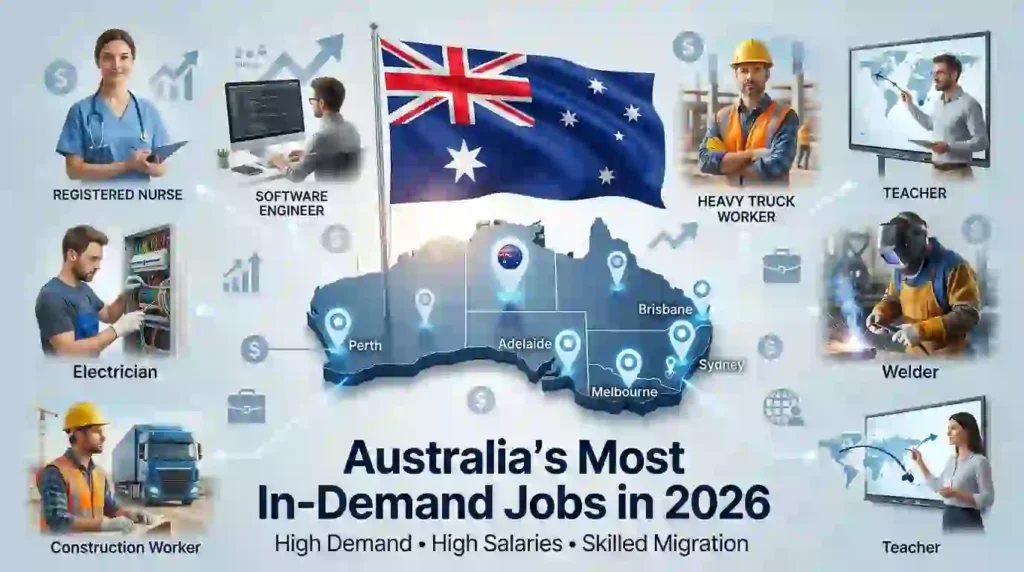
This is arguably more important than the raw average salary in Australia if you are considering migration. Jobs and Skills Australia found that 29% of assessed occupations were in national shortage in 2025, and 139 roles have appeared on that shortage list every single year since 2021.
The occupations that show up again and again: registered nurses, general practitioners, software programmers, civil engineers, electricians, and secondary teachers in maths and science. If your occupation falls into one of these categories, you are in a strong position, both for pay and for how quickly a skilled visa application is likely to move. Our full Australia Skilled Worker Visa 2026 guide covers eligibility, the points test, and the entire application process step by step, and is worth reading alongside this salary breakdown if you are seriously considering the move.

How Location Affects the Average Salary in Australia
Industry has the biggest impact on the average salary in Australia, but location plays a real secondary role. Sydney typically pays the most for professional roles, running about 9% above the national average according to recruitment data from Robert Half’s Australia salary guide. The Australian Capital Territory also sits near the top of the state rankings, largely because its workforce is dominated by well-paid public sector positions. Regional areas generally pay less on paper, but often come with a significantly lower cost of living, which can make the real-world value of a regional salary higher than it first appears.
Average Salary in Australia vs Other Migration Destinations
If you are choosing between countries rather than just checking a number, context matters. The median average salary in Australia, around $74,000 to $90,000 a year, holds up well against comparable roles in the UK once cost of living is factored in, and is broadly competitive with the United States. If you are weighing up multiple options, our guides on the Average Salary in Canada 2026 and Average Salary in USA 2026 break down the equivalent figures so you can compare properly before committing to a specific migration pathway. For a side-by-side look specifically at Canada versus European destinations, our Canada vs Europe for Immigrants guide covers many of the same trade-offs that apply when comparing Australia to other options.
Superannuation: The Part of the Average Salary in Australia People Forget
One detail that regularly trips up newcomers comparing salaries internationally: the average salary in Australia quoted in job ads and ABS data is usually the base figure before superannuation. Employers are currently required to pay 12% superannuation on top of your salary into a retirement fund, which is effectively extra compensation that does not show up in your take-home pay but does show up in your total remuneration package. When comparing a job offer in Australia to one in the UK, USA, or Europe, always ask whether the quoted figure includes super, because it meaningfully changes the real value of the offer.
Is $100,000 a Good Salary in Australia in 2026?
Given everything above, $100,000 puts you comfortably above the median and roughly in the top 30% of full-time earners in the country. It is above the realistic average salary in Australia for most individual workers, though its real-world value still depends heavily on where you live. Sydney and Melbourne compress purchasing power significantly due to housing costs, while the ACT, Adelaide, and regional Queensland tend to offer a better return on an equivalent salary.
The Bottom Line
The average salary in Australia is a useful headline figure, but it is not the number that should drive your decision. What actually matters is your occupation, your experience level, and whether your role sits on Australia’s genuine shortage list. Skilled trades, healthcare, engineering, and technology consistently deliver the strongest average salary in Australia across the board, while admin and hospitality roles sit toward the lower end of the national scale.
If your occupation is in demand, 2026 is a strong year to take Australia seriously, both for the pay itself and for how quickly the skilled migration process is likely to move once you apply. Before you start job hunting, it is worth making sure your resume is ready for the Australian market — you can build one for free using our Free ATS Resume Builder.
Frequently Asked Questions
What is the average salary in Australia in 2026?
The average full-time salary in Australia in 2026 is around $106,657 a year, based on ABS data from November 2025. The median, which better reflects a typical worker, sits closer to $74,672 to $90,000 a year.
Which occupation pays the most in Australia in 2026?
Mining-related roles pay the most, with average weekly earnings around $3,174.50. Mining engineers, ICT security specialists, and data scientists are also among the highest-paid individual occupations.
What is the average nurse salary in Australia in 2026?
Registered nurses typically earn between $75,000 and $95,000 a year, with senior and specialist nurses earning well over $110,000. Nursing remains one of Australia’s largest and most in-demand occupations.
Is $100,000 a good salary in Australia in 2026?
Yes, $100,000 puts you in roughly the top 30% of full-time earners, well above the national median. Its real value still depends on where you live, since Sydney and Melbourne have a much higher cost of living.
Which jobs are in shortage in Australia in 2026?
Registered nurses, general practitioners, software programmers, civil engineers, electricians, and secondary teachers in maths and science are among the occupations consistently in national shortage, making them strong picks for skilled migration.