
If you are dreaming of building a new life in a country known for high wages, world-class healthcare, and genuine career growth, the Australia Skilled Worker Visa is probably the first thing you have already searched for. And you are not wrong to look here — Australia continues to be one of the most welcoming destinations for skilled foreign professionals in 2026, actively inviting thousands of applicants every month through its points-based migration system.

But here is the part most people get wrong: the Australia Skilled Worker Visa is not a single visa. It is a group of pathways, each with different rules, different points requirements, and different outcomes. Choosing the wrong one — or misunderstanding how the points test works — can cost you months, sometimes years, of wasted effort. This guide breaks down everything you need to know about the Australia Skilled Worker Visa in 2026, in plain language, so you can move forward with a clear plan instead of guesswork.
Table of Contents
What Is the Australia Skilled Worker Visa?
The Australia Skilled Worker Visa is the general term used for Australia’s points-tested skilled migration program, managed by the Department of Home Affairs. Unlike an employer-sponsored visa, most pathways under the Australia Skilled Worker Visa system do not require a job offer. Instead, you are assessed on your age, skills, work experience, English ability, and qualifications — and if you score high enough, you receive an invitation to apply for permanent or provisional residence.
This system exists because Australia has ongoing skill shortages in healthcare, engineering, IT, trades, and education. Rather than waiting for employers to sponsor individual workers, the government runs an open pool where qualified people from anywhere in the world can apply directly.
The Three Main Pathways Under the Australia Skilled Worker Visa
There are three subclasses that fall under the Australia Skilled Worker Visa umbrella, and understanding the difference is the single most important step before you start.
| Visa Subclass | Type | Sponsorship Needed | Where You Can Live |
|---|---|---|---|
| Subclass 189 | Permanent | None (independent) | Anywhere in Australia |
| Subclass 190 | Permanent | State/territory nomination | Nominating state (initially) |
| Subclass 491 | Provisional (5 years) | State or family sponsorship | Designated regional areas |
The subclass 189 is the most flexible option under the Australia Skilled Worker Visa program because it gives you full freedom to live and work anywhere in the country. However, it is also the most competitive, since it depends purely on your own points score with no bonus points from a state.
The subclass 190 adds 5 points to your score in exchange for a commitment to live in the nominating state for at least two years. The subclass 491 adds 15 points but is provisional, meaning you will need to convert it to permanent residence later through the subclass 191 after meeting regional living and income conditions.
Eligibility Criteria for the Australia Skilled Worker Visa
Before applying for any pathway under the Australia Skilled Worker Visa, you need to meet the following baseline requirements:
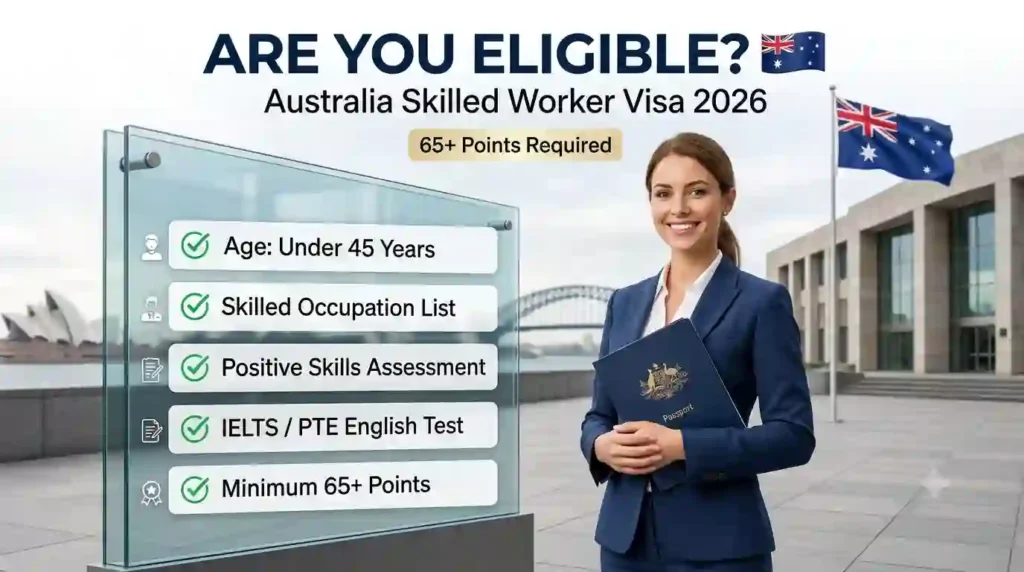
- Age: You must be under 45 years old at the time of invitation
- Occupation: Your job must appear on the relevant skilled occupation list
- Skills Assessment: A positive assessment from the relevant authority for your occupation (for example, ACS for IT, ANMAC for nursing, or Engineers Australia for engineering roles)
- English Language: A minimum score in an approved test such as IELTS or PTE
- Points Score: At least 65 points to enter the pool, though most successful applicants in 2026 are scoring well above that
Meeting the minimum requirements does not guarantee an invitation under the Australia Skilled Worker Visa program — it only makes you eligible to submit an Expression of Interest. Invitations are competitive, and higher-scoring candidates in in-demand occupations get invited first.
Australia Skilled Worker Visa Points Test Breakdown
The points test is the backbone of the entire Australia Skilled Worker Visa system. Here is a simplified breakdown of where most people earn their points:
| Factor | Maximum Points |
|---|---|
| Age (25-32 years scores highest) | 30 |
| English Language Ability | 20 |
| Skilled Work Experience (overseas) | 15 |
| Skilled Work Experience (in Australia) | 20 |
| Educational Qualification | 20 |
| State Nomination (190 only) | 5 |
| Regional Nomination/Sponsorship (491 only) | 15 |
| Partner Skills | 10 |
If you are early in your career, do not be discouraged by a lower score. Many applicants improve their points over 12 to 18 months by retaking their English test, gaining more experience, or completing a professional year program.
Documents You Will Need
Applying for the Australia Skilled Worker Visa requires solid preparation. Have these ready before you start your Expression of Interest:
- Valid passport
- Positive skills assessment result
- English test results (IELTS, PTE, or equivalent)
- Educational transcripts and degree certificates
- Employment reference letters with duties clearly stated
- Police clearance certificates from every country you lived in for 12+ months in the last 10 years
- Health examination results (requested after invitation)
Incomplete or inconsistent documentation is one of the most common reasons genuine Australia Skilled Worker Visa applications get delayed or sent back for more information.
Step-by-Step Australia Skilled Worker Visa Application Process
- Get your skills assessed — apply to the relevant assessing authority for your occupation and wait for a positive result. This can take anywhere from a few weeks to a few months.
- Take an approved English test — aim for the highest score you can, since English points make a real difference in your total score.
- Calculate your points — be honest with yourself here. Overestimating your score wastes time later in the process.
- Submit an Expression of Interest (EOI) through SkillSelect — this is the official government system where your profile is ranked against other applicants.
- Wait for an invitation — invitation rounds happen periodically, and higher-scoring profiles in priority occupations are invited first.
- Lodge your visa application — once invited, you generally have 60 days to submit your full application with supporting documents.
- Complete health and character checks — this includes medical exams and police clearances.
- Receive a decision — based on recent Department of Home Affairs data, many subclass 189 applications are finalized within roughly 5 months of lodgement, though this varies by case.
You can read the official details on the subclass 189 visa directly on the Department of Home Affairs website, and check current processing priorities on their visa processing priorities page.
Australia Skilled Worker Visa Fees and Processing Time
| Item | Approximate Cost/Time (2026) |
|---|---|
| Base application charge (primary applicant) | Several thousand AUD (varies by visa type) |
| Additional applicant charge (partner/dependents) | Additional cost per person |
| Skills assessment fee | Varies by assessing authority |
| English test fee | Varies by test provider |
| Processing time (subclass 189) | Roughly 5-12 months after lodgement |
Because fees and processing benchmarks are updated periodically, always confirm the latest numbers on the official government page before budgeting for your application.
In-Demand Occupations for the Australia Skilled Worker Visa in 2026
Australia’s skill shortages are heavily concentrated in a handful of sectors, and applicants in these fields generally see faster invitations under the Australia Skilled Worker Visa program:
- Registered nurses and healthcare professionals
- Secondary school teachers
- Software engineers and developers
- Civil, mechanical, and electrical engineers
- Accountants and auditors
- Electricians, plumbers, and other skilled trades
- Early childhood educators
Healthcare and education occupations are currently prioritized in invitation rounds, which means candidates in these fields often need fewer points to receive an invitation compared to saturated fields like general IT or accounting.
What You Can Expect to Earn After Moving
One of the biggest reasons people pursue the Australia Skilled Worker Visa is the earning potential once you arrive. Skilled trades, healthcare workers, and engineers in Australia consistently earn well above minimum wage, and many regional areas offer additional incentives to attract skilled migrants — which is part of why the subclass 491 pathway has become so popular among applicants who are flexible about location.
Common Mistakes to Avoid
Even strong candidates make avoidable mistakes when applying for the Australia Skilled Worker Visa. Watch out for these:

- Applying before your skills assessment is finalized — this wastes your EOI submission and can cost you months
- Overestimating English or work experience points — inaccurate claims can lead to visa refusal
- Ignoring regional pathways — many applicants only chase the subclass 189 and miss faster, realistic options through 190 or 491
- Submitting inconsistent employment letters — dates, duties, and hours must match across all documents
- Waiting too long to update your EOI — points can change as you gain experience, and an outdated EOI can cost you a higher ranking
Final Thoughts
The Australia Skilled Worker Visa remains one of the most realistic and rewarding pathways for skilled foreign workers who want more than just a temporary job abroad — it offers a genuine route to permanent residence in a country with strong wages, quality healthcare, and long-term stability. The process takes patience, accurate documentation, and an honest points assessment, but thousands of people successfully move through this pathway every year.
If you are also comparing your options across other countries, it may help to look at how the Canada work visa process compares step-by-step, or check the average salary in Canada if you are weighing Australia against other high-demand destinations before making your final decision.
Frequently Asked Questions
What is the minimum points score for the Australia Skilled Worker Visa in 2026?
You need at least 65 points to submit an Expression of Interest, but most successful applicants score 70-95+ depending on the visa subclass and occupation demand.
Do I need a job offer for the Australia Skilled Worker Visa?
No. Most pathways under the Australia Skilled Worker Visa, including subclass 189, 190, and 491, do not require a job offer since they are points-tested rather than employer-sponsored.
Which is faster, subclass 189, 190, or 491?
The subclass 491 is often the fastest route to an invitation for applicants with moderate points, since it adds 15 bonus points for regional nomination or sponsorship, while the 189 requires the highest independent score.
How long does the Australia Skilled Worker Visa take to process?
Based on recent Department of Home Affairs data, many subclass 189 applications are finalized within approximately 5 months after lodgement, though this varies by occupation and case complexity.
Can I include my family in my Australia Skilled Worker Visa application?
Yes, you can include your spouse or partner and dependent children in your application, and your partner’s skills may even add extra points to your total score.