
USA Jobs With Visa Sponsorship for Skilled Workers 2026
If you are a skilled worker outside the United States and you are serious about building your career there, visa sponsorship is your real starting point. The good news is that in 2026, American employers are still actively hiring international talent across dozens of industries. The demand is real, the opportunities are documented, and for workers with the right skills, the path is more accessible than most people think.
This guide is written for skilled professionals in the UK, Canada, Europe, and beyond who want to understand how USA jobs with visa sponsorship actually work in 2026 — which sectors are hiring, which visa types matter, how to find legitimate roles, and how to position yourself as a candidate worth sponsoring.USA Jobs With Visa Sponsorship for Skilled Workers 2026
Table of Contents
Why US Employers Sponsor Foreign Workers in 2026
The United States continues to face serious skill gaps in technology, healthcare, engineering, and finance. American companies are not sponsoring foreign workers out of generosity — they do it because they genuinely cannot fill specialized roles with local candidates fast enough.
According to the US Bureau of Labor Statistics, healthcare and technology are projected to be among the fastest-growing employment sectors through the mid-2020s. Employers in these fields regularly turn to the international talent pool when domestic hiring falls short.
For skilled workers, this is an important reality to understand. Sponsorship is not a favour. It is a business decision. When a company sponsors you, it is because your skills solve a real problem for them. That mindset shift changes how you approach your job search entirely.
Which Visa Types Cover Skilled Workers
Before searching for jobs, you need to understand which US work visas actually apply to skilled professionals.
- H-1B Visa
The H-1B is the most common visa for skilled foreign workers in the United States. It is designed for roles that require at least a bachelor’s degree or equivalent in a specialized field. Technology, finance, architecture, engineering, and scientific research all fall under H-1B territory.
The H-1B operates through an annual lottery system run by US Citizenship and Immigration Services (USCIS). Employers file the petition on your behalf, and your registration enters the lottery. In recent years, the cap has been set at 65,000 regular visas plus 20,000 for advanced degree holders from US universities.
Because of the lottery, timing and employer selection matter enormously. Large technology firms and consulting companies file in high volumes and increase your odds significantly.
- L-1 Visa
If you already work for a multinational company with offices in the US, the L-1 visa allows an intracompany transfer. There is no lottery involved. This is often a faster and more predictable route for skilled professionals already employed by global firms.
- TN Visa
Citizens of Canada and Mexico benefit from the TN visa under the USMCA trade agreement. It covers specific professional categories including engineers, accountants, scientists, and healthcare professionals. The TN is notably easier to obtain than the H-1B and has no annual cap.
- O-1 Visa
The O-1 is reserved for individuals with extraordinary ability or achievement in their field — science, arts, business, education, or athletics. It is competitive but has no lottery. If you have a strong professional track record, publications, awards, or notable achievements, this is worth researching with an immigration attorney.
- EB-3 Green Card (Employer-Sponsored)
For workers aiming at permanent residency rather than a temporary work visa, the EB-3 immigrant visa is relevant. It covers skilled workers, professionals, and some unskilled workers. Healthcare recruitment agencies, particularly those hiring registered nurses, commonly use the EB-3 route for international candidates.
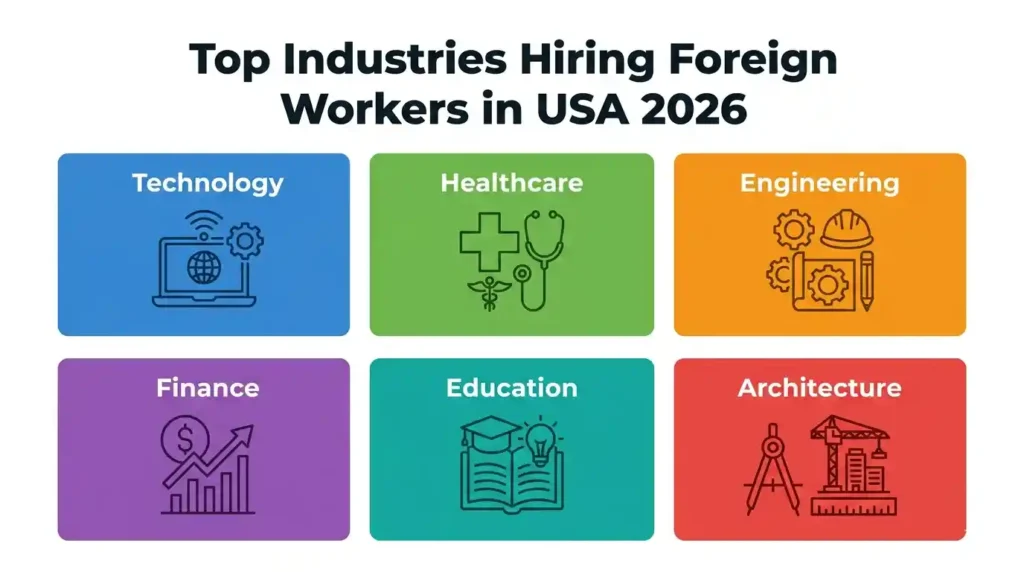
Top Industries Actively Sponsoring Skilled Workers in 2026
- Technology
Software engineers, data scientists, cloud architects, cybersecurity analysts, and AI/ML specialists remain the highest-demand roles in the US job market. Companies like Google, Microsoft, Amazon, Meta, and IBM are consistently among the top H-1B sponsors in the country.
Startups and mid-size tech firms also sponsor, though less frequently. Targeting established tech employers with documented sponsorship history is a smarter strategy than applying broadly.
- Healthcare
The US is facing a significant and ongoing nursing shortage. International registered nurses, particularly those with ICU, emergency, or surgical experience, are being actively recruited. Staffing agencies working under the EB-3 visa route are placing nurses from the Philippines, India, Nigeria, and increasingly from UK-trained candidates as well.
Beyond nursing, physicians with J-1 waiver eligibility, physical therapists, radiologists, and pharmacists are all in demand with documented sponsorship pathways.
- Engineering
Civil, mechanical, electrical, and petroleum engineers are consistently hired through H-1B and other skilled worker routes. Infrastructure investment in the US has increased demand for qualified engineers across both public and private sector projects.
- Finance and Accounting
Chartered accountants, financial analysts, quantitative analysts, and compliance officers are regularly sponsored by investment banks, asset management firms, and consulting companies. CPA qualification or equivalent international credentials strengthen your application considerably.
- Education and Research
University faculty, research scientists, and postdoctoral researchers often work on J-1 or H-1B visas. Higher education institutions are among the most reliable sponsoring employers for international academics.
- Architecture and Construction
Licensed architects and structural engineers with international credentials have found strong pathways into the US market, particularly in states with active development such as Texas, Florida, and California.
Top Companies That Sponsor US Work Visas in 2026
Some of the most active H-1B sponsoring employers in recent years include:
Amazon — consistent top-volume H-1B filer across tech and logistics roles
Google / Alphabet — heavy sponsorship in engineering and data science
Microsoft — sponsors across software, product, and cloud roles
Cognizant, Infosys, Tata Consultancy Services — IT services firms that file very high volumes
Deloitte, Ernst & Young, PwC, KPMG — consulting and finance roles
Apple — engineering and research positions
Kaiser Permanente, HCA Healthcare — nursing and physician sponsorship
You can verify an employer’s actual sponsorship history using the USCIS H-1B Employer Data Hub at uscis.gov, which is free and publicly searchable. This is one of the most underused tools by international job seekers.
How to Find Legitimate USA Jobs With Visa Sponsorship
The biggest challenge in this space is not a lack of jobs — it is filtering out fake listings and employers who are not genuinely open to sponsorship. Here is how to approach your search properly.
Use MyVisaJobs.com, which aggregates H-1B filing data and lets you search companies by sponsorship volume and occupation. This gives you verified data rather than self-reported claims.
LinkedIn remains the most effective platform for professional networking and direct outreach. Many hiring managers respond to direct messages from qualified candidates. When you reach out, keep it specific — mention your skill set, your visa situation clearly, and ask whether the company has an immigration process in place.
Indeed and LinkedIn both allow you to filter job listings by “visa sponsorship” or “willing to sponsor.” Use these filters consistently and set up job alerts with your target keywords.
Staffing agencies that specialize in international placement are another legitimate route, particularly in healthcare and IT. Be cautious of agencies that charge candidates upfront fees — legitimate US employers pay sponsorship filing costs, not the employee.
What Makes Employers Choose to Sponsor You
Companies sponsor workers when the cost and process of doing so is worth it to them. That calculation depends entirely on how well-matched your skills are to the specific role.
Employers prioritize candidates who already have relevant experience, strong credentials, and a clear track record. If you are applying from the UK, Europe, or Canada, your international qualifications carry real weight — particularly in healthcare, engineering, and finance where professional licensing is recognized.
Writing a US-format resume is essential. American CVs differ significantly from UK or European standards. They are typically one to two pages, use clean formatting compatible with Applicant Tracking Systems (ATS), and focus on quantified achievements rather than duties. workercv.com offers a free ATS-compatible resume builder that is designed to help international candidates format their profiles to US employer standards.
When your application lands in front of a US recruiter, the first thirty seconds matter. Clarity, keyword relevance, and formatting are what get you past the ATS and into a human’s hands.
Salary Expectations for Sponsored Roles in 2026
Salaries for visa-sponsored positions in the US vary significantly by role, location, and employer. According to ZipRecruiter data from mid-2026, the average annual pay for sponsored roles sits around $78,000 to $80,000. However, this average covers a wide range.
Software engineers in major tech hubs earn between $110,000 and $180,000. Registered nurses in high-demand states earn $70,000 to $110,000. Data scientists in finance or technology roles frequently exceed $130,000. Civil engineers typically earn between $75,000 and $105,000 depending on specialization and location.
State matters considerably. California, New York, Washington, and Texas have the highest concentration of sponsoring employers but also the highest cost of living. States like North Carolina, Georgia, and Tennessee are increasingly attractive due to growing tech sectors with lower living costs.
Common Mistakes That Cost Skilled Workers Their Sponsorship Opportunity
Applying too broadly and not tailoring applications to companies with a documented sponsorship history wastes time. Prioritize quality over volume.
Not disclosing your visa requirement honestly is a serious mistake. Many candidates try to hide their sponsorship need early in the process, only to have it surface later and damage trust. Be transparent from the first interaction — it filters in the right employers and filters out the wrong ones quickly.
Relying on generic job boards without filtering for sponsorship-open employers leads to frustration. Use data-backed resources like MyVisaJobs or LinkedIn’s sponsorship filter to focus your effort.
Ignoring the H-1B lottery timeline is another costly error. The registration window typically opens in March, with the lottery drawn shortly after. If you miss this window, you are looking at a full year’s delay. Planning your job search around this timeline is critical.
Where to Start Right Now
If you are serious about USA jobs with visa sponsorship in 2026, these are your immediate next steps.
Research your target role using the USCIS H-1B Employer Data Hub to identify which companies actively sponsor in your field. Update your resume to US format — clean, ATS-compatible, achievement-focused. Create a targeted list of 20 to 30 employers with proven sponsorship records. Begin applying on LinkedIn and Indeed with sponsorship filters active. If budget allows, consult a US immigration attorney early. Even a one-hour consultation can clarify your specific visa pathway and save months of misdirected effort.
The US job market in 2026 remains one of the most accessible and well-paying destinations for skilled international workers. The process takes patience and strategy, but for workers who approach it with the right information, the opportunity is genuinely there.
Frequently Asked Questions
More Guides You Will Find Useful
Which jobs in the USA offer visa sponsorship for skilled workers in 2026?
The most commonly sponsored jobs in the USA for skilled workers in 2026 are in technology (software engineers, data scientists, cybersecurity analysts), healthcare (registered nurses, physicians, pharmacists), engineering (civil, mechanical, electrical), finance (accountants, financial analysts), and architecture. These sectors face ongoing skill shortages, which is why US employers regularly sponsor foreign workers through visas like H-1B and EB-3.
How can I find US employers that sponsor work visas?
The most reliable way is to use the free USCIS H-1B Employer Data Hub at uscis.gov, which shows exactly which companies have filed sponsorship petitions and how many. You can also use MyVisaJobs.com, filter job searches on LinkedIn and Indeed by “visa sponsorship,” and target companies with a documented history of hiring international talent such as Amazon, Google, Microsoft, Deloitte, and major healthcare networks.
What is the easiest US work visa to get sponsored for in 2026?
For skilled professionals, the TN visa is generally the most straightforward — but it is only available to citizens of Canada and Mexico under the USMCA agreement. For workers from the UK, Europe, Pakistan, India, and other countries, the H-1B is the most common route, though it involves an annual lottery. The L-1 visa is another easier option if you already work for a multinational company with US offices, as there is no lottery involved.
How long does US visa sponsorship take for skilled workers?
The timeline varies by visa type. H-1B petitions are typically filed in March, with lottery results in April and work start dates from October 1st — meaning the full process can take 6 to 9 months from job offer to start date. Premium processing (an additional fee paid by the employer) can speed up USCIS adjudication to around 15 business days. EB-3 green card sponsorship takes significantly longer, often 1 to 3 years or more depending on your country of birth.
Can unskilled or semi-skilled workers get visa sponsorship for the USA?
Yes. While most coverage focuses on skilled professionals, unskilled and semi-skilled workers can also be sponsored through the H-2B visa (seasonal non-agricultural work such as hospitality, landscaping, and food processing) and the H-2A visa (agricultural work). The EB-3 category also includes a pathway for certain unskilled workers seeking permanent residency. These routes are more limited in numbers but are legitimate and actively used by US employers each year.