
Ireland has quietly become one of Europe’s most attractive destinations for skilled foreign professionals, and getting an Ireland Work Permit for Foreigners in 2026 is now a well-defined, structured process if you know exactly which route to follow. With a booming tech sector in Dublin, a growing healthcare system, and English as the first language, thousands of non-EEA nationals apply for an Irish employment permit every single year. But the system has multiple permit categories, updated salary thresholds, and strict documentation rules that trip up even well-qualified applicants.
This guide breaks down everything you need to know about the Ireland Work Permit for Foreigners in 2026 — the permit types, updated salary requirements, step-by-step application process, required documents, processing times, and the fastest path to long-term residency. Whether you’re a software engineer in Lagos, a nurse in Manila, or an engineer in Karachi, this article will help you understand exactly how the Ireland Work Permit for Foreigners system works and how to avoid the mistakes that get applications refused.
Table of Contents
Why Foreign Workers Are Choosing Ireland in 2026
Ireland’s economy has continued to attract multinational employers — Google, Amazon, Meta, Accenture, Pfizer, and dozens of pharmaceutical and financial services companies operate major hubs in Dublin, Cork, and Galway. This corporate presence is precisely why demand for the Ireland Work Permit for Foreigners has grown steadily. Employers in technology, engineering, healthcare, and finance regularly hire outside the EU/EEA because local talent supply cannot meet demand in these sectors.
Beyond the job market, Ireland offers three practical advantages that foreign applicants consistently mention when comparing European destinations. First, English is the working language, which removes the barrier that affects applicants heading to Germany, France, or the Netherlands. Second, Ireland offers one of the fastest routes to long-term settlement in Europe — permit holders can apply for unrestricted residency (Stamp 4) in under two years. Third, spouses of employment permit holders are granted strong work rights, which is not guaranteed under many other European sponsorship systems.
Understanding the Ireland Work Permit for Foreigners System
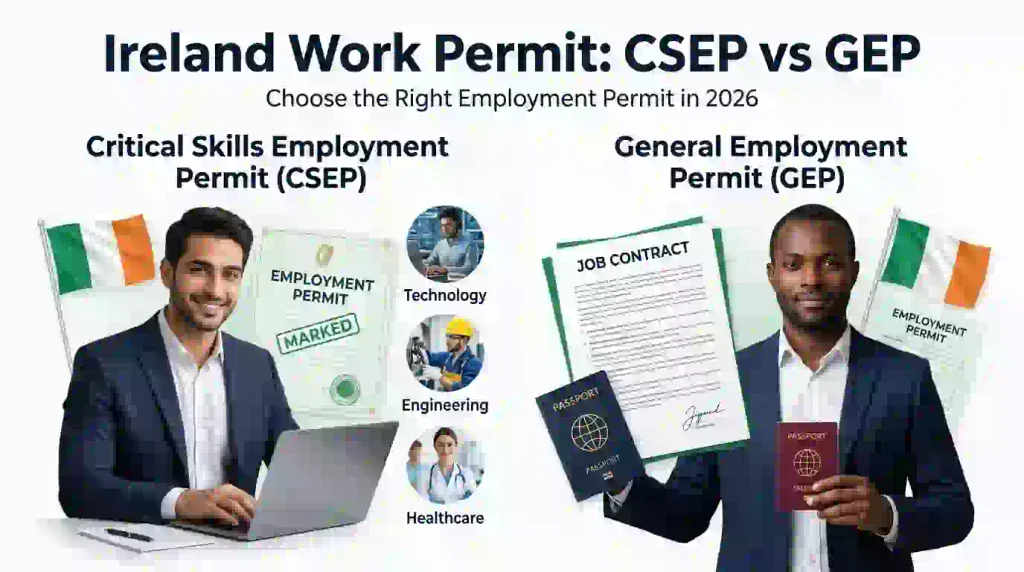
Any non-EEA national who wants to work in Ireland needs an employment permit issued by the Department of Enterprise, Tourism and Employment (DETE), unless they are otherwise exempt. EEA, EU, and Swiss citizens do not need one. The Employment Permits Act 2024, as amended, allows for nine different types of employment permits to be granted, but in practice, almost every applicant researching the Ireland Work Permit for Foreigners route ends up choosing between two main categories: the Critical Skills Employment Permit and the General Employment Permit.
1. Critical Skills Employment Permit (CSEP)
This is the premium and most sought-after category within the Ireland Work Permit for Foreigners system. It is designed for occupations Ireland urgently needs, and it comes with the fastest track to permanent settlement. Eligible occupations under this permit type are considered critically important to growing Ireland’s economy, are in high demand, and face a significant shortage of supply in the labour market — roles such as ICT professionals, professional engineers, and technologists are typically covered.
To qualify for this route of the Ireland Work Permit for Foreigners, applicants generally need:
- A valid full-time job offer from a registered Irish employer
- A role that appears on the official Critical Skills Occupations List, or a high enough salary if the role is not listed
- A relevant third-level qualification or equivalent professional experience
- A job contract lasting at least two years
2. General Employment Permit (GEP)
The second major pathway under the Ireland Work Permit for Foreigners umbrella is the General Employment Permit. This permit replaced the old Work Permit Employment Permit and is the primary route used by the State to attract non-EEA nationals for occupations experiencing a labour or skills shortage. Unlike the Critical Skills route, the General Employment Permit assumes all occupations are eligible unless they appear on the official Ineligible List of Occupations for Employment Permits, which makes it a broader, more flexible option for applicants whose profession isn’t on the Critical Skills list.
There are also several smaller categories under the Ireland Work Permit for Foreigners framework — including the Intra-Company Transfer Permit for multinational staff being relocated to an Irish branch, Dependant/Partner/Spouse permits, and permits for specific sectors like sea fishing. Most first-time applicants, however, will fall under either CSEP or GEP.
Eligibility Criteria for the Ireland Work Permit for Foreigners
Regardless of which category you apply under, every Ireland Work Permit for Foreigners application is assessed against a consistent set of core requirements:
- You must be a non-EEA national, since EU, EEA, and Swiss citizens do not require a permit
- You must hold a genuine, full-time job offer from a bona-fide employer registered with Ireland’s Revenue Commissioners
- Your occupation and salary must meet the relevant threshold for the permit type you’re applying under
- A signed employment contract must accompany the application
- Applications must be submitted at least 12 weeks before the proposed employment start date, and there is a strict 28-day cut-off from starting an application to submitting it, after which incomplete applications are automatically deleted
If your qualifications don’t directly match the role, or your employer isn’t properly registered, your Ireland Work Permit for Foreigners application will almost certainly be refused — so accuracy at this stage matters far more than speed.
Updated Salary Thresholds for 2026
Salary is one of the biggest deciding factors in any Ireland Work Permit for Foreigners application, and the numbers changed in 2026. From 1 March 2026, the minimum annual salary requirement for employment permits increased under a new roadmap for Minimum Annual Remuneration. Under the current structure:
- Critical Skills Employment Permit: €40,904 for roles on the Critical Skills Occupation List, or €68,911 for other eligible roles
- General Employment Permit: €36,605 for most occupations
- A reduced threshold of roughly €36,848 may apply if you qualified within the past 12 months and your role is on the Critical Skills list
These thresholds are reviewed periodically, so anyone researching the Ireland Work Permit for Foreigners process should always confirm the latest figures directly with the Department before submitting an application, since salary requirements are one of the most common reasons applications get rejected.
Step-by-Step Application Process
Applying for the Ireland Work Permit for Foreigners system follows a fairly linear process once you understand the sequence:
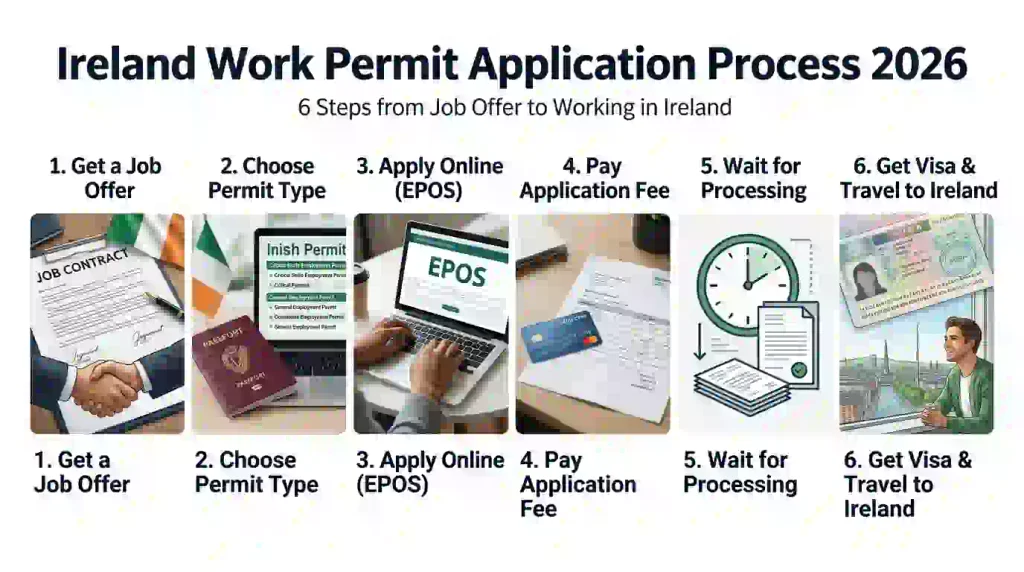
Step 1: Secure a job offer. Nothing moves forward on an Ireland Work Permit for Foreigners application without a genuine, signed job offer from a registered Irish employer.
Step 2: Determine the correct permit category. Check whether your occupation sits on the Critical Skills Occupations List or the Ineligible List, since this decides whether you apply for CSEP or GEP.
Step 3: Submit your application through Employment Permits Online (EPOS). All Ireland Work Permit for Foreigners applications are lodged through this online portal, and either you or your employer can submit it. Most employers manage this step directly.
Step 4: Pay the application fee. The standard fee is €1,000 for a two-year Critical Skills permit, though fees vary by permit type and duration.
Step 5: Wait for processing. Standard processing currently runs around 4 to 8 weeks for straightforward applications, though this can extend during periods of high demand.
Step 6: Apply for your entry visa (if required). Applicants from visa-required countries must apply for a D-visa once the permit itself is granted.
Step 7: Travel and register in Ireland. Once you arrive, you must register with the local immigration office and obtain your Irish Residence Permit (IRP) card — in Dublin, this happens at the Burgh Quay Registration Office.
Documents You’ll Typically Need
Every Ireland Work Permit for Foreigners application should be backed by a complete and accurate document set, including:
- A valid passport with sufficient remaining validity
- Signed employment contract detailing salary, job title, and duration
- Proof of relevant qualifications or equivalent work experience
- Evidence of employer registration with Revenue
- Passport-sized photographs meeting Irish visa specifications
- Proof of application fee payment
Missing or inconsistent documentation is one of the most common reasons an Ireland Work Permit for Foreigners application gets delayed or refused, so it’s worth double and triple-checking everything before submission.
Family Reunification and Spouse Work Rights
One of the strongest selling points of the Ireland Work Permit for Foreigners system, especially compared to other European countries, is how it treats family members. Holders of the Critical Skills Employment Permit can apply for family reunification to bring their spouse or civil partner, along with minor dependent children, to Ireland. If approved, the relatives receive a Stamp 1G, and after arriving in Ireland, spouses can apply for a Dependant/Partner/Spouse Employment Permit that grants full access to the Irish labour market — without needing separate sponsorship. This is a meaningfully better arrangement than the restricted spousal work rights found under many competing European permit systems.
The Path to Long-Term Residency (Stamp 4)
For most applicants, the real appeal of the Ireland Work Permit for Foreigners route is what happens after the permit itself: eligibility for Stamp 4, Ireland’s unrestricted residency status. Critical Skills Employment Permit holders can apply for Stamp 4 after roughly 21 months of continuous employment with their sponsoring employer, which is considerably faster than the settlement timelines in most other EU countries. General Employment Permit holders typically follow a longer path, usually requiring around five years of continuous employment before qualifying for long-term residency.
Once granted, Stamp 4 removes the employer-tied restriction entirely, allowing the holder to work for any employer in Ireland without needing a new permit — a major upgrade in flexibility for anyone who started out on the Ireland Work Permit for Foreigners track.
Common Mistakes Applicants Make
Having reviewed how thousands of applications succeed or fail, a few recurring mistakes stand out for anyone applying for the Ireland Work Permit for Foreigners:
- Applying for the wrong permit category, especially assuming a role qualifies for Critical Skills when it’s actually only eligible under the General Employment Permit
- Submitting an incomplete contract that doesn’t clearly state salary, job title, and duration
- Missing the 12-week minimum lead time before the proposed start date
- Letting the application sit unfinished past the 28-day cut-off, which forces a complete restart
- Underestimating how strictly qualifications must match the job role on paper
Avoiding these errors is often the real difference between a smooth Ireland Work Permit for Foreigners approval and months of unnecessary delay.
Ireland vs Other Immigration Destinations
If you’re weighing Ireland against other options, it helps to see how the numbers and pathways compare. Many applicants researching the Ireland Work Permit for Foreigners route are also comparing Canada and mainland Europe as alternatives — our detailed breakdown on Canada vs Europe for immigrants is a useful next read if you want to weigh points-based immigration against employer-sponsored routes like Ireland’s before making a final decision.
Ireland’s biggest advantages remain its English-speaking workplace, the comparatively fast 21-month route to unrestricted residency, and generous spouse work rights — but Canada’s permanent-residency-first model and mainland Europe’s broader Blue Card system each offer their own trade-offs worth understanding before you commit time and money to any single country’s process.
Final Tips Before You Apply
The Ireland Work Permit for Foreigners system rewards preparation. Before you or your employer submit anything through EPOS, confirm your occupation’s current listing status, verify the latest salary threshold for your permit type, and make sure your contract and qualifications line up exactly with the job description your employer is submitting. Since thresholds and occupation lists are reviewed periodically, always check the Department’s official page for the most current figures rather than relying on older sources.
For internationally job-hunting professionals building their application package, having a strong, ATS-friendly resume ready before you start job hunting for Irish employers makes a real difference in getting the job offer that anchors your entire Ireland Work Permit for Foreigners application in the first place. You can put one together for free using our ATS resume builder on WorkerCV before you start applying to Irish employers.
Getting an Ireland Work Permit for Foreigners approved in 2026 comes down to three things: the right job offer, the right permit category, and a complete, accurate application. Get those three right, and Ireland’s fast track to European residency is very much within reach.
Useful official resources:
- Department of Enterprise, Tourism and Employment – Employment Permits
- Citizens Information – Employment Permits Ireland
- Employment Permits Online (EPOS) – Official Application Portal
Who needs an Ireland Work Permit for Foreigners in 2026?
Any non-EEA national who wants to work in Ireland needs an employment permit, unless exempt. EU, EEA, and Swiss citizens do not require one.
What is the minimum salary for an Ireland Work Permit for Foreigners?
From March 2026, the Critical Skills Employment Permit requires €40,904 (listed roles) or €68,911 (other roles), while the General Employment Permit requires €36,605 for most occupations.
How long does it take to get an Ireland Work Permit for Foreigners approved?
Standard processing typically takes 4 to 8 weeks, though this can extend during periods of high application volume.
Can my spouse work in Ireland on my employment permit?
Yes. Spouses and civil partners of Critical Skills Employment Permit holders can apply for a Dependant/Partner/Spouse permit, which grants full access to the Irish labour market.
How soon can I apply for permanent residency after getting an Ireland Work Permit for Foreigners?
Critical Skills Employment Permit holders can apply for Stamp 4 (unrestricted residency) after about 21 months of continuous employment.
What is the application fee for an Ireland Work Permit for Foreigners?
The standard fee is €1,000 for a two-year Critical Skills Employment Permit, with fees varying by permit type and duration.