
When people think about moving to Canada for work, the first question that comes to mind is almost always the same — how much will I actually earn? It is a fair question. Knowing the average salary in Canada before you make the move can help you plan your finances, choose the right province, and pick the right career path.
The good news is that Canada remains one of the highest-paying countries in the world for skilled workers in 2026. The average salary has grown steadily over the past few years, driven by high demand in healthcare, technology, and construction. But the numbers vary significantly depending on what you do, where you live, and how much experience you bring to the table.
This guide breaks down the Average Salary in Canada 2026 in a way that is honest, practical, and easy to understand — whether you are planning to move from Pakistan, India, the Philippines, UK, or anywhere else in the world.

Table of Contents
What Is the Average Salary in Canada in 2026?
Let us start with the big number. According to the latest data from Statistics Canada, the average annual salary in Canada in 2026 is approximately:
$62,000 to $68,000 CAD per year
This translates to roughly:
| Time Period | Average Earnings (CAD) |
|---|---|
| Per Year | $62,000 — $68,000 |
| Per Month | $5,100 — $5,650 |
| Per Week | $1,190 — $1,310 |
| Per Hour | $29 — $33 |
These are gross figures — meaning before taxes and deductions. After taxes, your take-home pay will be lower depending on your province and income level. We will cover that in detail later in this guide.
It is also important to understand that these are averages. A truck driver in Saskatchewan earns very differently from a software engineer in Toronto. A nurse in British Columbia earns more than a retail worker in Nova Scotia. The average gives you a starting point — but the real picture is much more detailed.
Canada Minimum Wage in 2026
Before we get into specific salaries, it is important to know the minimum wage — the absolute lowest amount any employer can legally pay you in Canada.
Canada does not have a single national minimum wage for most workers. Each province sets its own. Here are the 2026 minimum wages across Canada:
| Province / Territory | Minimum Wage (CAD/hour) |
|---|---|
| Ontario | $17.20 |
| British Columbia | $17.40 |
| Alberta | $15.00 |
| Quebec | $15.75 |
| Saskatchewan | $14.00 |
| Manitoba | $15.30 |
| Nova Scotia | $15.20 |
| New Brunswick | $15.30 |
| Prince Edward Island | $15.40 |
| Newfoundland & Labrador | $15.60 |
| Federal Workers | $17.30 |
If you are just starting out in Canada — in retail, food service, or general labor — these numbers represent your starting point. But for most skilled foreign workers coming to Canada in 2026, salaries are significantly higher than minimum wage.
Average Salary by Industry in Canada 2026
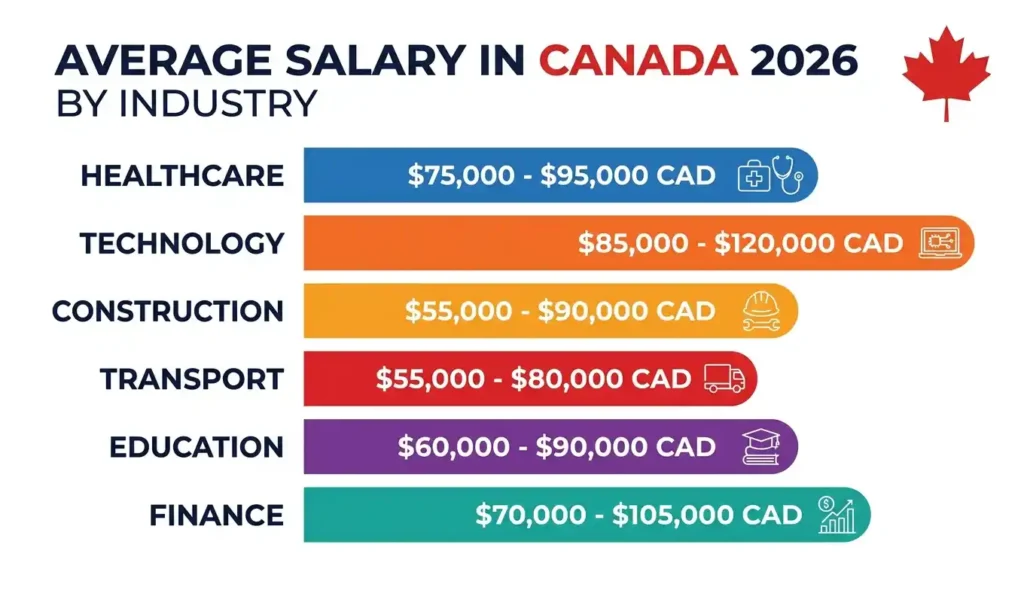
Different industries pay very differently in Canada. Here is a realistic breakdown of what workers earn on average across the most common sectors:
Healthcare and Medical
Healthcare is the single highest-priority industry in Canada right now. The country is dealing with a serious shortage of medical professionals, which means salaries are strong and job security is excellent.
| Job Title | Average Annual Salary (CAD) |
|---|---|
| Registered Nurse | $75,000 — $95,000 |
| General Practitioner (Doctor) | $180,000 — $250,000 |
| Pharmacist | $95,000 — $115,000 |
| Physiotherapist | $70,000 — $90,000 |
| Personal Support Worker | $38,000 — $50,000 |
| Medical Laboratory Technician | $58,000 — $72,000 |
If you are a healthcare professional considering Canada, 2026 is genuinely one of the best years to make the move. Several provinces — including Nova Scotia, Saskatchewan, and Prince Edward Island — are actively running targeted immigration draws specifically for nurses and healthcare workers.
Technology and IT
Canada’s tech industry, particularly in cities like Toronto, Vancouver, and Ottawa, continues to grow strongly. Despite global tech layoffs in some markets, Canada’s domestic demand for tech talent remains high — especially in AI, cybersecurity, and cloud computing.
| Job Title | Average Annual Salary (CAD) |
|---|---|
| Software Developer | $85,000 — $120,000 |
| Data Scientist | $90,000 — $130,000 |
| Cybersecurity Specialist | $95,000 — $135,000 |
| Cloud Engineer | $100,000 — $140,000 |
| UX/UI Designer | $70,000 — $95,000 |
| IT Project Manager | $95,000 — $125,000 |
Tech workers in Canada also benefit from the Global Talent Stream, which fast-tracks work permits in as little as two weeks. If you work in tech and are targeting Canada, this is the pathway worth exploring first.
Construction and Skilled Trades
With Canada’s massive housing crisis and infrastructure expansion plans, skilled tradespeople are in extraordinary demand in 2026. Many provinces are actively fast-tracking immigration for electricians, plumbers, and construction workers.
| Job Title | Average Annual Salary (CAD) |
|---|---|
| Electrician | $65,000 — $90,000 |
| Plumber | $62,000 — $88,000 |
| Welder | $55,000 — $78,000 |
| Construction Project Manager | $85,000 — $115,000 |
| Carpenter | $52,000 — $72,000 |
| HVAC Technician | $58,000 — $80,000 |
What makes trades particularly attractive in 2026 is that many of these roles are available outside of expensive major cities. Working in smaller provinces like Manitoba or New Brunswick means lower competition, easier immigration pathways, and a much lower cost of living.
Transportation and Logistics
Canada’s geography means the country relies heavily on its transportation network. Long-haul truck drivers in particular are in serious demand, and employers are actively recruiting from abroad.
| Job Title | Average Annual Salary (CAD) |
|---|---|
| Long-Haul Truck Driver | $55,000 — $80,000 |
| Bus Driver | $45,000 — $60,000 |
| Warehouse Supervisor | $52,000 — $70,000 |
| Supply Chain Manager | $80,000 — $110,000 |
| Delivery Driver | $40,000 — $55,000 |
Many truck driving positions come with additional benefits like fuel allowances, accommodation on the road, and overtime pay — which can push total earnings significantly higher than the base salary.
Education
| Job Title | Average Annual Salary (CAD) |
|---|---|
| Elementary School Teacher | $60,000 — $85,000 |
| Secondary School Teacher | $65,000 — $90,000 |
| College Professor | $85,000 — $120,000 |
| Early Childhood Educator | $38,000 — $52,000 |
Finance and Banking
| Job Title | Average Annual Salary (CAD) |
|---|---|
| Accountant (CPA) | $70,000 — $100,000 |
| Financial Analyst | $72,000 — $105,000 |
| Investment Banker | $100,000 — $180,000 |
| Bank Teller | $38,000 — $48,000 |
Average Salary by Province in Canada 2026
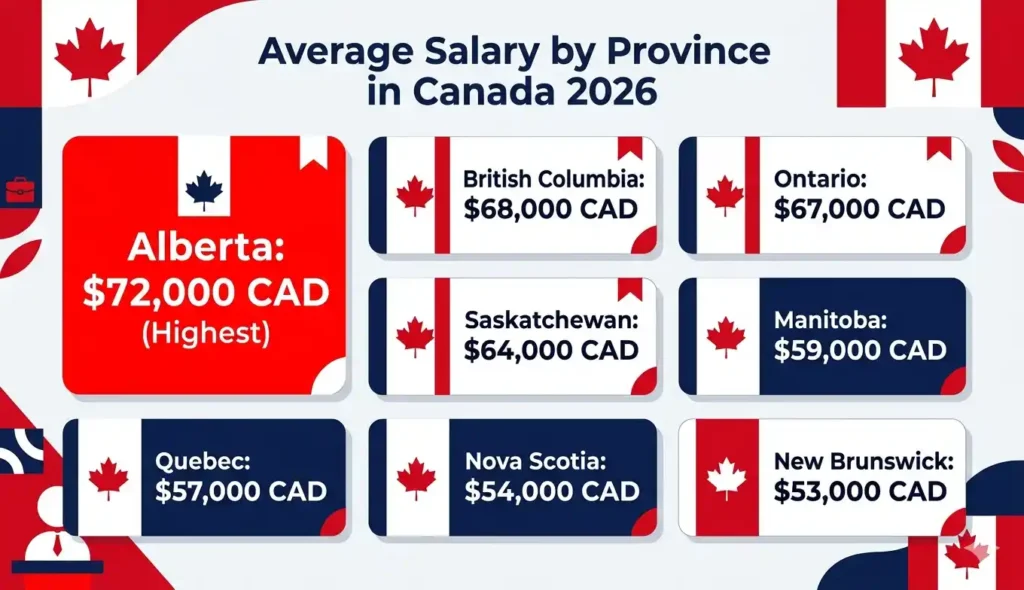
Where you live in Canada matters almost as much as what you do. Here is how average salaries compare across provinces:
| Province | Average Annual Salary (CAD) |
|---|---|
| Alberta | $72,000 |
| British Columbia | $68,000 |
| Ontario | $67,000 |
| Saskatchewan | $64,000 |
| Manitoba | $59,000 |
| Quebec | $57,000 |
| Nova Scotia | $54,000 |
| New Brunswick | $53,000 |
| Newfoundland & Labrador | $58,000 |
| Prince Edward Island | $51,000 |
Alberta consistently leads Canada in average salary, largely due to its oil and gas industry. British Columbia and Ontario are close behind, driven by tech and finance. However, these provinces also have the highest cost of living — particularly for housing in Vancouver and Toronto.
Canada Salary vs Cost of Living — The Real Picture
Earning $70,000 CAD in Toronto sounds great — until you look at the cost of living. Here is a realistic monthly budget for a single person in Canada’s major cities in 2026:
| Expense | Toronto | Vancouver | Calgary | Montreal |
|---|---|---|---|---|
| Rent (1BR) | $2,400 | $2,600 | $1,800 | $1,600 |
| Groceries | $400 | $420 | $380 | $350 |
| Transport | $156 | $112 | $120 | $97 |
| Utilities | $150 | $100 | $180 | $130 |
| Internet | $70 | $70 | $65 | $60 |
| Total | ~$3,176 | ~$3,302 | ~$2,545 | ~$2,237 |
This is why many newcomers to Canada choose cities like Calgary, Edmonton, or Montreal over Toronto or Vancouver. The salaries are slightly lower, but the cost of living is significantly more manageable — and your actual quality of life can be better.
Canada Salary vs Other Countries — How Does It Compare?
Many people wonder whether Canada actually pays better than the UK, USA, or Australia. Here is an honest comparison of average annual salaries:
| Country | Average Annual Salary (Local Currency) | In USD Approximate |
|---|---|---|
| Canada | $65,000 CAD | ~$48,000 |
| USA | $59,000 USD | $59,000 |
| UK | £35,000 GBP | ~$44,000 |
| Australia | $90,000 AUD | ~$58,000 |
| Germany | €45,000 EUR | ~$48,000 |
The USA pays more on average — but healthcare costs in the USA are enormous. Canada offers universal public healthcare, which means your actual financial security is much stronger than raw salary numbers suggest. For most international workers, Canada offers the best balance of salary, healthcare, job security, and quality of life.
Taxes in Canada — What You Actually Take Home
Canadian income tax is progressive — meaning the more you earn, the higher your tax rate. In 2026, federal tax brackets are:
| Income (CAD) | Federal Tax Rate |
|---|---|
| Up to $55,867 | 15% |
| $55,867 — $111,733 | 20.5% |
| $111,733 — $154,906 | 26% |
| $154,906 — $220,000 | 29% |
| Over $220,000 | 33% |
On top of federal tax, each province charges its own provincial income tax. You also pay into CPP (Canada Pension Plan) and EI (Employment Insurance) — but these are investments in your future security, not just costs.
For a practical example — if you earn $65,000 CAD per year in Ontario, your take-home pay after all taxes and deductions is approximately $48,000 to $50,000 CAD — or about $4,000 per month.
Tips to Earn More Money in Canada in 2026
Simply arriving in Canada does not guarantee a high salary. Here are real, practical strategies that experienced immigrants use to maximize their earnings:
Get your credentials recognized early. Many internationally trained professionals — especially in healthcare and engineering — earn less than their Canadian counterparts simply because they have not had their foreign credentials officially recognized. Contact the relevant regulatory body for your profession as early as possible.
Target Alberta or BC for higher salaries. If your profession exists across multiple provinces, applying to Alberta or British Columbia typically means higher base salaries — especially in trades, healthcare, and technology.
Negotiate your salary. Many newcomers accept the first offer out of gratitude or uncertainty. In Canada, salary negotiation is normal and expected. Research the market rate for your role on Job Bank Canada and negotiate confidently.
Upgrade your Canadian qualifications. Taking a short Canadian certification course — even a few months — can significantly boost your salary. For example, a Project Management Professional (PMP) certification can add $15,000 to $20,000 to your annual salary in many fields.
Leverage overtime and shift premiums. In trades and healthcare especially, overtime rates in Canada are generous. Working evening or weekend shifts often comes with a 1.5x or 2x pay premium.
Build your Canadian network. Canada’s hidden job market is real. Many of the highest-paying positions are never publicly advertised. Attending industry events, joining LinkedIn groups, and connecting with professionals in your field can open doors that job boards never will.
Final Thoughts
The Average Salary in Canada 2026 tells only part of the story. The real question is not just how much Canada pays — it is how much you can keep, how far it goes, and how secure your future will be.
For a skilled worker coming from Pakistan, India, the Philippines, or anywhere else in the world, Canada offers something genuinely rare — a combination of strong wages, universal healthcare, world-class education for your children, and a clear pathway to permanent residency and citizenship.
The salaries are real. The opportunities are real. But success in Canada requires preparation — the right credentials, the right province, the right job, and the right mindset. Use this guide as your starting point, do your research, and make your move with confidence.
Frequently Asked Questions
What is a good salary in Canada in 2026?
A salary of $65,000 to $75,000 CAD per year is considered a comfortable salary for a single person in Canada in 2026. This amount covers rent, groceries, transport, and other living expenses with some money left over for savings. However, “good” depends heavily on which city you live in. In Toronto or Vancouver, $65,000 feels tight due to high rent prices. In cities like Calgary, Edmonton, or Montreal, the same salary gives you a much more comfortable lifestyle. For a family of four, a combined household income of $100,000 to $120,000 CAD is generally considered comfortable across most Canadian provinces.
How much does a fresh immigrant earn in Canada in their first year?
Most fresh immigrants in Canada earn between $35,000 and $50,000 CAD in their first year. This is because many newcomers start in entry-level or survival jobs while they get their credentials recognized, build their Canadian work experience, and expand their professional network. However, immigrants with pre-arranged job offers in high-demand fields like healthcare, technology, or skilled trades often start at $60,000 to $85,000 CAD from day one. The key is to arrive prepared — with recognized credentials, a strong Canadian-format CV, and ideally a job offer already in hand.
Which province in Canada pays the highest salaries in 2026?
Alberta consistently offers the highest average salaries in Canada in 2026, with an average annual salary of around $72,000 CAD. This is largely driven by the oil, gas, and energy sector. British Columbia and Ontario follow closely behind. However, it is important to balance salary with cost of living. Alberta — particularly Edmonton and Calgary — offers high salaries with a relatively lower cost of living compared to Toronto or Vancouver, making it one of the best overall destinations for new immigrants looking to save money and build wealth quickly.
Do Canadian employers pay immigrants the same salary as Canadian citizens?
Legally, yes — Canadian law prohibits salary discrimination based on nationality or immigration status. However, in practice, some newcomers do earn slightly less in their early years due to lack of Canadian work experience, unrecognized foreign credentials, or simply accepting the first offer without negotiating. The gap tends to close significantly after 2 to 3 years of Canadian work experience. To avoid being underpaid from the start, always research the market salary for your role on Job Bank Canada before accepting any offer, and do not hesitate to negotiate.
Is it possible to save money in Canada on an average salary in 2026?
Yes, it is absolutely possible — but it requires smart financial planning. On an average salary of $65,000 CAD, after taxes your monthly take-home is approximately $4,000 CAD. If you choose an affordable city like Calgary or Montreal, keep your rent under $1,800, and manage your grocery and transport costs wisely, you can realistically save $800 to $1,200 CAD per month. Many immigrants also take advantage of Canada’s TFSA (Tax-Free Savings Account) and RRSP (Registered Retirement Savings Plan) to grow their savings faster with tax advantages.