If you are searching for the most common interview questions UK jobs demand in 2026, you have come to the right place. Getting a job interview in the UK is exciting. But let us be honest — it is also nerve-wracking. You have spent hours applying, tailoring your CV, and finally you get that email or phone call inviting you for an interview. Now the real work begins.
The truth is, most people lose job opportunities not because they lack the skills — but because they are not prepared for the questions. UK employers ask specific types of questions, follow a particular interview structure, and look for answers that demonstrate not just what you can do, but how you think, how you handle pressure, and how well you will fit into their team.
Whether you are applying for a job in London, Manchester, Birmingham, or anywhere else in the UK — whether you are a fresh graduate, an experienced professional, or an international applicant — this guide will prepare you for every question that is likely to come your way in a UK job interview in 2026.
Table of Contents
How Job Interviews Work in the UK
Before we get into the questions, it helps to understand how UK employers typically structure their interviews. Unlike some countries where interviews are very informal and conversational, UK job interviews tend to be structured and professional.
In 2026, most UK companies use one or more of the following interview formats:
Telephone or Video Interview — This is usually the first stage. A recruiter or HR manager will call you or invite you to a video call on Zoom or Microsoft Teams. The questions are usually general — about your background, availability, and salary expectations. The goal is to shortlist candidates before inviting them for a formal interview.
One-to-One Interview — A single interviewer, usually a hiring manager or team leader, sits down with you and asks a structured set of questions. This is the most common format for mid-level roles.
Panel Interview — Two or three interviewers sit across from you and take turns asking questions. This is common in public sector jobs, NHS roles, teaching positions, and senior corporate roles. It can feel intimidating, but the key is to make eye contact with each panel member when answering, not just the person who asked the question.
Competency-Based Interview — This format is extremely popular in the UK. Instead of asking general questions, the interviewer asks you to describe specific situations from your past experience. These are also called behavioral questions and we will cover them in detail later in this guide.
Assessment Centre — For graduate schemes and large corporate employers, you may be invited to a full-day assessment centre where you complete group exercises, presentations, written tasks, and interviews. Companies like KPMG, Deloitte, the NHS, and major banks commonly use this format.
Knowing which format to expect — and preparing accordingly — already puts you ahead of most candidates.
Most Common Interview Questions UK Jobs — With Best Answers
These are the questions that appear in almost every UK job interview, regardless of industry or role. Master these and you will walk into any interview with genuine confidence.
1. Tell Me About Yourself
This is almost always the very first question. It sounds simple, but most candidates either ramble on for too long or give a flat, boring answer that fails to make an impression.
What UK employers actually want: A brief, confident summary of who you are professionally — your background, your key skills, and why you are here today applying for this specific role.
Best Answer Structure:
- Start with your current or most recent role
- Mention your key experience and skills
- Connect it to why you are applying for this job
Example Answer: “I have been working as a Project Coordinator for the past four years, primarily in the construction sector. During that time I have managed multiple projects from planning through to completion, working closely with contractors, clients, and local authorities. I have developed strong skills in budget management, stakeholder communication, and risk assessment. I am now looking to take the next step in my career and move into a Project Manager role, and when I saw this position at your company, I felt it was exactly the kind of opportunity I have been working towards.”
Keep your answer to around 90 seconds. Practice it out loud before the interview.
2. Why Do You Want to Work for Us?
This question separates the candidates who genuinely want this specific job from those who are applying to every company they can find. UK employers can always tell the difference.
What UK employers actually want: Evidence that you have researched the company and that your values, goals, and interests genuinely align with theirs.
How to prepare: Before your interview, spend 20 to 30 minutes on the company’s website. Read their About page, their latest news, and their values or mission statement. Look them up on LinkedIn and check their recent posts and updates.
Example Answer: “I have been following your company for about a year now, and I have been genuinely impressed by your commitment to sustainable construction practices. Your recent project in Leeds — the zero-carbon office development — was something I read about in detail and it aligns directly with the kind of work I want to be doing. I also spoke to a former colleague who worked here and she spoke very highly of the team culture and the opportunities for professional development. This is not just a job application for me — this is the company I want to build my career with.”
3. What Are Your Strengths?
Do not be modest and do not be arrogant. UK culture values confidence balanced with humility. Pick two or three genuine strengths that are directly relevant to the job you are applying for.
Example Answer: “My biggest strength is my ability to stay calm and organised under pressure. In my previous role, we regularly dealt with last-minute changes and tight deadlines, and I found that being methodical and keeping clear communication with the team helped us deliver consistently. I am also a strong communicator — I am comfortable presenting to senior stakeholders as well as working closely with frontline staff. And I would say my attention to detail is something that has been noticed and appreciated by every manager I have worked with.”
4. What Is Your Greatest Weakness?
This is one of the most misunderstood interview questions. The worst answers are fake weaknesses like “I work too hard” or “I am a perfectionist” — UK interviewers have heard these thousands of times and they make a very poor impression.
What UK employers actually want: Genuine self-awareness and evidence that you are actively working to improve.
Example Answer: “Honestly, I used to struggle with delegating tasks. I had a tendency to take on too much myself because I wanted to make sure everything was done to a high standard. But I recognised that this was not sustainable and it was not fair to my team either. Over the past year I have made a conscious effort to trust my colleagues more, give clearer briefings, and step back and let people do their jobs. It has made a real difference — both to my own workload and to the team’s overall performance.”
5. Where Do You See Yourself in Five Years?
UK employers ask this to understand your ambition and whether this role fits into your longer-term career plan. They do not want someone who will leave after six months, but they also do not want someone with no drive or direction.
Example Answer: “In five years, I see myself in a senior role within this field — ideally having developed my technical expertise and taken on more responsibility for leading projects or mentoring junior team members. I am genuinely committed to growing within a company rather than jumping around, and I am looking for an employer who invests in their people’s development as much as I intend to invest in my own.”
Behavioral Interview Questions — The STAR Method
Competency-based or behavioral questions are extremely common in UK interviews — particularly in the NHS, public sector, finance, and large corporations. These questions always start with phrases like:
- “Tell me about a time when…”
- “Give me an example of…”
- “Describe a situation where…”
The best way to answer these questions is using the STAR Method — a structured technique that UK employers love because it gives clear, evidence-based answers.
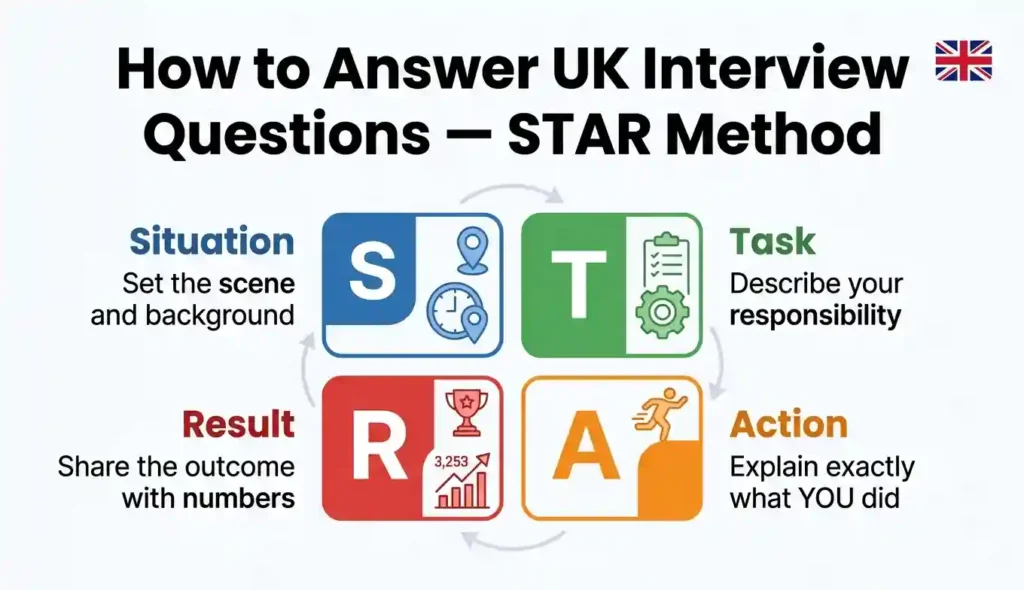
STAR stands for:
| Letter | Meaning | What to Say |
|---|---|---|
| S | Situation | Set the scene — where were you, what was happening? |
| T | Task | What was your specific responsibility? |
| A | Action | What did YOU do? (Focus on your actions, not the team) |
| R | Result | What was the outcome? Use numbers where possible |
Common Behavioral Questions with STAR Answers
“Tell me about a time you dealt with a difficult colleague or customer.”
“In my previous role as a customer service supervisor at a retail company, we had a situation where a long-term client became extremely frustrated after a delivery error caused significant disruption to their business. (Situation) My task was to manage the complaint personally and find a resolution that would retain the client. (Task) I called the client directly, listened without interrupting, acknowledged the mistake fully, and then proposed a concrete solution — a partial refund, a replacement delivery within 24 hours, and a dedicated point of contact for all future orders. (Action) The client not only stayed with us but actually increased their order volume over the following quarter and mentioned the way the complaint was handled in a positive review. (Result)”
“Describe a time when you worked under pressure to meet a deadline.”
“During a product launch at my previous company, our lead designer left unexpectedly two weeks before the launch date. (Situation) As the project coordinator, it fell to me to redistribute the workload and ensure the launch still happened on time. (Task) I immediately called a team meeting, mapped out all outstanding tasks, identified which ones were critical and which could be simplified, and brought in a freelance designer for the most complex visual work. I also communicated transparently with the client about the situation and gave them a realistic updated timeline. (Action) We launched on the revised date — just three days later than originally planned — and the client praised the quality of the final product and our communication throughout the process. (Result)”
Tips to Perform Well in a UK Job Interview
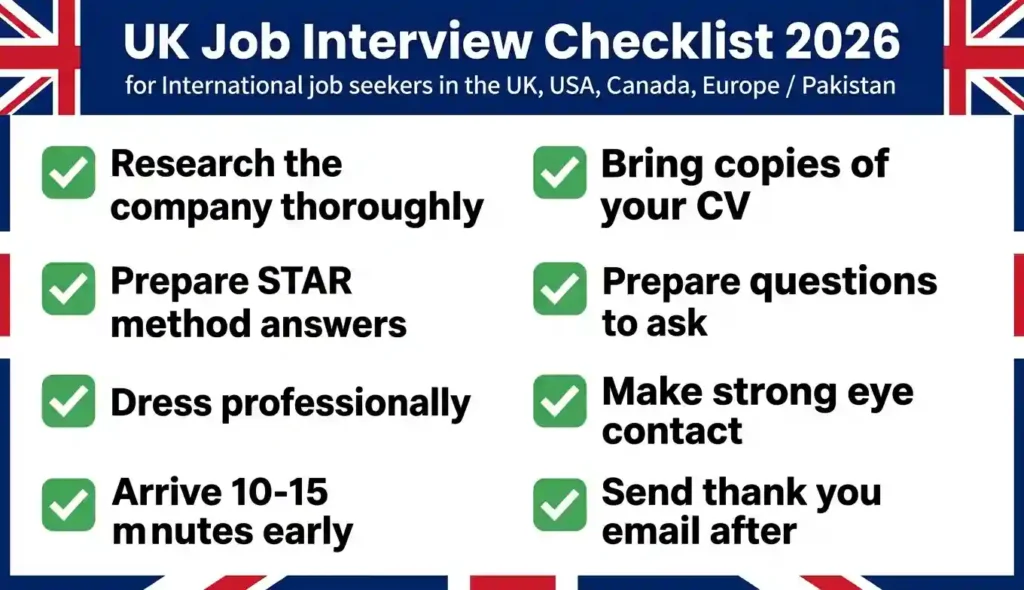
Research the company thoroughly. Read their website, recent news, annual report if available, and their LinkedIn page. Knowing specific details about the company shows genuine interest and sets you apart immediately.
Prepare questions to ask the interviewer. At the end of almost every UK interview, the interviewer will ask — “Do you have any questions for us?” Never say no. Prepare two or three thoughtful questions in advance. Good examples include asking about team culture, opportunities for development, or what success looks like in the role in the first six months.
Dress appropriately. In the UK, it is always better to be slightly overdressed than underdressed. For most professional roles, a smart business casual outfit is appropriate. For banking, law, or senior roles, a full suit is expected.
Arrive on time — or early. Being late to a UK interview is considered extremely unprofessional and is often an immediate disqualification. Plan to arrive 10 to 15 minutes early. If you are doing a video interview, test your technology at least 30 minutes before.
Be specific in your answers. Vague answers like “I am a hard worker” mean nothing without evidence. Every claim you make should be backed up with a real example from your experience.
Follow up after the interview. Send a brief, professional thank-you email within 24 hours of your interview. It is not always done in the UK, which means doing it makes you memorable. Keep it short — thank them for their time, express your continued interest in the role, and mention one specific thing from the interview that reinforced your enthusiasm.
Body Language Tips for UK Interviews
In the UK, non-verbal communication matters enormously. Here is what to pay attention to:
Handshake — A firm, confident handshake when you meet your interviewer makes an immediate positive impression. Not too strong, not limp.
Eye contact — Maintain steady, natural eye contact throughout the interview. Looking away too often suggests nervousness or lack of confidence. In panel interviews, make eye contact with each panel member.
Posture — Sit up straight with both feet on the floor. Leaning back too casually suggests arrogance. Leaning too far forward can feel aggressive. A natural upright posture communicates confidence and engagement.
Nodding — Nodding occasionally while the interviewer speaks shows you are listening and engaged. Do not overdo it.
Hands — Keep your hands visible on the table or in your lap. Avoid fidgeting with a pen, your phone, or your hair. These are signs of nervousness that distract from your answers.
Smile — A genuine, natural smile at appropriate moments makes you more likeable and memorable. UK interviewers want to hire someone they can imagine working with every day.
Common Mistakes to Avoid in UK Job Interviews
Speaking negatively about a previous employer. This is one of the biggest red flags in any UK interview. Even if your last job was genuinely terrible, find a diplomatic and professional way to describe why you are moving on.
Not preparing specific examples. Generic answers without real examples from your experience sound hollow and unconvincing. Always have three to five strong work stories ready to use across different questions.
Talking too much or too little. Aim for answers that last between 60 and 120 seconds for most questions. Rambling loses the interviewer’s attention. Being too brief suggests you lack experience or confidence.
Failing to ask questions. Saying you have no questions at the end of an interview suggests a lack of genuine interest in the role.
Lying or exaggerating on your CV or in the interview. UK employers carry out thorough background checks and reference checks. Any exaggeration will almost certainly be discovered — and will result in immediate disqualification or dismissal if discovered after hiring.
Not knowing your own CV. Be ready to discuss everything on your CV in detail. If you listed a skill or achievement, be prepared to give a specific example or explain it further.
Final Thoughts
A UK job interview is not something to fear — it is an opportunity. It is your chance to show a potential employer not just what your CV says, but who you actually are as a professional and as a person.
The candidates who succeed in UK interviews in 2026 are not necessarily the most qualified. They are the ones who prepare the most thoroughly, answer with genuine confidence and specific examples, and make the interviewer feel that hiring them would be an easy and obvious decision.
Use this guide, practice your answers out loud, research every company before you walk through the door, and approach every interview with the mindset that you have something genuinely valuable to offer. Because you do.
Good luck — you have got this.
Frequently Asked Questions
What are the most common interview questions asked in UK jobs in 2026?
The most commonly asked interview questions in UK jobs in 2026 follow a very consistent pattern regardless of the industry or company size. Almost every UK interview will include classic questions like “Tell me about yourself”, “Why do you want to work for us?”, “What are your strengths and weaknesses?”, and “Where do you see yourself in five years?”
Beyond these standard questions, UK employers in 2026 heavily rely on competency-based or behavioral questions — questions that ask you to describe specific real situations from your past experience. Examples include “Tell me about a time you dealt with a difficult situation at work” or “Give me an example of when you worked under pressure to meet a deadline.”
The best way to prepare for these questions is to have five to six strong work stories ready before your interview. Each story should cover a different skill — such as problem-solving, teamwork, leadership, communication, and handling pressure. Using the STAR method (Situation, Task, Action, Result) to structure your answers will make your responses clear, confident, and convincing to any UK interviewer.
How long should my answers be in a UK job interview?
This is something many candidates — especially those interviewing in the UK for the first time — genuinely struggle with. The honest answer is that most interview responses should last between 60 and 120 seconds — roughly one to two minutes per question.
Answers that are too short — just two or three sentences — suggest a lack of experience, confidence, or preparation. On the other hand, answers that go on for four or five minutes without a clear structure tend to lose the interviewer’s attention and can make you seem disorganized or unable to communicate concisely.
The key is to be specific and structured. Use the STAR method for behavioral questions to keep your answers focused and on track. For straightforward questions like “Tell me about yourself,” aim for a well-rehearsed 90-second summary that covers your background, key skills, and why you are applying for this particular role.
One practical tip — practice your answers out loud at home before the interview. Most people are surprised to discover that answers which seem perfectly timed in their head actually run far too long when spoken aloud. Recording yourself on your phone and playing it back is one of the most effective preparation techniques used by successful candidates.
Is it normal to feel nervous before a UK job interview and how can I manage it?
Absolutely — feeling nervous before a job interview is completely normal and experienced by virtually every candidate, including highly experienced professionals. In fact, a certain level of nervousness is actually helpful because it keeps you alert and focused. The problem only arises when nerves become overwhelming and start affecting your performance.
There are several practical techniques that work well for managing interview nerves. First and most importantly — thorough preparation reduces anxiety dramatically. The more you have practiced your answers, researched the company, and thought through potential questions, the more confident and in control you will feel walking into that room.
On the day of the interview, arrive early so you are not rushing. Sit quietly for a few minutes before going in and take slow, deep breaths — this genuinely helps regulate your nervous system and lowers your heart rate. Remind yourself that the interviewer wants you to do well — they are hoping you are the right person for the job, not looking for reasons to reject you.
During the interview itself, slow down your speech slightly if you feel your nerves taking over. Nervous candidates tend to speak too fast. Taking a brief pause before answering a question is not a weakness — it shows that you are thoughtful and composed. UK interviewers genuinely respect candidates who take a moment to think before speaking rather than rushing into an unstructured answer.
Should I send a thank you email after a UK job interview?
Yes — and more candidates should do this than currently do. Sending a brief, professional thank-you email within 24 hours of your interview is a simple but genuinely effective way to make a positive lasting impression on a UK employer.
In many countries, sending a follow-up thank-you email after an interview is considered standard practice. In the UK, it is less universally done — which actually works in your favor. When most candidates simply wait passively for a decision, taking the initiative to send a thoughtful follow-up email makes you stand out immediately.
Your thank-you email does not need to be long. Keep it to three or four short paragraphs. Start by thanking the interviewer for their time and the opportunity to discuss the role. Then mention one or two specific things from the interview that reinforced your enthusiasm for the position — this shows you were genuinely engaged and paying attention during the conversation. Finally, briefly reaffirm your interest in the role and your confidence that your skills and experience make you a strong fit.
Send the email to the direct interviewer if you have their contact details, or to the HR contact who arranged the interview. Make sure your email is professional in tone, completely free of spelling or grammar errors, and sent from a professional-looking email address. A well-written follow-up email has genuinely changed the outcome of close hiring decisions in favor of candidates who took the time to send one.
How should I answer the question “Why do you want to leave your current job?” in a UK interview?
This is one of the trickiest questions in any UK job interview because the honest answer is sometimes complicated — and yet UK employers can immediately detect when a candidate is being evasive or dishonest.
The golden rule for answering this question is simple but important — never speak negatively about your current or previous employer, no matter how justified your frustration might be. UK hiring managers view candidates who badmouth their employers as potential risks. If you speak badly about your current company, the interviewer will naturally wonder whether you would speak the same way about their company in the future.
Instead, frame your answer entirely around what you are moving towards rather than what you are running away from. Focus on positive motivations — the desire for new challenges, opportunities for growth, a chance to develop new skills, or the specific appeal of this new role and company.
For example, a strong answer might sound like this — “I have genuinely enjoyed my time at my current company and learned a great deal. However, I feel I have reached a point where the opportunities for growth within my current role are limited, and I am ready for a bigger challenge. When I came across this position, the scope of the role and the reputation of your company felt like exactly the kind of step forward I have been working towards.”
This type of answer is honest, professional, and forward-looking — exactly what UK employers want to hear.