The dream of moving to the Great White North is more alive than ever. As we move through 2026, Canada continues to be a top destination for global talent. Whether you are a tech expert from Europe, a healthcare professional from the UK, or a skilled worker from Asia, finding jobs in Canada for foreigners 2026 is a process that requires strategy, the right documentation, and an understanding of the latest immigration shifts.
In 2026, Canada has shifted its focus towards “Category-Based Selection,” meaning they aren’t just looking for anyone—they are looking for you if you have specific skills. With the government’s 2026–2028 Immigration Levels Plan aiming to welcome hundreds of thousands of new permanent residents, the door is open, but the competition is smarter.
Table of Contents
Why Canada in 2026?
Canada’s economy is evolving. While the overall numbers for temporary residents have been recalibrated to ensure sustainability, the demand for skilled economic immigrants remains at an all-time high. The country is prioritizing individuals who can fill immediate gaps in healthcare, STEM (Science, Technology, Engineering, and Math), and skilled trades.
Essential Requirements to Work in Canada in 2026
Before you start clicking “Apply” on job boards, you must meet the baseline legal and professional requirements. Canada’s 2026 regulations are stricter regarding language and skill verification.
1. Language Proficiency (The New Standard)
In 2026, proficiency in English or French is non-negotiable. Even for many open work permits, IRCC now requires proof of language skills.
- Accepted Tests: IELTS (General Training) or CELPIP for English; TEF or TCF for French.
- The Benchmarks: For most skilled jobs, a CLB (Canadian Language Benchmark) level 7 is preferred, though some trades may accept level 4 or 5.
2. Educational Credential Assessment (ECA)
If you studied outside of Canada, you need to prove your degree is equal to Canadian standards.
- Top Organizations: World Education Services (WES) is the most popular choice for global applicants.
- Pro Tip: Get your ECA done early; it’s a prerequisite for the Express Entry pool.
3. Proof of Funds (Settlement Funds)
Unless you have a valid job offer (LMIA-supported) or are already working in Canada, you must show you have enough money to support yourself and your family.
- 2026 Threshold: For a single applicant, the requirement is approximately $15,263 CAD. This amount increases with family size.
4. Valid Travel Document
A passport with at least 6–12 months of validity is essential. Ensure your digital footprint (LinkedIn) matches your official documents to maintain credibility with high-tier employers.
5. Health and Security Clearances
All foreigners must be medically fit and have a clean criminal record. You will likely need a Police Clearance Certificate (PCC) from every country where you’ve lived for more than six months.
Step-by-Step Process & Top Job Platforms
Finding jobs in Canada for foreigners 2026 is no longer just about sending emails. It is a systematic process that involves digital precision and understanding the Canadian “Hidden Job Market.”
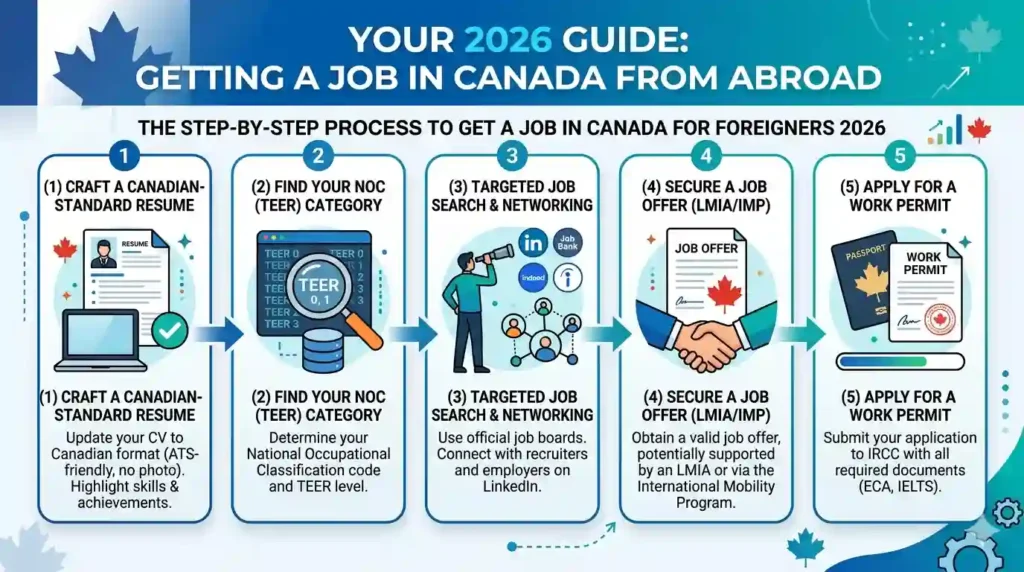
Step 1: Craft a “Canadian-Standard” Resume (The ATS Gap)
In 2026, most Canadian employers use AI-driven Applicant Tracking Systems (ATS). If your resume has a photo, your date of birth, or a complex layout, the system will automatically reject it.
- Keep it Simple: Use a clean, reverse-chronological format.
- Focus on Achievements: Instead of listing duties, list “results” (e.g., “Increased sales by 20%”).
- Keywords: Match your skills exactly with the words used in the job posting.
Step 2: Identify Your NOC (TEER) Category
Canada categorizes jobs using the National Occupational Classification (NOC) system, specifically the TEER (Training, Education, Experience, and Responsibilities) levels.
- Visit the Official Government NOC Page to find your 5-digit code. Knowing your TEER level (0, 1, 2, or 3) is crucial for Express Entry and Provincial Nomination Programs (PNP).
Step 3: Targeted Job Searching
Don’t just apply everywhere. In 2026, Canada has reduced the targets for the Temporary Foreign Worker Program (TFWP) but increased the quota for the International Mobility Program (IMP).
- Target LMIA-Exempt Roles: If you are from a country with a free trade agreement with Canada or belong to certain tech/healthcare categories, you might not need a complex LMIA (Labour Market Impact Assessment).
Step 4: Secure an Interview and Job Offer
If a Canadian employer wants to hire you, they will usually provide an LMIA-supported job offer or an offer under a Provincial Nominee Program. This document is the “Golden Ticket” that allows you to apply for a work permit.
Best Websites to Find Jobs in Canada (2026 Rankings)
To rank high in 2026, you need to use platforms that Canadian recruiters actually trust. Here are the top-rated sites:

| Platform | Best For | Why Use It in 2026? |
| Canada Job Bank | Verified Employers | Official government site; look for the “Foreign Candidates” filter. |
| LinkedIn Canada | Networking & Tech | Essential for the “Hidden Job Market” and direct recruiter contact. |
| Indeed Canada | High Volume | The biggest database of active job listings in every province. |
| CareerBoom.ai | AI-Driven Matching | A new leader in 2026 for matching foreign skills to Canadian gaps. |
| Eluta.ca | Direct Company Roles | Scrapes jobs directly from employer websites, avoiding “middleman” scams. |
Pro Tip: The Power of Networking
In Canada, nearly 60-70% of jobs are never posted on public boards. Use LinkedIn to connect with “Hiring Managers” in your industry. A simple, professional message can often lead to a referral, which is 10x more effective than a cold application.
In-Demand Jobs & Expert Tips to Increase Your Success
While thousands of people search for jobs in Canada for foreigners 2026, only those targeting the right industries succeed. Canada’s 2026 Immigration Levels Plan has made it clear: they are prioritizing “Category-Based Selection.” This means if your profession falls under a high-demand category, your processing will be faster and your chances of a job offer are significantly higher.
Top In-Demand Jobs in Canada (2026 Update)
Based on the latest labor market reports, these sectors have the highest vacancy rates and are actively recruiting international talent:
1. Healthcare Professionals (Highest Priority)
Canada’s aging population has created an urgent need for medical staff.
- Roles: Registered Nurses (NOC 31301), Patient Service Associates (NOC 33102), and Pharmacy Assistants.
- Average Salary: $65,000 – $110,000 CAD.
- PR Pathway: Healthcare Category-based Express Entry draws.
2. STEM & Technology
Despite global shifts, Canada remains a tech hub, specifically for AI and Cybersecurity.
- Roles: Software Developers (NOC 21232), Cybersecurity Specialists (NOC 21220), and Data Scientists (NOC 21211).
- Average Salary: $75,000 – $125,000 CAD.
- PR Pathway: Global Talent Stream (Fast-track work permits).
3. Skilled Trades & Construction
With a massive push for new housing, tradespeople are in desperate demand.
- Roles: Electricians (NOC 72200), Plumbers (NOC 72300), Welders, and Construction Project Managers.
- Average Salary: $55,000 – $95,000 CAD.
- Benefit: Many provinces offer specific PNP streams for trades without requiring a high university degree.
4. Transport and Logistics
- Roles: Long-haul Truck Drivers (NOC 73300) and Supply Chain Specialists.
- Average Salary: $50,000 – $80,000 CAD.
How to Increase Your Chances of Getting Hired from Abroad
If you are applying from the USA, UK, Europe, or Asia, you are competing with local talent. Use these 2026-specific strategies to stand out:
- Focus on the “Hidden Job Market”: Don’t just wait for job postings. Use LinkedIn to find recruiters at Canadian companies and send them a “Letter of Intent.” In Canada, a referral is often more powerful than a resume.
- Get Pre-Arrival Services: The Government of Canada offers Free Pre-Arrival Services to help you understand the workplace culture even before you land.
- Target Smaller Provinces (PNPs): Instead of only looking at Toronto or Vancouver, apply for jobs in Saskatchewan, Manitoba, or New Brunswick. These provinces have easier nomination programs (PNPs) that provide an extra 600 points toward your PR application.
- Show “Transferable Skills”: Canadian employers value soft skills like teamwork and adaptability. Clearly explain in your cover letter how your international experience directly solves a Canadian company’s problem.
- Optimize Your LinkedIn Profile: Ensure your location is set to “Open to Work” for Canadian recruiters and your headline includes your NOC job title.
Common Mistakes to Avoid & Final Strategy for 2026
Even with the best intentions, many foreigners fail to secure jobs in Canada for foreigners 2026 because of small, avoidable errors. As Canada tightens its immigration quotas and increases scrutiny on work permits, your margin for error is slimmer than ever. To ensure your application isn’t rejected, avoid these common pitfalls.

1. Using a Non-Canadian Resume Format
One of the biggest mistakes is sending a “Global CV” that includes a photo, marital status, or religion. In Canada, this is a major red flag due to privacy and anti-discrimination laws.
- The Fix: Use a clean, text-based, reverse-chronological format. Focus 100% on your professional achievements and quantifiable data (e.g., “Managed a budget of $50,000” rather than just “Managed budgets”).
2. Underestimating the “Temporary Resident Cap”
In 2026, the Canadian government officially reduced the target for temporary residents to below 5% of the total population. This means “Low-Wage” work permits are harder to get.
- The Fix: If you are applying from abroad, aim for High-TEER (0, 1, 2, or 3) occupations. Employers find it much easier to justify hiring a foreigner for a specialized role than for general labor in the current 2026 climate.
3. Falling for “Job Offer Scams”
Unfortunately, as demand for Canadian visas grows, so do scams. In 2026, AI-generated fake job offers are common.
- The Red Flags: If an employer asks for money upfront for “visa processing,” “training,” or “insurance,” it is 100% a scam.
- The Fix: Always verify the company on the Canada Business Registry and check if the email comes from a professional domain (e.g., @companyname.ca) rather than Gmail or Yahoo.
4. Choosing the Wrong NOC (TEER) Code
Your job title in your home country might not match the Canadian NOC code. If you select the wrong code on your Express Entry profile or work permit application, it can lead to an immediate refusal for “Misrepresentation.”
- The Fix: Read the “Lead Statement” and “Main Duties” of the NOC code on the official government website. Ensure at least 80% of your actual work experience matches those duties.
5. Ignoring Provincial Nomination Programs (PNP)
Many applicants focus only on the Federal Express Entry pool. In 2026, the federal scores (CRS) are expected to remain high.
- The Fix: Research regional needs. For example, if you are a healthcare worker, Nova Scotia or Saskatchewan might nominate you much faster than Ontario. A provincial nomination gives you an automatic 600 points, virtually guaranteeing your Permanent Residency.
Final Thoughts for International Applicants
The landscape of jobs in Canada for foreigners 2026 is competitive but highly rewarding for those who are prepared. The key to success this year is “Precision.” * Be Job-Ready: Have your ECA and IELTS/CELPIP results ready before you start applying.
- Be Persistent: The average international candidate sends 50–100 tailored applications before getting a solid interview.
- Be Adaptable: Consider starting in a smaller city (Rural Renewal Streams) where the cost of living is lower and the demand for your skills is higher.
Canada is still the land of opportunity, but in 2026, it rewards the “Skilled and Informed” applicant. By following the steps in this guide, you are already ahead of 90% of the competition.
Frequently Asked Questions (FAQ)
Can I get a job in Canada from abroad without an LMIA in 2026?
Yes, it is possible through the International Mobility Program (IMP) or if you qualify for specific Provincial Nominee Programs (PNP). Additionally, if you are a highly skilled professional in tech or healthcare, you may benefit from the Global Talent Stream, which fast-tracks work permits. However, for most general categories, a Labour Market Impact Assessment (LMIA) remains a standard requirement for foreigners.
What is the minimum IELTS score required for a Canadian work permit in 2026?
While requirements vary by job type, the general standard in 2026 has become stricter. For skilled professional roles (TEER 0, 1), a CLB level 7 (roughly 6.0 to 7.0 in each IELTS module) is typically required. For trades and semi-skilled jobs, a CLB level 4 or 5 may be sufficient. Always check the specific requirements for your NOC code before applying.
Which province in Canada is easiest to get a job in for foreigners?
In 2026, while Ontario and BC have the most jobs, they are also the most competitive. Provinces like Saskatchewan, Alberta, and New Brunswick are often considered “easier” because they have specific recruitment streams for international workers in healthcare, agriculture, and construction. These provinces offer lower competition and faster provincial nomination (PNP) pathways.
Are there any age limits for foreigners to apply for jobs in Canada?
There is no official “age limit” to work in Canada. However, for those looking to transition from a work permit to Permanent Residency (PR), age plays a crucial role in the Comprehensive Ranking System (CRS). Candidates between 20 and 29 years old receive the maximum points, and points begin to decrease after the age of 30.
How long does it take to process a Canadian work permit from Pakistan, UK, or USA in 2026?
Processing times fluctuate based on the volume of applications. On average, a standard work permit application can take anywhere from 8 to 20 weeks. However, if you are hired under the Global Talent Stream, your permit could be processed in as little as 2 weeks. Always ensure your documentation is 100% accurate to avoid additional administrative delays.