If you have started researching how to write a CV for Germany jobs, you have probably already noticed something confusing. Half the internet tells you to use Europass. The other half tells you Europass is the wrong choice and German recruiters quietly reject it. Both cannot be right, so let’s clear this up properly.
This guide focuses entirely on how to write a CV for Germany jobs the way German employers actually expect — not the generic EU template, but the real document known as a Lebenslauf. If you are applying to a company in Berlin, Munich, Frankfurt, or anywhere else in Germany, this is the format that gets your application read instead of ignored.
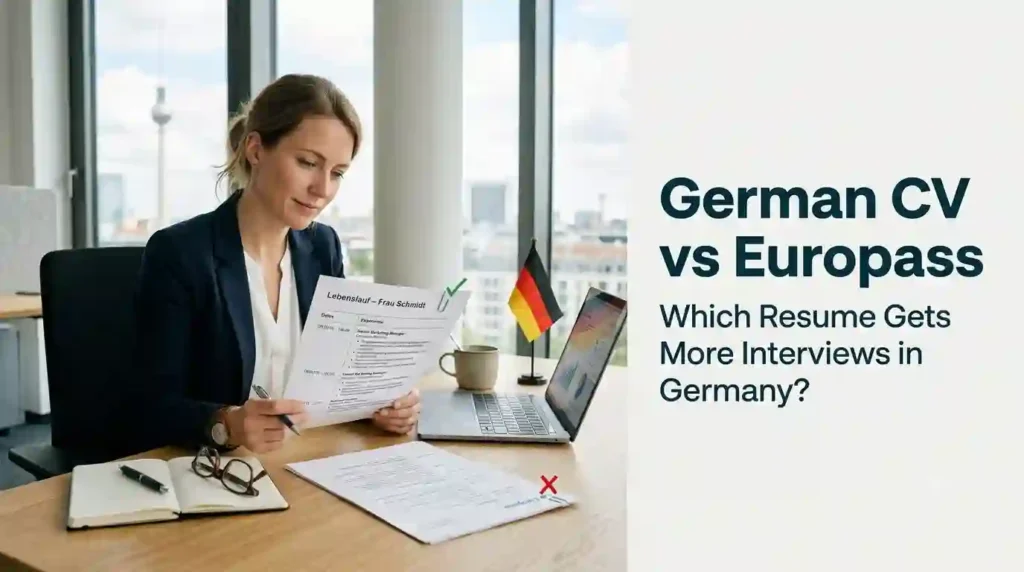
Table of Contents
Why Learning How to Write a CV for Germany Jobs the Right Way Matters
Germany’s labour market is short on skilled workers across IT, healthcare, engineering, and the skilled trades, which means there is real demand for foreign applicants. But demand does not mean recruiters relax their standards. German HR teams review large volumes of applications, and they expect a specific structure. A CV that looks perfect for a US or UK employer often gets rejected in Germany within seconds, simply because it does not follow local conventions.
That is exactly why understanding how to write a CV for Germany jobs is not optional — it is the difference between an interview invitation and silence. If you already have a work visa strategy sorted out, our Germany Work Visa Process for Foreigners 2026 guide pairs well with this article, since the visa and the CV process usually move in parallel.
German CV vs Europass: Why This Guide Skips Europass
A lot of people searching for how to write a CV for Germany jobs land on Europass because it is marketed as the “official EU CV.” In reality, Europass is a generic template originally built for cross-border recognition of qualifications, not a document optimized for how German recruiters actually scan applications. Many hiring managers in Germany find Europass rigid, visually outdated, and slow to read compared to the tabular Lebenslauf format that local companies expect.
If you have already built a Europass document, that is fine — you can read our separate guide on how to create a Europass CV for free for other EU countries. But if your goal is specifically how to write a CV for Germany jobs, the tabellarischer Lebenslauf (tabular CV) is the format you actually need, and that is what the rest of this article covers in detail.
Step 1: Understand the Tabular Lebenslauf Format
The foundation of how to write a CV for Germany jobs is the tabular layout. Instead of paragraphs describing your career story, a German CV uses a strict two-column table: dates on the left, details on the right. There is no storytelling, no marketing language, and no creative flair. German recruiters want to scan your entire career history in under a minute, and the tabular format makes that possible.
Key formatting rules to follow:
- Use A4 page size, never US Letter
- Keep it to one page if you have under five years of experience, two pages otherwise
- Use a clean font like Arial or Times New Roman, 10–12pt
- Save your file as a PDF, named clearly (for example: Lebenslauf_YourName.pdf)
- Dates should follow the MM.YYYY format, listed in reverse chronological order
This single formatting shift is often the biggest factor in whether your application gets past the first screening. Once you understand this, the rest of learning how to write a CV for Germany jobs becomes much easier.
Step 2: Personal Details Section
This is where a lot of foreign applicants get uncomfortable, because German CVs include information that would be considered unusual or even inappropriate in the US or UK. Understanding this section properly is a core part of how to write a CV for Germany jobs correctly.
At the top of your CV, include:
- Full name in bold, larger font, centered or left-aligned at the top
- Complete address in German postal format (street, postcode, city)
- Phone number and professional email address
- Date and place of birth
- Nationality
- Marital status (optional, and increasingly left out — but still common)
This level of personal detail is standard practice in Germany and is not viewed as discriminatory the way it might be elsewhere. Skipping it can actually look incomplete to a German recruiter, so don’t leave it out just because it feels unfamiliar.
Step 3: The Professional Photo (Bewerbungsfoto)
Here is something that surprises almost everyone learning how to write a CV for Germany jobs: a professional photo is still expected in most industries, even though it is no longer a legal requirement. This is one of the sharpest differences between a German Lebenslauf and CVs used in the UK, USA, or Canada.
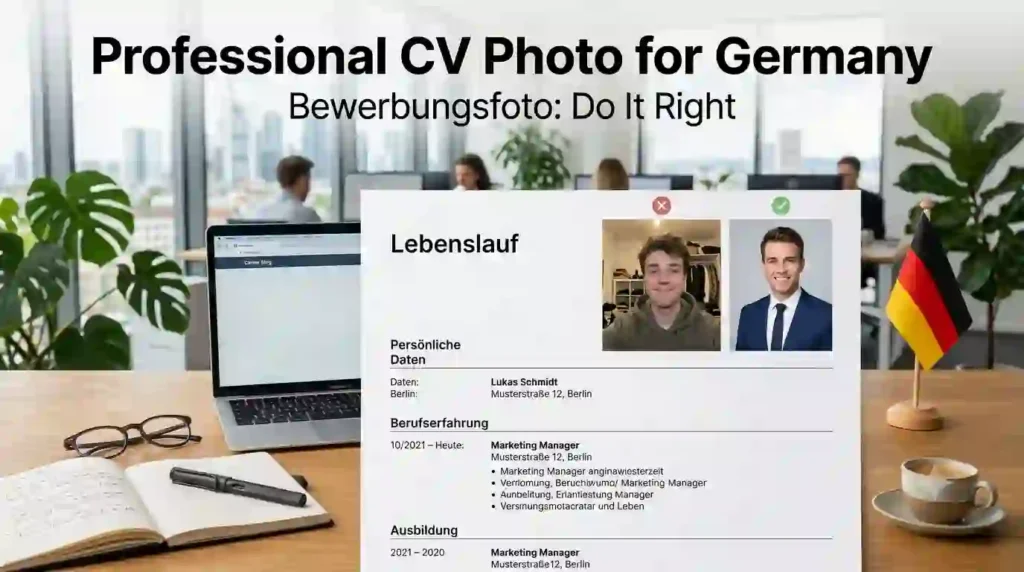
Photo guidelines to follow:
- Passport-style headshot, roughly 3.5–4.5 cm
- Neutral, plain background
- Business attire, neutral expression, good lighting
- Placed in the top-right corner of the first page
- No selfies, no casual photos, no filters
If you skip the photo entirely, some traditional German employers — particularly in banking, insurance, and manufacturing — may perceive your application as incomplete. This is a cultural expectation you need to respect when figuring out how to write a CV for Germany jobs that actually gets noticed.
Step 4: Work Experience in Reverse Chronological Order
The core of any CV, and this section is no different when learning how to write a CV for Germany jobs. List every relevant role starting with your current or most recent position, working backward.
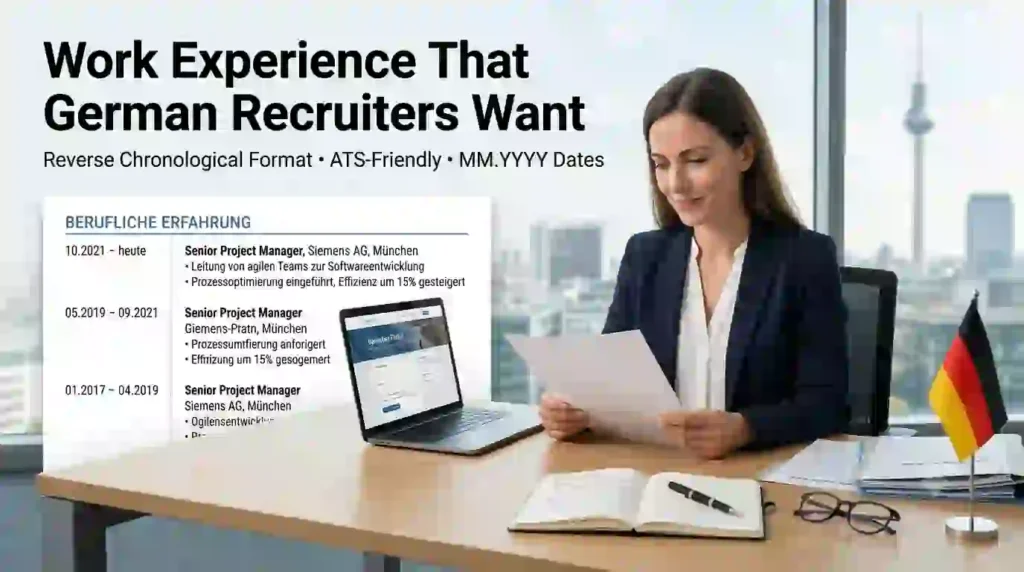
For each role include:
- Exact start and end dates in MM.YYYY format (never vague ranges like “2022–2024”)
- Job title (translated accurately into a recognizable German equivalent where possible)
- Company name and city
- Two to four concise bullet points describing your responsibilities and achievements
Avoid vague date ranges — German recruiters treat missing months as a red flag, often assuming you are hiding an employment gap. If you do have a gap, address it briefly and honestly rather than leaving it unexplained. Precision here is one of the most overlooked parts of how to write a CV for Germany jobs successfully.
Step 5: Education Section
List your academic background in the same reverse chronological, tabular style as your work experience. Include:
- Degree name and field of study
- Institution name and city
- Start and end dates (MM.YYYY)
- Grades, if strong and relevant (German employers often expect this, unlike US/UK norms)
If your degree was earned outside Germany, it can help to briefly note German equivalency where you know it, though this is not mandatory. This section is short but important — it’s part of why understanding how to write a CV for Germany jobs also means understanding what German employers consider “complete.”
Step 6: Skills, Languages, and Certifications
German employers scan this section closely, especially for language ability. When you’re working out how to write a CV for Germany jobs, list languages using the CEFR scale (A1–C2), not vague terms like “fluent” or “conversational.”
Example:
- German: B2 (Upper Intermediate)
- English: C1 (Advanced)
Also list technical skills, software proficiency, and relevant certifications. If the job posting mentions specific tools or platforms (SAP, Agile, specific programming languages), mirror that exact terminology — German ATS systems used by platforms like Workday and Taleo often filter by keyword match.
Step 7: Place, Date, and Signature
This step catches almost every foreign applicant off guard, but it’s a small detail that matters a lot in how to write a CV for Germany jobs correctly. At the bottom of the document, German convention expects:
- The city and current date (format: City, DD.MM.YYYY)
- A signature — handwritten and scanned, or a digital signature image
Skipping this is treated as a minor but noticeable lapse in professionalism by more traditional employers. It signals attention to detail, which matters in a document culture that values precision as much as Germany’s does.
Common Mistakes to Avoid
Even after learning how to write a CV for Germany jobs step by step, small errors can still cost you interviews. Watch out for these:
- Using a narrative, US-style resume instead of the tabular format
- Vague date ranges without exact months
- No photo, when the industry still expects one
- Overly designed templates with colours and graphics — traditional sectors prefer clean, minimal layouts
- Sending only a CV without a one-page Anschreiben (cover letter), which is considered essential in German applications
- Literal job title translations that don’t match recognizable German equivalents
- Language errors, if writing in German — have a native speaker review it if you’re not fluent
If your German is still developing, it is worth building your CV in English first using a clean ATS-friendly structure, then having it translated. Our free ATS resume builder is a solid starting point for getting the content and structure right before adapting it into German tabular format.
Quick Checklist Before You Apply
Before sending your application, run through this checklist — it summarizes everything covered in this guide on how to write a CV for Germany jobs:
- Tabular format, dates on the left, reverse chronological order
- A4 page size, saved as PDF
- Professional photo, top-right corner (if expected in your industry)
- Full personal details including date of birth and nationality
- Exact MM.YYYY dates for every role and qualification
- Languages listed with CEFR levels
- Place, date, and signature at the bottom
- Paired with a one-page Anschreiben (cover letter)
- Proofread in German, if applying in German
For official government guidance on the broader application process, the Make it in Germany portal and the Federal Employment Agency’s job search resources are both reliable references worth bookmarking as you prepare your application.
Final Thoughts
Knowing how to write a CV for Germany jobs is really about understanding a different application culture — one that values precision, completeness, and formal structure over creative self-branding. Once you switch from a narrative resume mindset to the tabular Lebenslauf approach, your applications start getting read the way German recruiters expect them to be read.
If you’re also preparing your visa paperwork alongside your CV, take a look at our Germany Work Visa Process guide next — and if you want a clean starting draft before converting it into German format, our ATS resume builder can help you get the content right first.
Getting how to write a CV for Germany jobs right the first time saves you weeks of silent rejections — and puts you ahead of most other foreign applicants who are still sending US-style resumes into a market that expects something completely different.
Frequently Asked Questions
Should I use Europass or a German-style CV for jobs in Germany?
For most direct applications to German employers, use the tabular Lebenslauf format rather than Europass. German recruiters are more familiar with the tabellarischer Lebenslauf and often find Europass templates harder to scan quickly.
Is a photo required on a German CV in 2026?
It’s no longer a legal requirement, but most traditional employers still expect a professional photo in the top-right corner, especially in banking, insurance, and manufacturing.
How long should a German CV be?
One page if you have under five years of experience, and up to two pages for more experienced candidates. Anything longer than two pages is unusual.
Do I need to write my CV in German?
If the job posting is in German, yes. If it’s in English or clearly international, English is acceptable, but having a German version ready is a strong advantage.